Und dann auf "Zum Home-Bildschirm [+]".

Stöbern
genialokal zum Startbildschirm hinzufügen
Installieren Sie die genialokal App auf Ihrem Startbildschirm für einen schnellen Zugriff und eine komfortable Nutzung.
Installieren Sie die genialokal App auf Ihrem Startbildschirm für einen schnellen Zugriff und eine komfortable Nutzung.
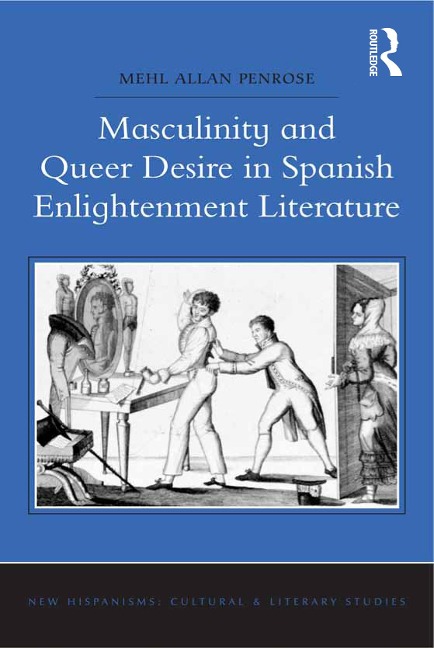
In Masculinity and Queer Desire in Spanish Enlightenment Literature, Mehl Allan Penrose examines three distinct male figures, each of which was represented as the Other in eighteenth- and early nineteenth-century Spanish literature. The most common configuration of non-normative men was the petimetre, an effeminate, Francophile male who figured a failed masculinity, a dubious sexuality, and an invasive French cultural presence. Also inscribed within cultural discourse were the bujarrón or 'sodomite,' who participates in sexual relations with men, and the Arcadian shepherd, who expresses his desire for other males and who takes on agency as the voice of homoerotica. Analyzing journalistic essays, poetry, and drama, Penrose shows that Spanish authors employed queer images of men to engage debates about how males should appear, speak, and behave and whom they should love in order to be considered 'real' Spaniards. Penrose interrogates works by a wide range of writers, including Luis Cañuelo, Ramón de la Cruz, and Félix MarÃa de Samaniego, arguing that the tropes created by these authors solidified the gender and sexual binary and defined and described what a 'queer' man was in the Spanish collective imaginary. Masculinity and Queer Desire engages with current cultural, historical, and theoretical scholarship to propose the notion that the idea of queerness in gender and sexuality based on identifiable criteria started in Spain long before the medical concept of the 'homosexual' was created around 1870.
Mehl Allan Penrose is Associate Professor of Spanish at the University of Maryland, USA. He has published several articles concerning Spanish and Mexican cultural discourse in peer-reviewed journals. His research interests include the problematic of gender and sexuality in modern Spanish cultural discourse, specifically non-normative representations of men, and also include queer studies, reception theory, camp theory, and the intersections of literature, science, law, and medicine.
Introduction; Part I The Reinvention of Masculinity and the Problematic Petimetre; Chapter 1 The Invocations of Hermaphrodism in the Periodicals El Censor, El Duende Especulativo, and El Pensador; Chapter 2 Proto-Camp; Part II The Invention of Sexuality and the Homoerotic Male; Chapter 3 "I Don't Burn Candles of That Sort"; Chapter 4 Male Friendship, Love, and Longing in the Poetry of Manuel María del Mármol; Chapter 101 Conclusion;
Dieses eBook wird im PDF-Format geliefert und ist mit einem Adobe Kopierschutz (DRM) versehen. Sie können dieses eBook mit allen Geräten lesen, die das PDF-Format und den Adobe Kopierschutz (DRM) unterstützen.
Zum Beispiel mit den folgenden Geräten:
• tolino Reader
Laden Sie das eBook direkt über den Reader-Shop auf dem tolino herunter oder übertragen Sie das eBook auf Ihren tolino mit einer kostenlosen Software wie beispielsweise Adobe Digital Editions.
• Sony Reader & andere eBook Reader
Laden Sie das eBook direkt über den Reader-Shop herunter oder übertragen Sie das eBook mit der kostenlosen Software Sony READER FOR PC/Mac oder Adobe Digital Editions auf ein Standard-Lesegeräte mit epub- und Adobe DRM-Unterstützung.
• Tablets & Smartphones
Möchten Sie dieses eBook auf Ihrem Smartphone oder Tablet lesen, finden Sie hier unsere kostenlose Lese-App für iPhone/iPad und Android Smartphone/Tablets.
• PC & Mac
Lesen Sie das eBook direkt nach dem Herunterladen mit einer kostenlosen Lesesoftware, beispielsweise Adobe Digital Editions, Sony READER FOR PC/Mac oder direkt über Ihre eBook-Bibliothek in Ihrem Konto unter „Meine eBooks“ - „online lesen“.
Schalten Sie das eBook mit Ihrer persönlichen Adobe ID auf bis zu sechs Geräten gleichzeitig frei.
Bitte beachten Sie, dass die Kindle-Geräte das Format nicht unterstützen und dieses eBook somit nicht auf Kindle-Geräten lesbar ist.