
Stöbern
genialokal zum Startbildschirm hinzufügen
Installieren Sie die genialokal App auf Ihrem Startbildschirm für einen schnellen Zugriff und eine komfortable Nutzung.
Installieren Sie die genialokal App auf Ihrem Startbildschirm für einen schnellen Zugriff und eine komfortable Nutzung.
Tippen Sie einfach auf Teilen:
 Und dann auf "Zum Home-Bildschirm [+]".
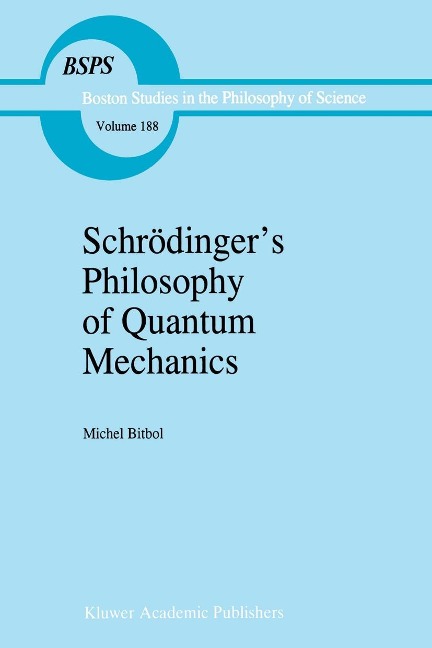
This book is the final outcome of two projects. My first project was to publish a set of texts written by Schrodinger at the beginning of the 1950's for his seminars and lectures at the Dublin Institute for Advanced Studies. These almost completely forgotten texts contained important insights into the interpretation of quantum mechanics, and they provided several ideas which were missing or elusively expressed in SchrOdinger's published papers and books of the same period. However, they were likely to be misinterpreted out of their context. The problem was that current scholarship could not help very much the reader of these writings to figure out their significance. The few available studies about SchrOdinger's interpretation of quantum mechanics are generally excellent, but almost entirely restricted to the initial period 1925-1927. Very little work has been done on Schrodinger's late views on the theory he contributed to create and develop. The generally accepted view is that he never really recovered from his interpretative failure of 1926-1927, and that his late reflections (during the 1950's) are little more than an expression of his rising nostalgia for the lost ideal of picturing the world, not to say for some favourite traditional picture. But the content and style of Schrodinger's texts of the 1950's do not agree at all with this melancholic appraisal; they rather set the stage for a thorough renewal of accepted representations. In order to elucidate this paradox, I adopted several strategies.
1: The Controversy between Schrödinger and the Göttingen-Copenhagen Physicists in the 1950's.- 1-1 Schrödinger's successive interpretations of quantum mechanics according to the current views.- 1-2 Born's and Heisenberg's criticism of Schrödinger's late interpretation of quantum mechanics.- 1-3 Historical flaws in the Born-Heisenberg critique of Schrödinger's late interpretation of quantum mechanics.- 1-4 Misunderstandings about the concept of particle.- 1-5 Misunderstandings about the concept of "reality".- 1-6 Misunderstandings about "causality".- 1-7 Schrödinger's over-revolutionary attitude.- 1-8 Modernity and post-modernity.- 1-9 The continuity of Schrödinger's attitude towards quantum mechanics (an outline).- 2: Schrödinger's Theoretical Project.- 2-1 Reality and virtuality (1924).- 2-2 Holism and wave-packets (1925).- 2-3 Holism and the three dimensions of space (1926).- 2-4 Wave interpretation versus electrodynamic interpretation: a prehistory of the empirical correspondence rules.- 2-5 The lack of pictures.- 2-6 The lack of continuity.- 3: The Analytical Stance.- 3-1 The ontological significance of the uncertainty relations.- 3-2 The state vector as a catalog of informations.- 4: Towards a New Ontology.- 4-1 The fading of the concept of particle.- 4-2 An ontology of state vectors.- 4-3 The "blind spot" of quantum mechanics.- 4-4 Neo-Schrödingerian views on the measurement problem. I-Everett's interpretation.- 4-5 Neo-Schrödingerian views on the measurement problem II-Modal and critical interpretations.- 5: The "Thing" of Everyday Life.- 5-1 The three features of objects.- 5-2 The aspects and the "thing".- 5-3 The "elements" of the construction (Mach, Russell,Schrödinger, Husserl).- 5-4 Are the "basic data" really basic?.- 5-5 The construction of objects and the unconscious.- 5-6 The "thing" and the future.- 5-7 Possibilities and infinities.- 5-8 The "thing" as theory, and the theory as expectation.- 5-9 Realism and morals.- 5-10 Form and individuality.- 5-11 Wholeness and individuality.- 6: Complemetarity, Representation and Facts.- 6-1 Schrödinger's criticism of Bohr's complementarity.- 6-2 Bohr's complementarities.- 6-3 Schrödinger's "complementarities".- 6-4 Two parallelisms.- 6-5 Being-in-a-body and being-in-the-world.- 6-6 The body, the world, and dualism.- 6-7 The body, the world, and monism.- 6-8 The body, the world, and anomalous parallelism.- Conclusion.