
Stöbern
genialokal zum Startbildschirm hinzufügen
Installieren Sie die genialokal App auf Ihrem Startbildschirm für einen schnellen Zugriff und eine komfortable Nutzung.
Installieren Sie die genialokal App auf Ihrem Startbildschirm für einen schnellen Zugriff und eine komfortable Nutzung.
Tippen Sie einfach auf Teilen:
 Und dann auf "Zum Home-Bildschirm [+]".
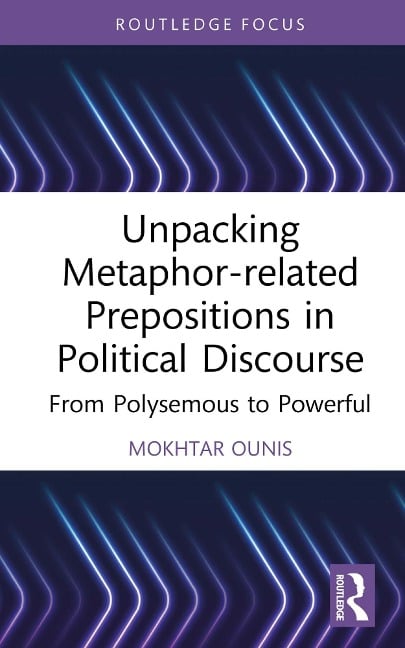
This book explores the context around why English prepositions are used in figurative language more frequently than nouns and verbs, using corpus-based evidence to examine the most often used prepositions and how they are employed and for what purpose. While research on cognitive approaches to metaphor has significantly expanded in recent decades, little attention has been paid to prepositions as vehicles of figurative language, owing to their polysemous, complex, and inconsistent nature. To bridge this gap, Ounis introduces an innovative conceptual framework that integrates conceptual metaphor theory, diachronic linguistics, and discourse pragmatics. Drawing upon an extensive corpus of American presidential inaugural addresses, this book considers the linguistic, conceptual, pragmatic, and contextual dimensions of English prepositions, revealing the fascinating interplay between language, culture, and cognition. This volume will be of interest to scholars in pragmatics, metaphor studies, English language, rhetoric studies, and historical linguistics.
Mokhtar Ounis is a linguist who earned his PhD from the University of Toulon in France, where he conducted research on the use of conceptual metaphors in political communication. He has been a faculty member at the University of Hail in Saudi Arabia for ten years, where he has taught courses in linguistics and related fields.
Contents Preface 1. Chapter 1: Introduction 1.1. Defining key terms 1.2. Scope of this study 1.3. Structure of this book 2. Chapter 2: Navigating Prepositions 2.1. Defining prepositions 2.2. Polysemy: networks and principles 2.3. Cognitive grammar's view of prepositions 2.4. Prepositions' cognitive potential 2.5. Prepositions' contextual dynamics 2.6. Prepositions' axiological framing 3. Chapter 3: Metaphor: Insights from Classical and Cognitive Approaches 3.1. Classical views on metaphor 3.2. Cognitive view on metaphor 4. Chapter 4: The Power of Prepositions in Political Discourse 4.1. Political language 4.2. The history of political discourse analysis 4.3. The inaugural addresses and their generic properties 4.4. Conceptual metaphors in political discourse 4.5. The evolution trends of inaugural addresses 4.6. Metaphor variation and diachronic approach 5. Chapter 5: A Prepositional Portrait: Corpus and Frequency 5.1. Corpus linguistics and metaphor research 5.2. The Inaugural Corpus 5.3. The prepositions' frequency patterns 5.4. Tracking the preposition-to-word ratio 6. Chapter 6 Unpacking Metaphorical Patterns 6.1. Conceptual mappings of the metaphor-related prepositions 6.2. System metaphors and cross-system mapping 6.3. The coherence of metaphors 6.4. Prepositions and their metonymic basis 6.5. Conceptual notation revisited 7. Chapter 7: Beyond Spatial Metaphors 7.1. The cognitive model: an overview 7.2. Conceptual identity 7.3. Conceptual space 8. Chapter 8: Tracing Patterns of Change and Stability 8.1. Metaphor variations 8.2. Patterns of diachronic variations 9. Chapter 9: Concluding Remarks 9.1. How are prepositions distributedin the Inaugural Corpus? 9.2. What is the conceptual basis of metaphor-related prepositions? 9.3. How do metaphor-related prepositions mix? 9.4. Do metaphor-related prepositions reflect any systematic conceptualizations? 9.5. How do metaphor-related prepositions vary across history? 9.6. Final words Index
Dieses eBook wird im PDF-Format geliefert und ist mit einem Adobe Kopierschutz (DRM) versehen. Sie können dieses eBook mit allen Geräten lesen, die das PDF-Format und den Adobe Kopierschutz (DRM) unterstützen.
Zum Beispiel mit den folgenden Geräten:
• tolino Reader
Laden Sie das eBook direkt über den Reader-Shop auf dem tolino herunter oder übertragen Sie das eBook auf Ihren tolino mit einer kostenlosen Software wie beispielsweise Adobe Digital Editions.
• Sony Reader & andere eBook Reader
Laden Sie das eBook direkt über den Reader-Shop herunter oder übertragen Sie das eBook mit der kostenlosen Software Sony READER FOR PC/Mac oder Adobe Digital Editions auf ein Standard-Lesegeräte mit epub- und Adobe DRM-Unterstützung.
• Tablets & Smartphones
Möchten Sie dieses eBook auf Ihrem Smartphone oder Tablet lesen, finden Sie hier unsere kostenlose Lese-App für iPhone/iPad und Android Smartphone/Tablets.
• PC & Mac
Lesen Sie das eBook direkt nach dem Herunterladen mit einer kostenlosen Lesesoftware, beispielsweise Adobe Digital Editions, Sony READER FOR PC/Mac oder direkt über Ihre eBook-Bibliothek in Ihrem Konto unter „Meine eBooks“ - „online lesen“.
Schalten Sie das eBook mit Ihrer persönlichen Adobe ID auf bis zu sechs Geräten gleichzeitig frei.
Bitte beachten Sie, dass die Kindle-Geräte das Format nicht unterstützen und dieses eBook somit nicht auf Kindle-Geräten lesbar ist.