
Stöbern
genialokal zum Startbildschirm hinzufügen
Installieren Sie die genialokal App auf Ihrem Startbildschirm für einen schnellen Zugriff und eine komfortable Nutzung.
Installieren Sie die genialokal App auf Ihrem Startbildschirm für einen schnellen Zugriff und eine komfortable Nutzung.
Tippen Sie einfach auf Teilen:
 Und dann auf "Zum Home-Bildschirm [+]".
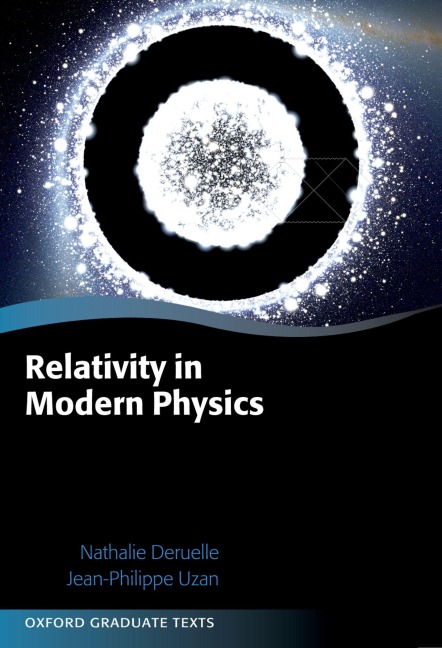
This comprehensive textbook on relativity integrates Newtonian physics, special relativity and general relativity into a single book that emphasizes the deep underlying principles common to them all, yet explains how they are applied in different ways in these three contexts.
Newton's ideas about how to represent space and time, his laws of dynamics, and his theory of gravitation established the conceptual foundation from which modern physics developed. Book I in this volume offers undergraduates a modern view of Newtonian theory, emphasizing those aspects needed for understanding quantum and relativistic contemporary physics.
In 1905, Albert Einstein proposed a novel representation of space and time, special relativity. Book II presents relativistic dynamics in inertial and accelerated frames, as well as a detailed overview of Maxwell's theory of electromagnetism. This provides undergraduate and graduate students with the background necessary for studying particle and accelerator physics, astrophysics and Einstein's theory of general relativity.
In 1915, Einstein proposed a new theory of gravitation, general relativity. Book III in this volume develops the geometrical framework in which Einstein's equations are formulated, and presents several key applications: black holes, gravitational radiation, and cosmology, which will prepare graduate students to carry out research in relativistic astrophysics, gravitational wave astronomy, and cosmology.
Nathalie Deruelle and Jean-Philippe Uzan are researchers in Theoretical Physics. After a career at the Centre National de la Recherche Scientifique (CNRS) in France, Nathalie Deruelle is now an invited professor at the Université Libre de Bruxelles (ULB).
Jean-Philippe Uzan is a CNRS researcher at the Institut d'Astrophysique de Paris (IAP) from Sorbonne Université. They are both affiliated professors at the Kyoto Yukawa Institute (YITP).
- Book 1 Space, time, and gravity in Newton's theory - Part I Kinematics - 1: Cartesian coordinates - 2: Vector geometry - 3: Curvilinear coordinates - 4: Differential geometry - Part II Dynamics - 5: Equations of motion - 6: Dynamics of massive systems - 7: Conservation laws - 8: Lagrangian mechanics - 9: Hamiltonian mechanics - 10: Kinetic theory - Part III - 11: The law of gravitation - 12: The Kepler problem - 13: The N-body problem - 14: Deformations of celestial bodies - 15: Self-gravitating fluids - 16: Newtonian cosmology - 17: Light in Newtonian theory - Book 2 Special relativity and Maxwell's theory - Part I Kinematics - 1: Minkowski spacetime - 2: The kinematics of a point particle - 3: The kinematics of light - 4: The wave vector of light - 5: Accelerated frames - Part II Dynamics - 6: Dynamics of a point particle - 7: Rotating systems - 8: Fields and matter - 9: The classical scalar field - 10: The Nordström theory - Part III Electromagnetism - 11: The Lorentz force - 12: The Maxwell equaions - 13: Constant fields - 14: The free field - 15: Electromagnetic waves - 16: Waves in a medium - Part IV Electrodynamics - 17: The field of moving charge - 18: Radiation by a charge - 19: The radiation reaction force - 20: Interacting charges I - 21: Interacting charges II - 22: Electromagnetism and differential geometry - Book 3 General relativity and gravitation - Part I Curved spacetime and gravitation - 1: The equivalence principle - 2: Riemannian manifolds - 3: Matter in curved spacetime - 4: The Einstein equations - 5: Conservation laws - Part II The Schwarzschild solution and black holes - 6: The Schwarzchild solution - 7: The Schwarzchild black hole - 8: The Kerr solution - 9: The physics of black holes I - 10: The physics of black holes II - Part III General relativity and experiment - 11: Tests in the solar system - 12: The post-Newtonian approximation - 13: Gravitational waves and the radiative field - 14: Gravitational radiation - 15: The two-body problem and radiative losses - 16: The two-body problem: an effective-one-body approach: Written in collaboration with Félix-Louis Julié - Part IV Friedmann-Lemaître solutions and cosmology - 17: Cosmological spacetimes - 18: Friedmann-Lemaître spacetimes - 19: The Lambda-CDM model of the hot Big Bang - 20: Inflationary models of the primordial universe - 21: Cosmological perturbations - 22: Primordial quantum perturbations - Part V Elements of Riemannian geometry - 23: The covariant derivative and the curvature - 24: Riemannian manifolds - 25: The Cartan structure equations
Dieses eBook wird im PDF-Format geliefert und ist mit einem Adobe Kopierschutz (DRM) versehen. Sie können dieses eBook mit allen Geräten lesen, die das PDF-Format und den Adobe Kopierschutz (DRM) unterstützen.
Zum Beispiel mit den folgenden Geräten:
• tolino Reader
Laden Sie das eBook direkt über den Reader-Shop auf dem tolino herunter oder übertragen Sie das eBook auf Ihren tolino mit einer kostenlosen Software wie beispielsweise Adobe Digital Editions.
• Sony Reader & andere eBook Reader
Laden Sie das eBook direkt über den Reader-Shop herunter oder übertragen Sie das eBook mit der kostenlosen Software Sony READER FOR PC/Mac oder Adobe Digital Editions auf ein Standard-Lesegeräte mit epub- und Adobe DRM-Unterstützung.
• Tablets & Smartphones
Möchten Sie dieses eBook auf Ihrem Smartphone oder Tablet lesen, finden Sie hier unsere kostenlose Lese-App für iPhone/iPad und Android Smartphone/Tablets.
• PC & Mac
Lesen Sie das eBook direkt nach dem Herunterladen mit einer kostenlosen Lesesoftware, beispielsweise Adobe Digital Editions, Sony READER FOR PC/Mac oder direkt über Ihre eBook-Bibliothek in Ihrem Konto unter „Meine eBooks“ - „online lesen“.
Schalten Sie das eBook mit Ihrer persönlichen Adobe ID auf bis zu sechs Geräten gleichzeitig frei.
Bitte beachten Sie, dass die Kindle-Geräte das Format nicht unterstützen und dieses eBook somit nicht auf Kindle-Geräten lesbar ist.