
Stöbern
genialokal zum Startbildschirm hinzufügen
Installieren Sie die genialokal App auf Ihrem Startbildschirm für einen schnellen Zugriff und eine komfortable Nutzung.
Installieren Sie die genialokal App auf Ihrem Startbildschirm für einen schnellen Zugriff und eine komfortable Nutzung.
Tippen Sie einfach auf Teilen:
 Und dann auf "Zum Home-Bildschirm [+]".
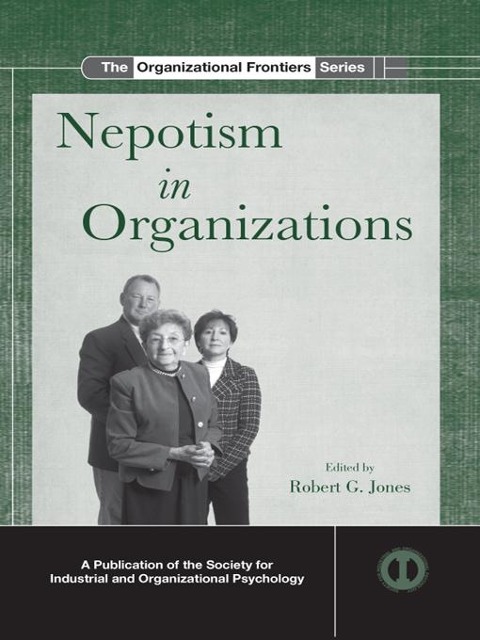
There is a huge elephant in the room: organizational decisions are often based on family relationships, rather than on the 'rational' approach advocated by many professionals. Textbooks on Human Resources, Management, Organizational Behavior, Economics, Public Administration, and a host of related areas seem to have entirely missed this important aspect of organizational decision making. This book seeks to change all of this. By clearly identifying and defining nepotism in organizations, this book pulls back the curtain on the primary basis for many of the important things that really happen in organizations, large and small. The authors skillfully weave examples of nepotism in real organizations with the usual scholarly textbook topics (hiring, leadership, employment law, career search, culture, etc.) in a way that defines an entire new field of quantitative organizational research. This new book in SIOP's Organizational Frontiers series represents the first time IO psychologists have looked at the important subject of nepotism in organizations.
Robert G. Jones is professor of psychology and department head at Missouri State University. After a first career in music and banking, Bob returned to school to get his PhD in industrial/organizational psychology from The Ohio State University in 1992. In this second career, Bob and his students, colleagues, and clients have dealt with a broad range of issues in selection and assessment. Most of this work has focused on understanding and managing the basis for applied, person-perception-based assessments, including emotive perception and prejudices. He has addressed these issues in various publications, numerous applied settings, and classrooms in the U.S., Australia, and the Netherlands. As Book Review Editor of Personnel Psychology (1994-2004), Bob had the pleasant task of reading lots of books, including the ones that inspired this one.
E. Salas, Series Foreword. Preface. R.G. Jones, Defining a Psychology of Nepotism. A. Gutman, Nepotism and Employment Law. P. W. Muchinsky, The Nepotistic Organization: What is This Place and How Do the People Make It? E. Van Hooft, T. Stout, Nepotism and Career Choice, Job Search, and Job Choice. M.W. Dickson, L.R.G. Nieminen, B.J. Biermeier-Hanson, Nepotism and Organizational Homogeneity: How the ASA Process is Accelerated by Non-merit-based Decision-making. T.E. Becker, Nepotism and the Commitment of Relevant Parties. A. Masuda, M. Visio, Nepotism Practices and the Work-Family Interface. K.H. Mhatre, R.E. Riggio, H.R. Riggio, Nepotism and Leadership. G. Wated, J.I. Sanchez, The Cultural Boundary of Managing Nepotism. B.H. Mulder, A Model of Organizational Nepotism. R.G. Jones, Toward a New Understanding of Nepotistic Organizational Behavior.
Dieses eBook wird im PDF-Format geliefert und ist mit einem Adobe Kopierschutz (DRM) versehen. Sie können dieses eBook mit allen Geräten lesen, die das PDF-Format und den Adobe Kopierschutz (DRM) unterstützen.
Zum Beispiel mit den folgenden Geräten:
• tolino Reader
Laden Sie das eBook direkt über den Reader-Shop auf dem tolino herunter oder übertragen Sie das eBook auf Ihren tolino mit einer kostenlosen Software wie beispielsweise Adobe Digital Editions.
• Sony Reader & andere eBook Reader
Laden Sie das eBook direkt über den Reader-Shop herunter oder übertragen Sie das eBook mit der kostenlosen Software Sony READER FOR PC/Mac oder Adobe Digital Editions auf ein Standard-Lesegeräte mit epub- und Adobe DRM-Unterstützung.
• Tablets & Smartphones
Möchten Sie dieses eBook auf Ihrem Smartphone oder Tablet lesen, finden Sie hier unsere kostenlose Lese-App für iPhone/iPad und Android Smartphone/Tablets.
• PC & Mac
Lesen Sie das eBook direkt nach dem Herunterladen mit einer kostenlosen Lesesoftware, beispielsweise Adobe Digital Editions, Sony READER FOR PC/Mac oder direkt über Ihre eBook-Bibliothek in Ihrem Konto unter „Meine eBooks“ - „online lesen“.
Schalten Sie das eBook mit Ihrer persönlichen Adobe ID auf bis zu sechs Geräten gleichzeitig frei.
Bitte beachten Sie, dass die Kindle-Geräte das Format nicht unterstützen und dieses eBook somit nicht auf Kindle-Geräten lesbar ist.