
Stöbern
genialokal zum Startbildschirm hinzufügen
Installieren Sie die genialokal App auf Ihrem Startbildschirm für einen schnellen Zugriff und eine komfortable Nutzung.
Installieren Sie die genialokal App auf Ihrem Startbildschirm für einen schnellen Zugriff und eine komfortable Nutzung.
Tippen Sie einfach auf Teilen:
 Und dann auf "Zum Home-Bildschirm [+]".
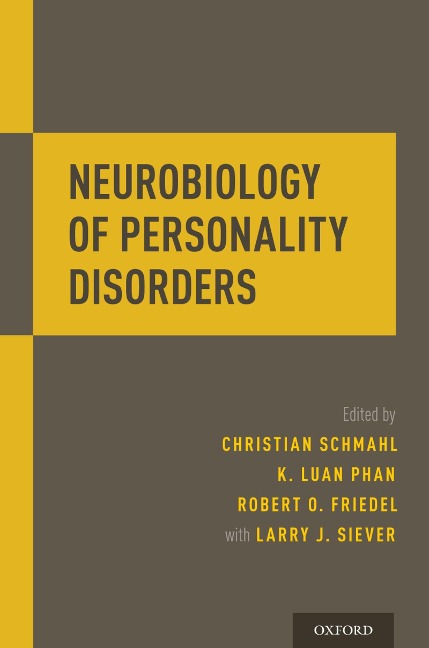
Personality disorders are highly prevalent and cause a substantial amount of human suffering and harm-not only to the individuals and families directly affected, but also to the population at large. These disorders generally have a heritability rate that is in excess of fifty percent, strongly suggesting that the behavioral disturbance they cause have a significant biomedical etiology. However, knowledge about the biological nature of personality disorders-and effective treatment of the latter-is significantly lacking. Although basic biological principles have overall served well in the foundation of psychiatry, they have received relatively little attention with regard to the areas of personality, temperament, and personality disorders. Neurobiology of Personality Disorders is the first book to focus specifically on the neurobiology of disturbed personality. It provides a thorough outline of the principles of neural science that mediate personality and describe what is currently known about how these biological processes are impaired in individuals with personality disorders. Its team of editors and authors are among the most frequently published and highly renowned international neuroscientists in the field of personality disorders, and its coverage of topics is comprehensive, authoritative, and heuristic.
Christian Schmahl is Professor of Experimental Psychopathology and Medical Director of the Department of Psychosomatic Medicine at the Central Institute of Mental Health in Mannheim, Germany. His research focus is on emotion regulation, self-injurious behavior and dissociation as well as the interaction of neurobiology and psychotherapy in Borderline Personality Disorder and Posttraumatic Stress Disorder. Since 2015 he is spokesperson of the Clinical Research Unit "Mechanisms of Disturbed Emotion Processing in BPD". He has published more than 150 articles and book chapters.
Robert O. Friedel is Distinguished Clinical Professor of Psychiatry at Virginia Commonwealth University in Richmond, Virginia USA. His primary focus of academic work has been in the neurobiological basis and pharmacological treatment of Borderline Personality Disorder. He received his medical training at Duke University and his research training in biology at Duke and at the National Institute of Mental Health (NIMH). Dr. Friedel served as chair of the departments of psychiatry at Virginia Commonwealth University, the University of Michigan, where he was also Executive Director of the Mental Health Research Institute, and chair at the University of Alabama at Birmingham. He has published more than 100 scientific articles, books and book chapters.
K. Luan Phan, MD is Professor of Psychiatry and Director of the Mood and Anxiety Disorders Program at the University of Illinois at Chicago. His research is focused on the neuroscience of emotion and emotion-cognition interactions, especially emotion regulation, and in relation of psychopathology and treatment interventions. He has published over 200 peer-reviewed articles.
Preface
1. Neurocircuitry of Affective, Cognitive, Regulatory Systems Annmarie McNamara and K. Luan Phan
2. The Fundamentals of Brain Neurotransmission Robert O. Friedel and Stephen M. Stahl
3. Genetics of Personality Disorders Ted Reichborn-Kjennerud and Kenneth S. Kendler
4. Cognitive Neuroscience Approaches to Personality Disorders Andrew Poppe and Angus W. MacDonald III
5. Minding the Emotional Thermostat: Integrating social cognitive and affective neuroscience evidence to form a model of the cognitive control of emotion Bryan T. Denny and Kevin N. Ochsner
6. The Neurobiology of Attachment and Mentalizing: A Neurodevelopmental Perspective Patrick Luyten and Peter Fonagy
7. Emotion Regulation Katja Bertsch, Karold Koenigsberg, Inga Niedtfeld, and Christian Schmahl
8. The Clinical Neuroscience of Impulsive Aggression Royce Lee, Jennifer R. Fanning, and Emil F. Coccaro
9. Social Cognition in Personality Disorders Stefanie Lis, Nicole E. Derish, M. Mercedes Perez-Rodriguez
10. Attachment in Personality Disorders M. Mercedes Perez-Rodriguez, Nicole E. Derish, Nerea Palomares, Sukhbir Kaur, Armando Cuesta-Diaz, and Stefanie Lis
11. Suicide and Non-Suicidal Self Injury Paul Soloff, Christian Schmahl
12. The Neurobiology and Genetics of Schizotypal Personality Disorder Daniel R. Rossell and Larry J. Siever
13. The Neurobiological Basis of Borderline Personality Disorder Robert O. Friedel, Christian Schmahl, and Marijn Distel
14. The Neurobiology of antisocial Disorder Focusing on Psychopathy Michael Baliousis, Najat Khalifa, and Birgit Vollm
15. The Neurobiological Basis of Avoidant Personality Disorder Theresa Wilberg and Kenneth Silk
16. Established and Novel Pharmacological Approaches to the Treatment of Personality Disorders S. Charles Schulz and Robert O. Friedel
17. Neurobiological Underpinnings of Psychosocial Treatment in Personality Disorders Marianne Goodman, Jennifer Chen, and Erin A. Hazlett
18. Conclusion and Future Directions Robert O. Friedel, K. Luan Pham, and Christian Schmahl
Dieses eBook wird im PDF-Format geliefert und ist mit einem Adobe Kopierschutz (DRM) versehen. Sie können dieses eBook mit allen Geräten lesen, die das PDF-Format und den Adobe Kopierschutz (DRM) unterstützen.
Zum Beispiel mit den folgenden Geräten:
• tolino Reader
Laden Sie das eBook direkt über den Reader-Shop auf dem tolino herunter oder übertragen Sie das eBook auf Ihren tolino mit einer kostenlosen Software wie beispielsweise Adobe Digital Editions.
• Sony Reader & andere eBook Reader
Laden Sie das eBook direkt über den Reader-Shop herunter oder übertragen Sie das eBook mit der kostenlosen Software Sony READER FOR PC/Mac oder Adobe Digital Editions auf ein Standard-Lesegeräte mit epub- und Adobe DRM-Unterstützung.
• Tablets & Smartphones
Möchten Sie dieses eBook auf Ihrem Smartphone oder Tablet lesen, finden Sie hier unsere kostenlose Lese-App für iPhone/iPad und Android Smartphone/Tablets.
• PC & Mac
Lesen Sie das eBook direkt nach dem Herunterladen mit einer kostenlosen Lesesoftware, beispielsweise Adobe Digital Editions, Sony READER FOR PC/Mac oder direkt über Ihre eBook-Bibliothek in Ihrem Konto unter „Meine eBooks“ - „online lesen“.
Schalten Sie das eBook mit Ihrer persönlichen Adobe ID auf bis zu sechs Geräten gleichzeitig frei.
Bitte beachten Sie, dass die Kindle-Geräte das Format nicht unterstützen und dieses eBook somit nicht auf Kindle-Geräten lesbar ist.