
Stöbern
genialokal zum Startbildschirm hinzufügen
Installieren Sie die genialokal App auf Ihrem Startbildschirm für einen schnellen Zugriff und eine komfortable Nutzung.
Installieren Sie die genialokal App auf Ihrem Startbildschirm für einen schnellen Zugriff und eine komfortable Nutzung.
Tippen Sie einfach auf Teilen:
 Und dann auf "Zum Home-Bildschirm [+]".
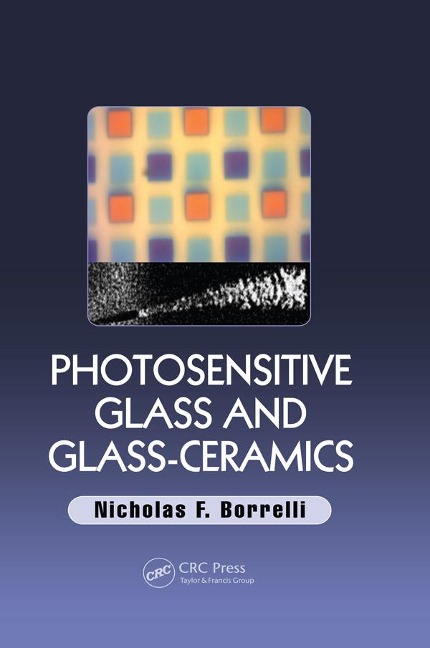
This book will discuss how glass and glass ceramic interact with light, both transiently and permanently. Ways that light permanently alter the properties of glass and glass ceramic like the color, refractive index, and mechanical and chemical behaviors will be included. Each photochromatic phenomenon will be discussed in detail from the physical and chemical origin to the method fabrication and ultimately to their utilization.
Nicholas F. Borrelli presently is in a position as a corporate research fellow in the research division of Corning Incorporated located in Corning NY.
1) Introduction. Bit of history. Technical Relevance. Scope. 2) Basic photosensitive mechanism. 2.1) Initial chemistry. 2.2) Metal ions. 2.3) Origin of color. 3) Other phases produced photosensitively. 3.1) Basic mechanism for photo- nucleation of other glass-ceramic phases 3.11) Li-metasilicate (Fotoform(TM)) 3.111) Photo-machinable 3.112) Spherical lens arrays (SMILE(TM)). 3.12) NaF (Fota-Lite(TM)) 3.121 Colored 3.13) NaF (Polychromatic(TM)) 3.131) mechanism of controlled color 3.14) AgCl (Rainbow) 3.141) Mechanism of thermal formation 3.142) photo-induced effects) 3.15) Li-aluminosilicate (Nepheline) 3.151) example of double nucleation phenomenon 4) Photorefractive Effects (induced refractive index) 4.1) NaF-based 4.11) Holograms 4.12) Gradient index lenses 4.2) Photorefractive and polarizing 4.21 Photorefraction (see 3.142) 4.22) polarizing mechanism 4.3) Fs-laser induced 4.31) waveguides 4.32) gratings 4.4) Bulk Fiber Bragg Grating SiO2/GeO2+ H2 5) Photo-adaption 5.1) definition and description of the various manifestations 5.11) photo-induced color 5.12 photo-induced polarization 6) Solarization 6.1) Different Mechanisms 6.2) Extent of effect in different glasses 6.3) Bleaching effects 7) Photochemistry in porous Vycor(TM) 7.1) description and preparation of porous glass 7.2) photo-produced effect with the aid of organo-metallic impregnation
Dieses eBook wird im PDF-Format geliefert und ist mit einem Adobe Kopierschutz (DRM) versehen. Sie können dieses eBook mit allen Geräten lesen, die das PDF-Format und den Adobe Kopierschutz (DRM) unterstützen.
Zum Beispiel mit den folgenden Geräten:
• tolino Reader
Laden Sie das eBook direkt über den Reader-Shop auf dem tolino herunter oder übertragen Sie das eBook auf Ihren tolino mit einer kostenlosen Software wie beispielsweise Adobe Digital Editions.
• Sony Reader & andere eBook Reader
Laden Sie das eBook direkt über den Reader-Shop herunter oder übertragen Sie das eBook mit der kostenlosen Software Sony READER FOR PC/Mac oder Adobe Digital Editions auf ein Standard-Lesegeräte mit epub- und Adobe DRM-Unterstützung.
• Tablets & Smartphones
Möchten Sie dieses eBook auf Ihrem Smartphone oder Tablet lesen, finden Sie hier unsere kostenlose Lese-App für iPhone/iPad und Android Smartphone/Tablets.
• PC & Mac
Lesen Sie das eBook direkt nach dem Herunterladen mit einer kostenlosen Lesesoftware, beispielsweise Adobe Digital Editions, Sony READER FOR PC/Mac oder direkt über Ihre eBook-Bibliothek in Ihrem Konto unter „Meine eBooks“ - „online lesen“.
Schalten Sie das eBook mit Ihrer persönlichen Adobe ID auf bis zu sechs Geräten gleichzeitig frei.
Bitte beachten Sie, dass die Kindle-Geräte das Format nicht unterstützen und dieses eBook somit nicht auf Kindle-Geräten lesbar ist.