
Stöbern
genialokal zum Startbildschirm hinzufügen
Installieren Sie die genialokal App auf Ihrem Startbildschirm für einen schnellen Zugriff und eine komfortable Nutzung.
Installieren Sie die genialokal App auf Ihrem Startbildschirm für einen schnellen Zugriff und eine komfortable Nutzung.
Tippen Sie einfach auf Teilen:
 Und dann auf "Zum Home-Bildschirm [+]".

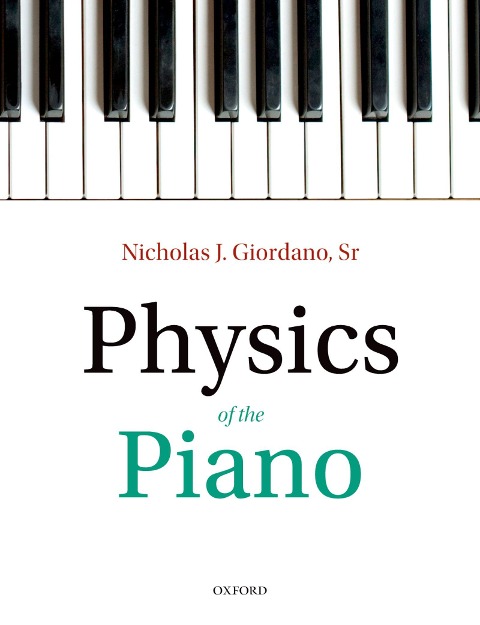
Why does a piano sound like a piano? A similar question can be asked of virtually all musical instruments. A particular note-such as middle C-can be produced by a piano, a violin, a clarinet, and many other instruments, yet it is easy for even a musically untrained listener to distinguish between these different instruments. A central quest in the study of musical instruments is to understand why the sound of the "same" note depends greatly on the instrument, and to elucidate which aspects of an instrument are most critical in producing the musical tones characteristic of the instrument. The primary goal of this book is to investigate these questions for the piano. The explanations in this book use a minimum of mathematics, and are intended for anyone who is interested in music and musical instruments. At the same time, there are many insights relating physics and the piano that will likely be interesting and perhaps surprising for many physicists.
Nicholas J. Giordano, Sr. is Hubert James Distinguished Professor of Physics at Purdue University, Indiana. He joined the Department of Physics there as an Assistant Professor in 1979, becoming an Associate Professor in 1982 and Full Professor in 1985. He served as an Assistant Dean of Science from 2000-2003, and became Head of the Department of Physics in 2007. His research includes nanoscience and conduction in small metallic systems, micro- and nanofluidic systems, musical acoustics, and computational biophysics. He was an Alfred P. Sloan Foundation Fellow (1979-1983), received a Computational Science Education Award from the U.S. Department of Energy in 1977, and was named Indiana Professor of the Year by the Carnegie Foundation for the Advancement of Teaching in 2004.
- 1: Introduction - 2: Waves and sound - 3: Making a musical scale - 4: Why the piano was invented: A little history - 5: Vibrating strings - 6: Hitting strings with hammers - 7: The soundboard - 8: Connecting the strings to the soundboard - 9: Evolution of the piano - 10: Psychoacoustics: How we perceive musical tones - 11: The magic of Steinway - 12: What physics can and cannot teach us about music and musical instruments