
Stöbern
genialokal zum Startbildschirm hinzufügen
Installieren Sie die genialokal App auf Ihrem Startbildschirm für einen schnellen Zugriff und eine komfortable Nutzung.
Installieren Sie die genialokal App auf Ihrem Startbildschirm für einen schnellen Zugriff und eine komfortable Nutzung.
Tippen Sie einfach auf Teilen:
 Und dann auf "Zum Home-Bildschirm [+]".
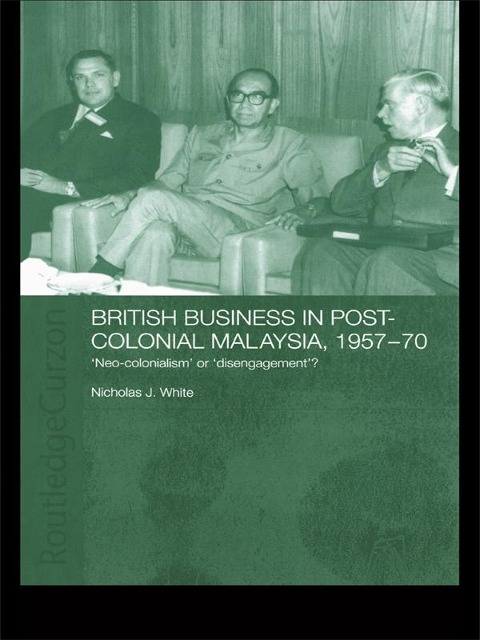
This book explores the limits of the idea of 'neo-colonialism' - the idea that in the period immediately after independence Malaya/Malaysia enjoyed only a 'pseudo-independence', largely because of the entrenched and dominant position of British business interests allied to indigenous elites. The author argues that, although British business did indeed have a strong position in Malaysia in this period, Malaysian politicians and administrators were able to utilise British business, which was relatively weak vis-a-vis the Malaysian state, for their own ends, at the same time as indigenous businesses and foreign, non-British competitors were gathering strength. In addition, despite the commitment of both Conservative and Labour governments in the UK to preserving British influence worldwide through the Commonwealth relationship, British firms in Malaysia received only limited support from the British post-imperial state.
Nicholas J. White is Senior Lecturer in Economic and Social History at Liverpool John Moores University where he specialises in British imperialism and decolonisation and the recent history of Southeast Asia.
Preface Abbreviations and Acronyms Introduction: Dependence, Interdependence and Disengagement in the Malaysian Context; 'Neo-colonialism' Re-visited; The Survival and Revival of British Business in Post-Colonial Malaysia; British Business and the British State: the Pursuit of 'Informal Empire'; 'Disengagement' Chapter 1. The Making and Unmaking of 'Greater Malaysia' A Neo-Colonialist Plot?; The Lure of 'Greater Malaysia'; Official Policy and 'Greater Malaysia'; Frustrations with 'Greater Malaysia'; Conclusion Chapter 2. Political Business: Politics and Economic Nationalism in the Post-Colonial State Bolstering the Alliance; Eternal Pessimism; Building the National Economy; The Beginnings of 'Crony Capitalism'; Frustration with Federation; Conclusion Chapter 3. The Years of Living Dangerously: Instability and Insecurity in the Post-Colonial State Lawlessness and the End of the Emergency; Konfrontasi; The Military Withdrawal from 'East of Suez'; Inter-Communal Violence; Conclusion Chapter 4. Looking After the Old Staples: Rubber and Tin in the Post-Colonial Era The Ongoing Reigns of Raja; Rubber and Tengku Tin; 'What Goes Up Must Come Down': Rubber and the Global Economy; Research, Replanting and Marketing: Rubber Development in Malaysia; The Limits of Commodity Agreements: Tin and the Global Economy; Land Alienation and Taxation: Tin Development in Malaysia; Conclusion Chapter 5. Oil Palms and Factories: Diversifying the Post-Colonial Economy British Prominence, British Dominance?; Palm Oil; Industrialising Malaysia; Conclusion Glossary Select Who's Who Bibliography
Dieses eBook wird im PDF-Format geliefert und ist mit einem Adobe Kopierschutz (DRM) versehen. Sie können dieses eBook mit allen Geräten lesen, die das PDF-Format und den Adobe Kopierschutz (DRM) unterstützen.
Zum Beispiel mit den folgenden Geräten:
• tolino Reader
Laden Sie das eBook direkt über den Reader-Shop auf dem tolino herunter oder übertragen Sie das eBook auf Ihren tolino mit einer kostenlosen Software wie beispielsweise Adobe Digital Editions.
• Sony Reader & andere eBook Reader
Laden Sie das eBook direkt über den Reader-Shop herunter oder übertragen Sie das eBook mit der kostenlosen Software Sony READER FOR PC/Mac oder Adobe Digital Editions auf ein Standard-Lesegeräte mit epub- und Adobe DRM-Unterstützung.
• Tablets & Smartphones
Möchten Sie dieses eBook auf Ihrem Smartphone oder Tablet lesen, finden Sie hier unsere kostenlose Lese-App für iPhone/iPad und Android Smartphone/Tablets.
• PC & Mac
Lesen Sie das eBook direkt nach dem Herunterladen mit einer kostenlosen Lesesoftware, beispielsweise Adobe Digital Editions, Sony READER FOR PC/Mac oder direkt über Ihre eBook-Bibliothek in Ihrem Konto unter „Meine eBooks“ - „online lesen“.
Schalten Sie das eBook mit Ihrer persönlichen Adobe ID auf bis zu sechs Geräten gleichzeitig frei.
Bitte beachten Sie, dass die Kindle-Geräte das Format nicht unterstützen und dieses eBook somit nicht auf Kindle-Geräten lesbar ist.