Und dann auf "Zum Home-Bildschirm [+]".

Stöbern
genialokal zum Startbildschirm hinzufügen
Installieren Sie die genialokal App auf Ihrem Startbildschirm für einen schnellen Zugriff und eine komfortable Nutzung.
Installieren Sie die genialokal App auf Ihrem Startbildschirm für einen schnellen Zugriff und eine komfortable Nutzung.
Ihr gewünschter Artikel ist in 0 Buchhandlungen vorrätig - wählen Sie hier eine Buchhandlung in Ihrer Nähe aus:


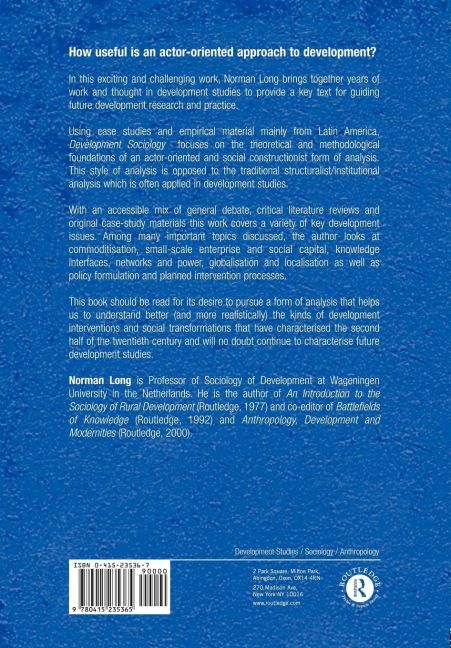
In this exciting and challenging work, Norman Long brings together years of work and thought in development studies to provide a key text for guiding future development research and practice. Using case studies and empirical material from Africa and Latin America, Development Sociology focuses on the theoretical and methodological foundations of an actor-oriented and social constructionist form of analysis. This style of analysis is opposed to the traditional structuralist/institutional analysis which is often applied in development studies. With an accessible mix of general debate, critical literature reviews and original case study materials this work covers a variety of key development issues. Among many important topics discussed, the author looks at commoditisation, small-scale enterprise and social capital, knowledge interfaces, networks and power, globalisation and localisation as well as policy formulation and planned intervention processes. This book should be read for its desire to pursue a form of analysis that helps us to understand better (and more realistically) the kinds of development interventions and social transformations that have characterised the second half of the twentieth century and will no doubt continue to characterise future development studies.
Norman Long works in the Rural Development Sociology Group at Wageningen Agricultural University in the Netherlands. He is the author of An Introduction to the Sociology of Rural Development (Routledge, 1977) and co-editor of Anthropology, Development & Modernities (Routledge, 1999).
List of illustrations, Preface and acknowledgements, Introduction, PART I Theoretical and methodological issues, PART II Commoditisation, social values and small-scale enterprise, PART III Knowledge interfaces, power and globalization, Appendix: Cornerstones of an actor-oriented approach, Notes, Bibliography, Index