
Stöbern
genialokal zum Startbildschirm hinzufügen
Installieren Sie die genialokal App auf Ihrem Startbildschirm für einen schnellen Zugriff und eine komfortable Nutzung.
Installieren Sie die genialokal App auf Ihrem Startbildschirm für einen schnellen Zugriff und eine komfortable Nutzung.
Tippen Sie einfach auf Teilen:
 Und dann auf "Zum Home-Bildschirm [+]".
Ihr gewünschter Artikel ist in 0 Buchhandlungen vorrätig - wählen Sie hier eine Buchhandlung in Ihrer Nähe aus:

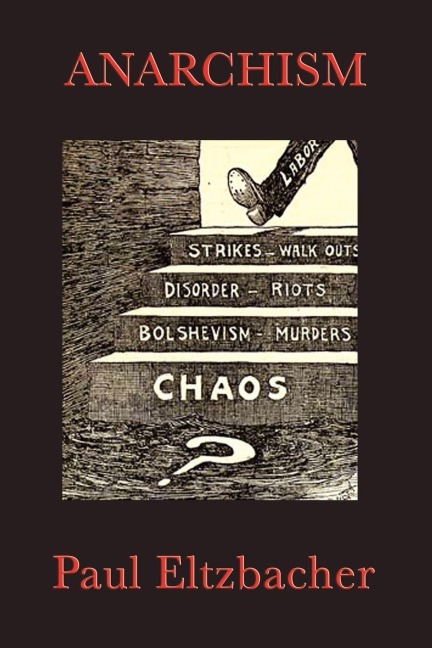
A systematic and influential study of anarchist political thought, Anarchism examines the ideas of the major theorists who shaped one of the most controversial movements in modern political philosophy. Paul Eltzbacher approaches anarchism not as a slogan or a single doctrine, but as a family of related theories about law, the state, property, society, and individual freedom. He studies the writings of leading anarchist thinkers, including William Godwin, Pierre-Joseph Proudhon, Max Stirner, Mikhail Bakunin, Peter Kropotkin, Benjamin Tucker, and Leo Tolstoy, comparing their arguments and identifying both their shared principles and their sharp differences. The result is a clear, organized account of a political tradition often misunderstood by both its critics and its admirers. First published in 1900, Anarchism remains valuable because of its disciplined structure and historical importance. Rather than reducing anarchism to chaos or rebellion, Eltzbacher treats it as a serious body of social and political theory, concerned with authority, coercion, justice, voluntary association, and the limits of government. For readers interested in political philosophy, radical thought, socialism, libertarian theory, and the history of modern revolutionary movements, this work offers a useful and compact introduction to the thinkers who defined anarchism as an intellectual tradition.
Paul Eltzbacher (1868-1928) was a German legal scholar, judge, and political writer best known for his systematic study Anarchism. Trained in law and active in German public life, he brought a jurist's concern for definitions, institutions, and legal theory to his examination of radical political movements. His work is especially useful because it treats anarchism analytically, distinguishing among different thinkers rather than presenting the movement as a single unified doctrine.Eltzbacher's study of anarchism became one of the important early scholarly treatments of the subject. By comparing figures such as Godwin, Proudhon, Stirner, Bakunin, Kropotkin, Tucker, and Tolstoy, he helped establish a framework for understanding anarchism through its central questions: the legitimacy of the state, the nature of law, the meaning of property, and the possibility of social order without coercive authority.Although Eltzbacher's own political views changed over time, Anarchism remains his best-known work and continues to be read for its clarity, organization, and historical significance. It offers a snapshot of anarchist thought at the turn of the twentieth century, when debates over socialism, in