
Stöbern
genialokal zum Startbildschirm hinzufügen
Installieren Sie die genialokal App auf Ihrem Startbildschirm für einen schnellen Zugriff und eine komfortable Nutzung.
Installieren Sie die genialokal App auf Ihrem Startbildschirm für einen schnellen Zugriff und eine komfortable Nutzung.
Tippen Sie einfach auf Teilen:
 Und dann auf "Zum Home-Bildschirm [+]".
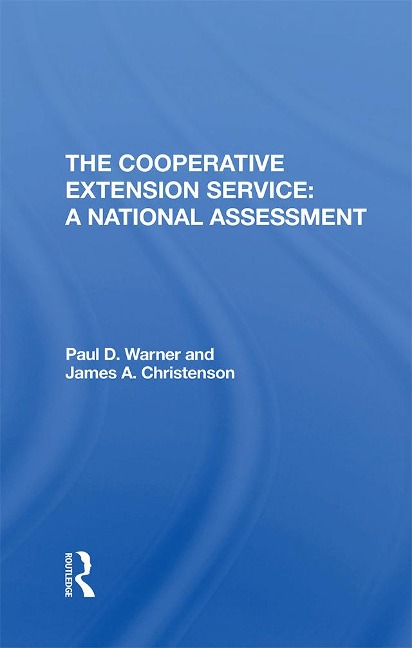
The Cooperative Extension Service, a publicly supported educational agency, is continually struggling to define its proper function and purpose in our changing society. Should its mission be broadly based or narrowly focused? Should staff members be generalists or specialists? Should its clients be primarily rural or urban, farm or nonfarm? What role should Extension play in the information networks of the twenty-first century? Professors Warner and Christenson take a broad look at these and other questions concerning where the Extension Service has been, how well it is doing, and where it ought to go. Theirs is, first, the only comprehensive national survey that looks at the total Extension organization rather than at just one program area. Second, it expresses the viewpoint of Extension clients and the public, rather than that of the organization's staff; and third, it combines outside survey information with data recorded in the Extension Management Information System (EMIS) and other routine agency reports. The authors evaluate, among other things, the extent of public awareness of the agency and its four major program areas (agriculture, home economics, 4-H, and community development), determine the users and nonusers of the programs and the accessibility of programs to the general population, identify the level of satisfaction with existing programs, and outline priorities and policy issues for the future.
"Paul D. Warner is professor of sociology at the University of Kentucky and Extension specialist with the Kentucky Cooperative Extension Service. He has conducted several evaluation studies of innovative program delivery systems, the most recent of which explored the organizational impacts of a videotext information system for delivering weather, market, and production information to farmers. James A. Christenson is professor and chairman of the Department of Sociology at the University of Kentucky. From 1972 to 1976 he was Extension specialist at North Carolina State University. Since 1979 he has served as director of the Survey Research Center at the University of Kentucky and is currently the editor of Rural Sociology."
Introduction -- Extension in Changing Times -- Evaluation in Extension -- Public Awareness of Extension -- Who Are Extension's Clientele? -- Some Clients Are Satisfied and Some Are Not -- Support for Extension -- The County as the Focus of Service Delivery -- Summary and Priorities -- Policy Issues Facing Extension -- The National Survey -- Additional Findings
Dieses eBook wird im PDF-Format geliefert und ist mit einem Adobe Kopierschutz (DRM) versehen. Sie können dieses eBook mit allen Geräten lesen, die das PDF-Format und den Adobe Kopierschutz (DRM) unterstützen.
Zum Beispiel mit den folgenden Geräten:
• tolino Reader
Laden Sie das eBook direkt über den Reader-Shop auf dem tolino herunter oder übertragen Sie das eBook auf Ihren tolino mit einer kostenlosen Software wie beispielsweise Adobe Digital Editions.
• Sony Reader & andere eBook Reader
Laden Sie das eBook direkt über den Reader-Shop herunter oder übertragen Sie das eBook mit der kostenlosen Software Sony READER FOR PC/Mac oder Adobe Digital Editions auf ein Standard-Lesegeräte mit epub- und Adobe DRM-Unterstützung.
• Tablets & Smartphones
Möchten Sie dieses eBook auf Ihrem Smartphone oder Tablet lesen, finden Sie hier unsere kostenlose Lese-App für iPhone/iPad und Android Smartphone/Tablets.
• PC & Mac
Lesen Sie das eBook direkt nach dem Herunterladen mit einer kostenlosen Lesesoftware, beispielsweise Adobe Digital Editions, Sony READER FOR PC/Mac oder direkt über Ihre eBook-Bibliothek in Ihrem Konto unter „Meine eBooks“ - „online lesen“.
Schalten Sie das eBook mit Ihrer persönlichen Adobe ID auf bis zu sechs Geräten gleichzeitig frei.
Bitte beachten Sie, dass die Kindle-Geräte das Format nicht unterstützen und dieses eBook somit nicht auf Kindle-Geräten lesbar ist.