
Stöbern
genialokal zum Startbildschirm hinzufügen
Installieren Sie die genialokal App auf Ihrem Startbildschirm für einen schnellen Zugriff und eine komfortable Nutzung.
Installieren Sie die genialokal App auf Ihrem Startbildschirm für einen schnellen Zugriff und eine komfortable Nutzung.
Tippen Sie einfach auf Teilen:
 Und dann auf "Zum Home-Bildschirm [+]".
Ihr gewünschter Artikel ist in 0 Buchhandlungen vorrätig - wählen Sie hier eine Buchhandlung in Ihrer Nähe aus:


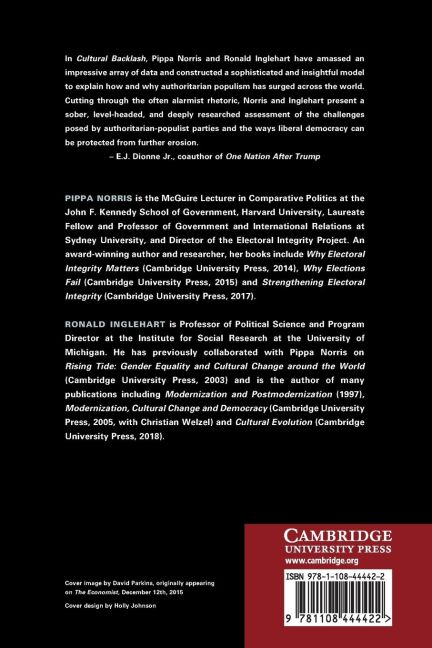
Authoritarian populist parties have advanced in many countries, and entered government in states as diverse as Austria, Italy, the Netherlands, Poland, and Switzerland. Even small parties can still shift the policy agenda, as demonstrated by UKIP's role in catalyzing Brexit. Drawing on new evidence, this book advances a general theory why the silent revolution in values triggered a backlash fuelling support for authoritarian-populist parties and leaders in the US and Europe. The conclusion highlights the dangers of this development and what could be done to mitigate the risks to liberal democracy.
Pippa Norris is the McGuire Lecturer in Comparative Politics at the John F. Kennedy School of Government, Harvard University, Massachusetts, Laureate Fellow and Professor of Government and International Relations at Sydney University, and Director of the Electoral Integrity Project. A multiple award-winning author and researcher, her publications include Why Electoral Integrity Matters (Cambridge, 2014), Why Elections Fail (Cambridge, 2015) and Strengthening Electoral Integrity (Cambridge, 2017).
Part I. Introduction: 1. Understanding populism; 2. The cultural backlash theory; 3. Varieties of populism; Part II. Authoritarian-Populist Values: 4. The backlash against the silent revolution; 5. Economic grievances; 6. Immigration; Part III. From Values to Votes: 7. Classifying parties; 8. Who votes for authoritarian-populists?; 9. Party fortunes and electoral rules; 10. Trump's America; 11. Brexit; Part IV. Conclusions: 12. Eroding the civic culture?; 13. The populist challenge; Endnotes; Appendices; Index.