Und dann auf "Zum Home-Bildschirm [+]".

Stöbern
genialokal zum Startbildschirm hinzufügen
Installieren Sie die genialokal App auf Ihrem Startbildschirm für einen schnellen Zugriff und eine komfortable Nutzung.
Installieren Sie die genialokal App auf Ihrem Startbildschirm für einen schnellen Zugriff und eine komfortable Nutzung.
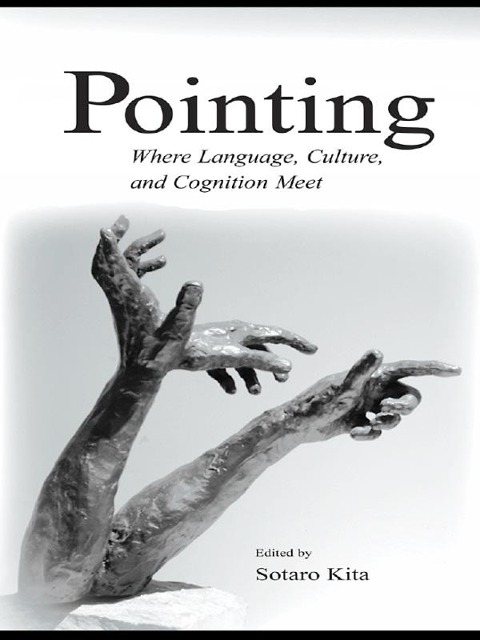
Pointing has captured the interest of scholars from various fields who study communication. However, ideas and findings have been scattered across diverse publications in different disciplines, and opportunities for interdisciplinary exchange have been very limited. The editor's aim is to provide an arena for such exchange by bringing together papers on pointing gestures from disciplines, such as developmental psychology, psycholinguistics, sign-language linguistics, linguistic anthropology, conversational analysis, and primatology. Questions raised by the editors include: *Do chimpanzees produce and comprehend pointing gestures in the same way as humans? *What are cross-cultural variations of pointing gestures? *In what sense are pointing gestures human universal? *What is the relationship between the development of pointing and language in children? *What linguistic roles do pointing gestures play in signed language? *Why do speakers sometimes point to seemingly empty space in front of them during conversation? *How do pointing gestures contribute to the unfolding of face-to-face interaction that involves objects in the environment? *What are the semiotic processes that relate what is pointed at and what is actually "meant" by the pointing gesture (the relationship between the two are often not as simple as one might think)? *Do pointing gestures facilitate the production of accompanying speech? The volume can be used as a required text in a course on gestural communication with multidisciplinary perspectives. It can also be used as a supplemental text in an advanced undergraduate or graduate course on interpersonal communication, cross-cultural communication, language development, and psychology of language.
Contents: S. Kita, Pointing: A Foundational Building Block of Human Communication. G. Butterworth, Pointing Is the Royal Road to Language for Babies. D. Povinelli, J.M. Bering, S. Giambrone, Chimpanzees' "Pointing": Another Error of the Argument by Analogy? N. Masataka, From Index-Finger Extension to Index-Finger Pointing: Ontogenesis of Pointing in Preverbal Infants. S. Goldin-Meadow, C. Butcher, Pointing Toward Two-Word Speech in Young Children. A. Kendon, L. Versante, Pointing by Hand in "Neapolitan." J.B. Haviland, How to Point in Zinacantán. D. Wilkins, Why Pointing With the Index Finger Is Not a Universal (in Sociocultural and Semiotic Terms). C. Goodwin, Pointing as Situated Practice. H.H. Clark, Pointing and Placing. E. Engberg-Pedersen, From Pointing to Reference and Predication: Pointing Signs, Eyegaze, and Head and Body Orientation in Danish Sign Language. D. McNeill, Pointing and Morality in Chicago. S. Kita, Interplay of Gaze, Hand, Torso Orientation, and Language in Pointing.
Dieses eBook wird im PDF-Format geliefert und ist mit einem Adobe Kopierschutz (DRM) versehen. Sie können dieses eBook mit allen Geräten lesen, die das PDF-Format und den Adobe Kopierschutz (DRM) unterstützen.
Zum Beispiel mit den folgenden Geräten:
• tolino Reader
Laden Sie das eBook direkt über den Reader-Shop auf dem tolino herunter oder übertragen Sie das eBook auf Ihren tolino mit einer kostenlosen Software wie beispielsweise Adobe Digital Editions.
• Sony Reader & andere eBook Reader
Laden Sie das eBook direkt über den Reader-Shop herunter oder übertragen Sie das eBook mit der kostenlosen Software Sony READER FOR PC/Mac oder Adobe Digital Editions auf ein Standard-Lesegeräte mit epub- und Adobe DRM-Unterstützung.
• Tablets & Smartphones
Möchten Sie dieses eBook auf Ihrem Smartphone oder Tablet lesen, finden Sie hier unsere kostenlose Lese-App für iPhone/iPad und Android Smartphone/Tablets.
• PC & Mac
Lesen Sie das eBook direkt nach dem Herunterladen mit einer kostenlosen Lesesoftware, beispielsweise Adobe Digital Editions, Sony READER FOR PC/Mac oder direkt über Ihre eBook-Bibliothek in Ihrem Konto unter „Meine eBooks“ - „online lesen“.
Schalten Sie das eBook mit Ihrer persönlichen Adobe ID auf bis zu sechs Geräten gleichzeitig frei.
Bitte beachten Sie, dass die Kindle-Geräte das Format nicht unterstützen und dieses eBook somit nicht auf Kindle-Geräten lesbar ist.