
Stöbern
genialokal zum Startbildschirm hinzufügen
Installieren Sie die genialokal App auf Ihrem Startbildschirm für einen schnellen Zugriff und eine komfortable Nutzung.
Installieren Sie die genialokal App auf Ihrem Startbildschirm für einen schnellen Zugriff und eine komfortable Nutzung.
Tippen Sie einfach auf Teilen:
 Und dann auf "Zum Home-Bildschirm [+]".

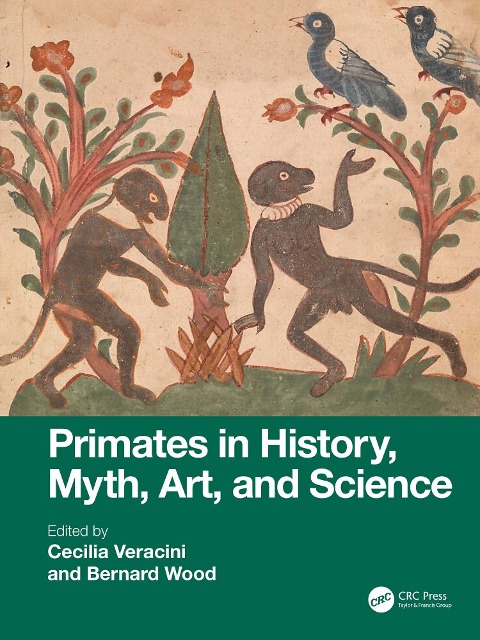
Non-human primates (hereafter just primates) play a special role in human societies, especially in regions where modern humans and primates co-exist. Primates feature in myths and legends and in traditional indigenous knowledge. Explorers observed them in the wild and brought them, at great cost, to Europe. There they were valued as pets and for display, their images featured in art and architecture, and where they were literally teased apart by scientists. The international team of contributors to this book draws these different perspectives together to show how primates helped humans better understand their own place in nature. The book will be of interest to undergraduate and graduate students as well scholars in disciplines ranging from anthropology to art history. Key features: - Includes contributions from an international team of historians and natural scientists - Integrates various perspectives and perceptions of non-human primates across time and place - Summarizes the place of non-human primates in science, art and culture - Includes rare early illustrations
Cecilia Veracini is associated researcher in CAPP- Public Administration and Public Policies Research Centre and invited assistant professor at the Faculty of Anthropology in the School of Social and Political Sciences/ University of Lisbon (ISCSP/ULisboa), Portugal. She graduated in Biological Science at the University of Pisa (Italy); received a Ph.D. degree in Anthropological Sciences and a Ph.D. degree in History of Science from the Florence and Pisa Universities. She served some years as Assistant Professor at the Florence and Pisa Universities and worked as collaborator at various institutions in different countries including Brazil, US and Spain. Her publications include papers in national and international peer reviewed journals and book chapters. She is co-editor of the books: 'History of Primatology: yesterday and today. The Mediterranean Tradition' (2019) and 'Peoples, nature and environments: learning to live together' (2020). Bernard Wood is the University Professor of Human Origins at George Washington University. Previously, he was the Courtuald Professor of Anatomy in the University of London, and the Derby Professor of Anatomy in the University of Liverpool. In 1968 he joined Richard Leakey's first expedition to the Turkana Basin, Kenya, and he subsequently joined the group of researchers working on the hominins recovered from Koobi Fora in Northern Kenya. In addition to his paleoanthropological research, he has a long-standing interest in primate comparative anatomy, with a focus on the ability of hard- and soft-tissue anatomy to recover the recent evolutionary history of the extant apes, and on the history of primate comparative anatomy. He is the co-author of research articles on many aspects of comparative anatomy, and the author, or co-author, of 20 books, including Food Acquisition and Processing in Primates (1984), Major Topics in Primate and Human Evolution (1986), and photographic atlases of the musculoskeletal anatomy of gorillas (2010), gibbons and siamangs (2012), chimpanzees (2013), orangutans (2013), and bonobos (2017).
Introduction SECTION I - Lore and mythology of non-human primates since antiquity 1. South, Southeast, and East Asia Philip Lutgendorf 2. Continental Africa 2.1 Ancient Egypt Cybelle Greenlaw 2.2. North Africa and Sub-Saharan Africa. Cecilia Veracini 3. Madagascar Alessio Anania & Giuseppe Donati 4. The Americas Cecilia Veracini & 5. A non-monkey land. Non-human primates in the ancient Near East, from protohistory to the first Islamic caliphate Marco Masseti 6. Europe from the Bronze Age (mid-3rd millennium BCE) to Greco-Roman times Marco Masseti & Cecilia Veracini SECTION II. The Middle Ages and the Age of Discovery in Europe and in the Arab world 7. Nonhuman primates in Medieval Europe Cecilia Veracini 8. Perception and description of non-human primates in the Arab world Cecilia Veracini & Malak Alghamdi 9. Non-human primates in the Age of Discovery (15th and 16th centuries) Cecilia Veracini SECTION III. Modern period (until Darwin) 10. Natural history of nonhuman primates in the 17th century: naturalists, missionaries, scientific expeditions and trade Cecilia Veracini 11. Natural history of Primates in the 18th-19th centuries, before Darwin Cecilia Veracini 12. Natural History of Great Apes from Gesner to Huxley Giulio Barsanti Section IV. Our Place in Nature 13. The contribution of morphology to Darwin's understanding of the genealogy of modern humans Bernard Wood, Ryan McRae, & Rowan M. Sherwood 14. How old and new lines of evidence have contributed to our understanding of the relationships among modern humans and the great apes: 1900-2021 Bernard Wood & Rowan M. Sherwood Glossary