Und dann auf "Zum Home-Bildschirm [+]".

Stöbern
genialokal zum Startbildschirm hinzufügen
Installieren Sie die genialokal App auf Ihrem Startbildschirm für einen schnellen Zugriff und eine komfortable Nutzung.
Installieren Sie die genialokal App auf Ihrem Startbildschirm für einen schnellen Zugriff und eine komfortable Nutzung.
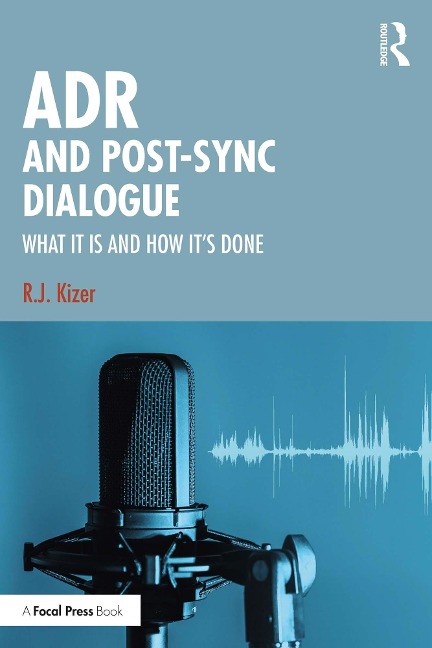
Written by industry expert, R.J. Kizer, this is the first book to provide a comprehensive overview of post-sync dialogue replacement, popularly known as ADR. It explores how this seldom recognised, but essential, technology is used in motion pictures and in fictional narrative television programs, with many examples from past and recent movies to explain approaches and techniques. It is intended primarily as an intuitive book, allowing readers to develop their own interpretation of ADR application, with both historical and procedural background provided throughout. It identifies the many different procedures and mechanical systems invented and used to accomplish the task of ADR, some from as long ago as the early 1920s. The text also details the many different steps, tasks, and routines that must be followed to identify (spot), program, record, edit, and mix the ADR lines into the final sound track of a show. Intended for the sound professional, it is also suitable for students and entry-level editors wishing to master audio dialogue replacement. Film historians and theorists will also find it both informative and enlightening by illustrating the many avenues used to affect and manipulate the recorded spoken word in motion pictures.
R.J. Kizer is an ADR editor with over 30 years' experience. He worked for directors such as Steven Spielberg, Christopher Nolan, and Peter Weir. Notable movie titles in his résumé include Catch Me If You Can (2002), War of the Worlds (2005), Inception (2010), and Interstellar (2014). He won the Motion Picture Sound Editors 'Golden Reel' award twice: for dialogue editing on The Lion King (1994) and dialogue/ADR editing on War for the Planet of the Apes (2017). A member of the Academy of Motion Picture Arts and Sciences since 2008, he served for 11 years on its Sound Branch Executive Committee.
1. Beginning 2. Spotting 3. Cuing, Programming and Line Counts 4. Group ADR Programming 5. Conforming the Programming 6. Scheduling and Preparation 7. The ADR Stage 8. The Principal ADR Session 9. Remote Recording 10. After Recording 11. Group ADR a/k/a Walla 12. The Group ADR Recording Session 13. Cutting/Editing/Fitting/Building 14. Group ADR - Cutting and Organizing 15. Conforming, Fixing, Updating 16. Temp Dubs - Predub - Rerecording - Updating 17. Finishing 18. The ADR Controversy: Then, Now, and The Future
Dieses eBook wird im PDF-Format geliefert und ist mit einem Adobe Kopierschutz (DRM) versehen. Sie können dieses eBook mit allen Geräten lesen, die das PDF-Format und den Adobe Kopierschutz (DRM) unterstützen.
Zum Beispiel mit den folgenden Geräten:
• tolino Reader
Laden Sie das eBook direkt über den Reader-Shop auf dem tolino herunter oder übertragen Sie das eBook auf Ihren tolino mit einer kostenlosen Software wie beispielsweise Adobe Digital Editions.
• Sony Reader & andere eBook Reader
Laden Sie das eBook direkt über den Reader-Shop herunter oder übertragen Sie das eBook mit der kostenlosen Software Sony READER FOR PC/Mac oder Adobe Digital Editions auf ein Standard-Lesegeräte mit epub- und Adobe DRM-Unterstützung.
• Tablets & Smartphones
Möchten Sie dieses eBook auf Ihrem Smartphone oder Tablet lesen, finden Sie hier unsere kostenlose Lese-App für iPhone/iPad und Android Smartphone/Tablets.
• PC & Mac
Lesen Sie das eBook direkt nach dem Herunterladen mit einer kostenlosen Lesesoftware, beispielsweise Adobe Digital Editions, Sony READER FOR PC/Mac oder direkt über Ihre eBook-Bibliothek in Ihrem Konto unter „Meine eBooks“ - „online lesen“.
Schalten Sie das eBook mit Ihrer persönlichen Adobe ID auf bis zu sechs Geräten gleichzeitig frei.
Bitte beachten Sie, dass die Kindle-Geräte das Format nicht unterstützen und dieses eBook somit nicht auf Kindle-Geräten lesbar ist.