Und dann auf "Zum Home-Bildschirm [+]".

Stöbern
genialokal zum Startbildschirm hinzufügen
Installieren Sie die genialokal App auf Ihrem Startbildschirm für einen schnellen Zugriff und eine komfortable Nutzung.
Installieren Sie die genialokal App auf Ihrem Startbildschirm für einen schnellen Zugriff und eine komfortable Nutzung.
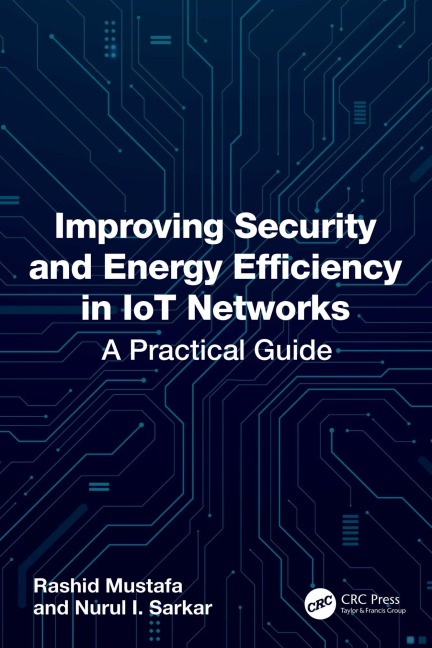
A practical guide to designing secure and energy-efficient IoT networks through cross-layer frameworks, lightweight cryptography, and machine learning-based intrusion detection, Improving Security and Energy Efficiency in IoT Networks equips readers with actionable strategies to balance security and energy efficiency in resource-constrained IoT environments. It delivers hands-on frameworks validated through simulations and hardware testbeds, covering adaptive routing, lightweight encryption, and ML-driven anomaly detection. It also includes mini-projects, review questions, and reproducible configurations for real-world deployments. Key Features: - Effectively balances security and energy efficiency through cross-layer design principles. - Comprehensively integrates lightweight cryptography, adaptive routing, and ML-based anomaly detection. - Practically validates concepts with simulations, hardware testbeds, and hands-on mini projects. - Companion resources include configuration files, scripts, and experiment notes to support reproducibility and classroom use. Ideal for IoT practitioners, network engineers, cybersecurity professionals, and researchers seeking practical solutions for secure and sustainable IoT systems. Also suited for instructors and students in networking, embedded systems, and cybersecurity courses.
Rashid Mustafa is a Lecturer in Cybersecurity at Whitecliffe College of Arts and Sciences (New Zealand) and holds a PhD in Cybersecurity from Auckland University of Technology (AUT). Over 20+ years across academia and industry, he has supervised 40+ Master's projects and leads hands-on, lab-first teaching across network security, Microsoft Azure/cloud, Cisco/Fortinet systems, data communications, IoT, and software development (NZQA L5-L7). His research targets secure, energy-efficient cross-layer IoT architectures, ML-assisted intrusion detection, and cloud-enabled network defence, with recent outputs in Sensors (MDPI) and at ICOIN. He builds practical capability with tools such as Snort, Nessus, Wireshark, Burp Suite, and Kali Linux, drawing on prior roles at Saudi Telecom and PARCO Oil Refinery. Alongside Azure training and adult-education delivery, he contributes to curriculum design, industry engagement, and mentoring, helping students translate security concepts into deployable solutions. Nurul I. Sarkar is a distinguished academic and computer scientist specialising in network design, modelling, and performance evaluation. He currently serves as a Professor and Director of the Networking and Security Research Centre at Auckland University of Technology (AUT), New Zealand. He is a keynote speaker, chair, and committee member for various national and international fora. Professor Sarkar has over 30 years of teaching experience in universities at both undergraduate and postgraduate levels and has taught a wide range of subjects, including next-generation networking, computing technologies in society, Cisco networking, Internet of Things (IoT), data communications, and wireless networks. He earned his PhD in electrical, computer, and software engineering (wireless networks) from the University of Auckland. He is a research assessor for the Ministry of Business, Innovation and Employment (MBIE) and The Royal Society of New Zealand. Professor Sarkar has authored over 230 research articles (including more than 20 Q1 journal publications since 2018) in the areas of networking and communications. His work has appeared in leading journals such as IEEE Communications Magazine, IEEE Internet of Things Journal, IEEE Transactions on Vehicular Technology, IEEE Transactions on Network and Service Management, IEEE Transactions on Education, Ad Hoc Networks, Computer Communications, and Computer Networks. Improving the Performance of Wireless LANs: A Practical Guide (Taylor & Francis, 2014) is his second book. His first book, Tools for Teaching Computer Networking and Hardware Concepts (IGI Global, 2006), has received worldwide commendation. He has undertaken periods of research leave in South Korea, China, Japan, and Malaysia in recent years. Professor Sarkar has served on the editorial review boards of several prestigious journals and was a Guest Editor for the IEEE Communications Magazine. He was the Conference General Co-Chair for ITNAC 2019 and CECNet 2018, and TPC Co-Chair for ICOIN 2024-2026 and IEEE ICC 2014. He was a co-recipient of the 2017 Best Paper Award from the 31st ICOIN for his work on mobility-aware network selection for V2I communication over LTE-A networks. Professor Sarkar is a Member of the ACM and a Senior Member of the IEEE Communications Society, IEEE Vehicular Technology Society, and the Australasian Association for Engineering Education. His research interests include wireless network protocols, cognitive radio ad hoc networks, IoT, and fog computing.
Chapter 1: Introduction includes subtopics 1.1 Opening Insights, 1.2 Knowledge Outcomes, 1.3 Research Methodology for Investigation, 1.4 Contributions and the Structure of This Book, 1.5 Summary, 1.6 Key Terms, 1.7 Review Questions, and 1.8 Mini Projects. Chapter 2: Internet of Things Cross-Layer Approaches covers 2.1 Introduction, 2.2 Secure and Energy-Efficient Layered IoT Networks, 2.3 A Review of Literature on Cross-Layer IoT Networks, 2.4 Cross-Layer IoT Framework, 2.5 Energy Effectiveness and Security Measures of IoT Networks, 2.6 Autonomous Cross-Layer Framework for IoT Network, 2.7 Research Issues, 2.8 Enhancing Cross-Layer IoT Security and Efficiency Design, 2.9 Summary, 2.10 Key Terms, 2.11 Review Questions, and 2.12 Mini Projects. Chapter 3: Internet of Things Layered Architecture includes 3.1 Introduction, 3.2 Integration of Emerging Technologies in Cross-Layer Frameworks, 3.3 Methodological Approaches for Cross-Layer Optimization, 3.4 Cross-Layer Solutions in Smart Cities and Healthcare, 3.5 Performance Metrics and Evaluation Techniques, 3.6 IoT Layered Architecture, 3.7 Quality Standards and Trustworthiness, 3.8 Industrial Internet of Things (IIoT), 3.9 MAC-Routing, 3.10 Energy-Efficient Cross-Layer Design, 3.11 Key Strategies and Trends, 3.12 Summary, 3.13 Key Terms, 3.14 Review Questions, and 3.15 Mini Projects. Chapter 4: Research Design and Methodology includes 4.1 Learning Objectives, 4.2 Introduction, 4.3 Cross-Layer Architecture Design, 4.4 Simulation Environment and Tools, 4.5 Performance Evaluation Metrics, 4.6 Machine Learning Integration, 4.7 Comparative Analysis and Validation, 4.8 Mathematical Models and Proofs, 4.9 Summary, 4.10 Key Terms, 4.11 Review Questions, and 4.12 Mini Projects. Chapter 5: Proposed Cross-Layer Framework includes 5.1 Introduction, 5.2 Energy-Aware IoT Security Frameworks, 5.3 Cross-Layer Data Flow and Routing Protocols for IoT Efficiency, 5.4 Proposed Cross-Layer Framework, 5.5 Results and Discussion, 5.6 Summary, 5.7 Key Terms, 5.8 Review Questions, and 5.9 Mini Project. Chapter 6: Lightweight Cross-Layer Framework Encryption includes 6.1 Introduction, 6.2 Secure and Energy-Efficient Cross-Layer Framework Advancements, 6.3 Addressing IoT Security and Energy Efficiency, 6.4 Core Contributions and Framework Validation, 6.5 IoT Security and Energy Optimization Trends, 6.6 Proposed Secure and Energy-Efficient Architecture, 6.7 Performance Evaluation and Simulation Setup, 6.8 Results and Discussion, 6.9 Result Validation, 6.10 Summary, 6.11 Key Terms, 6.12 Review Questions, and 6.13 Mini Project. Chapter 7: Cross-Layer Framework Machine Learning Models includes 7.1 Introduction, 7.2 Security-Energy Trade-Offs, 7.3 Machine Learning-Enhanced Validation of Lightweight IoT Protocols, 7.4 IoT Gaps and ML Anomaly Detection, 7.5 Performance Evaluation and Proposed Architecture, 7.6 Development Environment and Experiment Setup, 7.7 Analysis of Energy-Efficient and Secure IoT Architecture, 7.8 Analysis Machine Learning Cross-Layer Framework, 7.9 Summary, 7.10 Key Terms, 7.11 Review Questions, and 7.12 Mini Projects. Chapter 8: Design and Validation of IoT Deployment Architectures includes 8.1 Introduction, 8.2 An Evolutionary Path for Adopting IoT, 8.3 Deployment of IoT Scenarios, 8.4 Real-World Case Studies and Hardware-Based Security Considerations, 8.5 Single-Floor Office Scenario, 8.6 Multi-Floor Office Scenario, 8.7 Summary of Findings, 8.8 Summary, 8.9 Key Terms, 8.10 Review Questions, and 8.11 Mini Projects. Chapter 9: Breakthroughs in Internet of Thing Technologies includes 9.1 Introduction, 9.2 Recent Developments in IoT, 9.3 Emerging Data Challenges in Modern IoT Systems, 9.4 Summary, 9.5 Key Terms, 9.6 Review Questions, 9.7 Mini Projects, and References.