
Stöbern
genialokal zum Startbildschirm hinzufügen
Installieren Sie die genialokal App auf Ihrem Startbildschirm für einen schnellen Zugriff und eine komfortable Nutzung.
Installieren Sie die genialokal App auf Ihrem Startbildschirm für einen schnellen Zugriff und eine komfortable Nutzung.
Tippen Sie einfach auf Teilen:
 Und dann auf "Zum Home-Bildschirm [+]".
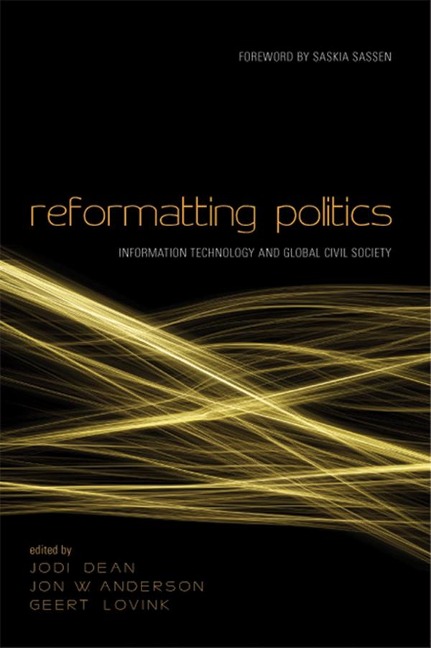
This book examines the ways in which new information and communication technologies (ICTs) are being used by civil society organizations (CSOs) to achieve their aims through activities and networks that cross national borders. These new ICTs (the internet, mobile phones, satellite radio and television) have allowed these civil society organizations to form extensive networks linking the local and the global in new ways and to flourish internationally in ways that were not possible without them. Reformatting Politics consists of four sections containing essays by some of the top scholars and activists working at the intersections of networked societies, civil society organizations, and information technology. The book also includes a section that takes a critical look at the UN World Summit of Information Society and the role that global governance has played and will play in the use and dissemination of these new technologies. Finally, the contributors aim to influence this important and emerging field of inquiry by posing a set of questions and directions for future research. In sum, Reformatting Politics is a fresh look at the way critical network practice through the use of information technology is reformatting the terms and terrains of global politics.
JON W. ANDERSON is an anthropologist, has taught in Germany and Norway, and currently is Professor and Chair of Anthropology at the Catholic University of America. He is co-director of the Arab Information Project with Michael C. Hudson at Georgetown University's Center for Contemporary Arab Studies. JODI DEAN teaches political theory at Hobart and William Smith Colleges. She serves on the editorial board of the journals Theory and Event and Constellations and has edited symposia on new technologies for the journals Constellations and Signs as well as the books Feminism and the New Democracy (Sage 1997) and Cultural Studies and Political Theory (Cornell UP 2000). GEERT LOVINK is founder and director of the Institute of Network Cultures (www.networkcultures.org), professor at Interactive Media (Hogeschool van Amsterdam) and associate professor at the Media & Culture department, University of Amsterdam.
Introduction: The Postdemocratic Governmentality of Networked Societies Part 1: Networks 1. Network is Format Work: The Issue-Network as a Site of Politics and the Challenge of Making Info-Technology Part of Civil Society 2. Organized Networks and Non-Representative Democracy 3. Power Logs, Weblogs, and Inequality 4. The Packet Gang: Openness and its Discontents 5. Anybody Can Be on TV Part 2: Sites 6. Communicating Islamic Fundamentalism as Global Citizenship 7. Lost in Transition: the Internet and Reformasi in Indonesia 8. Exploring the Potential for More Strategic Civil Society Use of Mobile Phones 9. The Potential Role of IT in International Remittance Transfers 10. Network Society and Network Organizations Part 3: Formats 11. Understanding WSIS: An Institutional Analysis of the UN World Summit on the Information Society 12. The End of the Experiment: How ICANN's Foray into Global Internet Democracy Failed 13. Debating Communication Imbalances: from the MacBride Report to WSIS 14. Interview with Milton Mueller: Trial and Error in Internet Governance
Dieses eBook wird im PDF-Format geliefert und ist mit einem Adobe Kopierschutz (DRM) versehen. Sie können dieses eBook mit allen Geräten lesen, die das PDF-Format und den Adobe Kopierschutz (DRM) unterstützen.
Zum Beispiel mit den folgenden Geräten:
• tolino Reader
Laden Sie das eBook direkt über den Reader-Shop auf dem tolino herunter oder übertragen Sie das eBook auf Ihren tolino mit einer kostenlosen Software wie beispielsweise Adobe Digital Editions.
• Sony Reader & andere eBook Reader
Laden Sie das eBook direkt über den Reader-Shop herunter oder übertragen Sie das eBook mit der kostenlosen Software Sony READER FOR PC/Mac oder Adobe Digital Editions auf ein Standard-Lesegeräte mit epub- und Adobe DRM-Unterstützung.
• Tablets & Smartphones
Möchten Sie dieses eBook auf Ihrem Smartphone oder Tablet lesen, finden Sie hier unsere kostenlose Lese-App für iPhone/iPad und Android Smartphone/Tablets.
• PC & Mac
Lesen Sie das eBook direkt nach dem Herunterladen mit einer kostenlosen Lesesoftware, beispielsweise Adobe Digital Editions, Sony READER FOR PC/Mac oder direkt über Ihre eBook-Bibliothek in Ihrem Konto unter „Meine eBooks“ - „online lesen“.
Schalten Sie das eBook mit Ihrer persönlichen Adobe ID auf bis zu sechs Geräten gleichzeitig frei.
Bitte beachten Sie, dass die Kindle-Geräte das Format nicht unterstützen und dieses eBook somit nicht auf Kindle-Geräten lesbar ist.