Und dann auf "Zum Home-Bildschirm [+]".

Stöbern
genialokal zum Startbildschirm hinzufügen
Installieren Sie die genialokal App auf Ihrem Startbildschirm für einen schnellen Zugriff und eine komfortable Nutzung.
Installieren Sie die genialokal App auf Ihrem Startbildschirm für einen schnellen Zugriff und eine komfortable Nutzung.
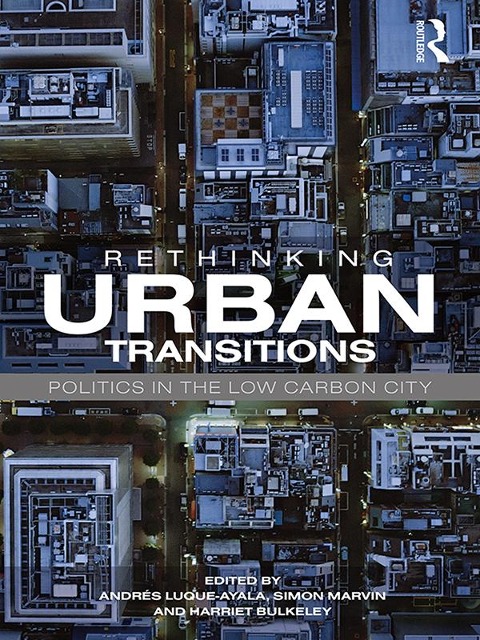
Rethinking Urban Transitions provides critical insight for societal and policy debates about the potential and limits of low carbon urbanism. It draws on over a decade of international research, undertaken by scholars across multiple disciplines concerned with analysing and shaping urban sustainability transitions. It seeks to open up the possibility of a new generation of urban low carbon transition research, which foregrounds the importance of political, geographical and developmental context in shaping the possibilities for a low carbon urban future. The book's contributions propose an interpretation of urban low carbon transitions as primarily social, political and developmental processes. Rather than being primarily technical efforts aimed at measuring and mitigating greenhouse gases, the low carbon transition requires a shift in the mode and politics of urban development. The book argues that moving towards this model requires rethinking what it means to design, practise and mobilize low carbon in the city, while also acknowledging the presence of multiple and contested developmental pathways. Key to this shift is thinking about transitions, not solely as technical, infrastructural or systemic shifts, but also as a way of thinking about collective futures, societal development and governing modes - a recognition of the political and contested nature of low carbon urbanism. The various contributions provide novel conceptual frameworks as well as empirically rich cases through which we can begin to interrogate the relevance of socio-economic, political and developmental dimensions in the making or unmaking of low carbon in the city. The book draws on a diverse range of examples (including 'world cities' and 'ordinary cities') from North America, South America, Europe, Australia, Africa, India and China, to provide evidence that expectations, aspirations and plans to undertake purposive socio-technical transitions are both emerging and encountering resistance in different urban contexts. Rethinking Urban Transitions is an essential text for courses concerned with cities, climate change and environmental issues in sociology, politics, urban studies, planning, environmental studies, geography and the built environment.
Andrés Luque-Ayala is an Assistant Professor in the Department of Geography at Durham University, UK. Simon Marvin is Director of the Urban Institute and Professor at the University of Sheffield, UK. Harriet Bulkeley is Professor in the Department of Geography at Durham University, UK.
1. Introduction Andrés Luque-Ayala, Simon Marvin and Harriet Bulkeley 2. Rethinking urban transitions: an analytical framework Andrés Luque-Ayala, Harriet Bulkeley and Simon Marvin Part I: Technologies, materialities, infrastructures 3. Seeking effective infrastructures of decarbonisation in Paris: material politics of socio-technical change Jonathan Rutherford 4. Legacies of energy autarky for low carbon urban transitions: a comparison of Berlin and Hong Kong Tim Moss and Maria Francesch-Huidobro 5. The amenable city-region: the symbolic rise and the relative decline of Greater Manchester's low carbon commitments, 2006-2017 Mike Hodson, Simon Marvin and Andy McMeekin 6. What is 'carbon neutral'? Planning urban deep decarbonisation in North America Laura Tozer Part II: Intermediation and governance 7. Reconfiguring spatial boundaries and institutional practices: mobilizing and sustaining urban low carbon transitions in Victoria, Australia Susie Moloney and Ralph Horne 8. Strong local government moving to the market? The case of low carbon futures in the city of Örebro, Sweden Mikael Granberg 9. Examining urban Africa's low-carbon and energy transition pathways Jonathan Silver and Simon Marvin 10. Localising environmental governance in India: mapping urban institutional structures Neha Sami Part III: Communities and subjectivities 11. Governing carbon conduct and subjects: insights from Australian cities Robyn Dowling, Pauline McGuirk and Harriet Bulkeley 12. Cultural conflicts and decarbonisation pathways: urban intensification politics as a site of contestation in Ottawa Matthew Paterson and Merissa Mueller 13. Postdevelopment carbon Andrés Luque-Ayala Conclusions 14. Conclusions Simon Marvin, Andrés Luque-Ayala and Harriet Bulkeley Index
Dieses eBook wird im PDF-Format geliefert und ist mit einem Adobe Kopierschutz (DRM) versehen. Sie können dieses eBook mit allen Geräten lesen, die das PDF-Format und den Adobe Kopierschutz (DRM) unterstützen.
Zum Beispiel mit den folgenden Geräten:
• tolino Reader
Laden Sie das eBook direkt über den Reader-Shop auf dem tolino herunter oder übertragen Sie das eBook auf Ihren tolino mit einer kostenlosen Software wie beispielsweise Adobe Digital Editions.
• Sony Reader & andere eBook Reader
Laden Sie das eBook direkt über den Reader-Shop herunter oder übertragen Sie das eBook mit der kostenlosen Software Sony READER FOR PC/Mac oder Adobe Digital Editions auf ein Standard-Lesegeräte mit epub- und Adobe DRM-Unterstützung.
• Tablets & Smartphones
Möchten Sie dieses eBook auf Ihrem Smartphone oder Tablet lesen, finden Sie hier unsere kostenlose Lese-App für iPhone/iPad und Android Smartphone/Tablets.
• PC & Mac
Lesen Sie das eBook direkt nach dem Herunterladen mit einer kostenlosen Lesesoftware, beispielsweise Adobe Digital Editions, Sony READER FOR PC/Mac oder direkt über Ihre eBook-Bibliothek in Ihrem Konto unter „Meine eBooks“ - „online lesen“.
Schalten Sie das eBook mit Ihrer persönlichen Adobe ID auf bis zu sechs Geräten gleichzeitig frei.
Bitte beachten Sie, dass die Kindle-Geräte das Format nicht unterstützen und dieses eBook somit nicht auf Kindle-Geräten lesbar ist.