
Stöbern
genialokal zum Startbildschirm hinzufügen
Installieren Sie die genialokal App auf Ihrem Startbildschirm für einen schnellen Zugriff und eine komfortable Nutzung.
Installieren Sie die genialokal App auf Ihrem Startbildschirm für einen schnellen Zugriff und eine komfortable Nutzung.
Tippen Sie einfach auf Teilen:
 Und dann auf "Zum Home-Bildschirm [+]".
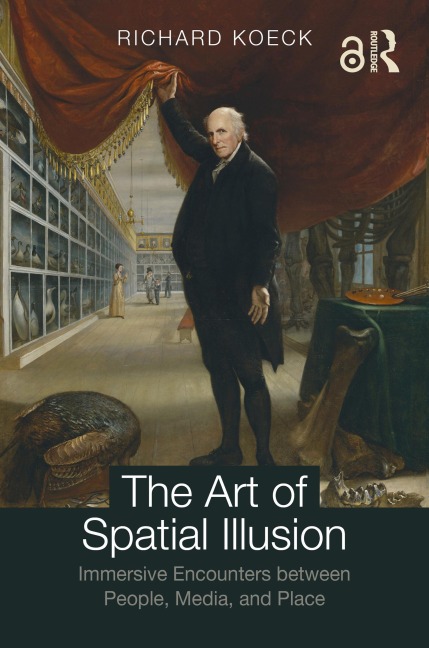
Contemporary art, entertainment, and architecture cultures offer a growing amount of digitally mediated spatial experiences, situated either in the metaverse (e.g. VR) or location-based in physical realms (e.g. AR), increasingly powered by generative systems (e.g. AI). Are such spatially "immersive experiences" a new phenomenon and dependent on digital innovation? The Art of Spatial Illusion: Immersive Encounters between People, Media, and Place is an insightful exploration of the evolving relationship between humans, media, and spatial environments, tracing their progression from the Renaissance, via Modernity and Postmodernity, to today's digital age. The author offers a compelling reading and re-evaluation of architectural history and media theory, drawing connections between historical practices, technological innovations, and contemporary immersive experiences. Inspired by scholars such as Walter Benjamin and Jean Baudrillard, the book discusses how technological advancements have transformed our situatedness in "image-spaces", highlighting the shift from material authenticity to digital reproductions. The book is structured into four parts - The Surface, The Stage, The Interface, and The Hybrid - each exploring different aspects of spatial illusions and their implications. It offers a critical perspective on the creation of architectural, immersive environments, examining the motivations behind them and their broader cultural and political contexts. Richly illustrated and deeply researched, The Art of Spatial Illusion is an essential reading for anyone interested in architecture and art as well as media archaeology, history, and theory. Seeing new, thought-provoking architectural propositions emerging on our horizon, the author provides a comprehensive understanding of how immersive experiences shape our perception of reality. Chapter 3 of this book is freely available as a downloadable Open Access PDF at http://www.taylorfrancis.com under a Creative Commons (CC-BY) 4.0 license.
Richard Koeck is Professor and Chair in Architecture and the Visual Arts in the School of Architecture at the University of Liverpool. He is also Director of CAVA | Centre for Architecture and the Visual Arts and founding director of the film/media company CineTecture in the UK. He is author of Cine-Scapes (2013) and co-/editor of several books on film and architecture. His cross-disciplinary R&D innovation and UKRI expertise is situated at the intersection of space, media, and culture with a particular interest in digital/immersive spaces. He led and collaborated on large projects in the architecture, creative arts, and entertainment sectors in the UK, China, and Singapore.
PART 1: The Surface | Screen Image Illusions 1. 16/17th c. Theaters of the World: Curiosity Cabinets and Whispering Chambers 2. 18th c. Panoramic Space: Barker and the Re-Representation of Power 3. 19th c. Panoramic Precision: The Colosseum of Hornor and Parris PART 2: The Stage | Moving Image Immersions 4. Arrival in the Age of Moving Spectacles 5. Paris 1900: Spatial Illusions and Immersive Experiences 6. Early Cinema: Producing Moving Image Simulations PART 3: The Interface | Architecture and Place Experiences 7. Pre-Modern: Spaces of Purpose, Image and Performace 8. Modern: Immersed in Abstract Spaces, Signs and Systems 9. Post-Modern: Sign, Screens and Pixels Conclusion: The Hybrid | Beyond the Screen 10. Hybridized Realities: The Rise of Screen Corporeality 11. Concluding Remarks
Dieses eBook wird im PDF-Format geliefert und ist mit einem Adobe Kopierschutz (DRM) versehen. Sie können dieses eBook mit allen Geräten lesen, die das PDF-Format und den Adobe Kopierschutz (DRM) unterstützen.
Zum Beispiel mit den folgenden Geräten:
• tolino Reader
Laden Sie das eBook direkt über den Reader-Shop auf dem tolino herunter oder übertragen Sie das eBook auf Ihren tolino mit einer kostenlosen Software wie beispielsweise Adobe Digital Editions.
• Sony Reader & andere eBook Reader
Laden Sie das eBook direkt über den Reader-Shop herunter oder übertragen Sie das eBook mit der kostenlosen Software Sony READER FOR PC/Mac oder Adobe Digital Editions auf ein Standard-Lesegeräte mit epub- und Adobe DRM-Unterstützung.
• Tablets & Smartphones
Möchten Sie dieses eBook auf Ihrem Smartphone oder Tablet lesen, finden Sie hier unsere kostenlose Lese-App für iPhone/iPad und Android Smartphone/Tablets.
• PC & Mac
Lesen Sie das eBook direkt nach dem Herunterladen mit einer kostenlosen Lesesoftware, beispielsweise Adobe Digital Editions, Sony READER FOR PC/Mac oder direkt über Ihre eBook-Bibliothek in Ihrem Konto unter „Meine eBooks“ - „online lesen“.
Schalten Sie das eBook mit Ihrer persönlichen Adobe ID auf bis zu sechs Geräten gleichzeitig frei.
Bitte beachten Sie, dass die Kindle-Geräte das Format nicht unterstützen und dieses eBook somit nicht auf Kindle-Geräten lesbar ist.