Und dann auf "Zum Home-Bildschirm [+]".

Stöbern
genialokal zum Startbildschirm hinzufügen
Installieren Sie die genialokal App auf Ihrem Startbildschirm für einen schnellen Zugriff und eine komfortable Nutzung.
Installieren Sie die genialokal App auf Ihrem Startbildschirm für einen schnellen Zugriff und eine komfortable Nutzung.
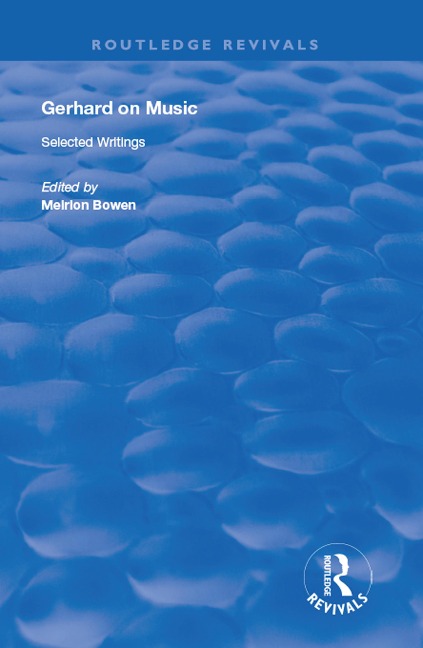
This title was first published in 2000: Catalan-born composer Roberto Gerhard (1896-1970) left significant legacies - both musical and documentary. Exiled in Cambridge with the onset of the Spanish Civil War, he gradually achieved wide recognition by performers and conductors, in both Britain and America, as a composer whose music was essential to the modern repertoire. In this work, the author collects many of the composer's articles, reviews, lectures and broadcasts to demonstrate the full extent and continuity of Gerhard's artistic and creative thinking. The writings have been arranged thematically to emphasize the evolution of Gerhard's musical interests. His attachment to Spanish and Catalonian traditions broadened into a fascination with folk music of all kinds. His studies with Schoenberg in the mid 1920s gave him the key to his own creative individuality; thereafter, his imaginative vitality led him eventually to experiment with electronic and concrete music and he continued breaking new ground, even in his final years.
Meirion Bowen Roberto Gerhard
Part I: Composer and Public. 1. Listening to Music (1930). 2. The Composer and his audience (1960). 3. Second and Symbol (1957). 4. The Contemporary Musical Situation (1956). Part II: Tradition and Innovation. Music at the court of Alfonso V the Magnanimous (1936). 6. A Note on Felipe Pedrell (c. 1940). 7. New Musical Methods (1930). 8. Music and Poetry (1935). Part III: Contemporary Composers (1929-1939). 9. Hanns Eisler (1898-1982). 10. Bartok. 11. Ildebrando Pizzetti. 12. Baltasa Samper. 13. Some Composers from Madrid. Part IV: Music and Drama. 14. Opera (1930). 15. Music and Film (1930). 16. The Duenna (1949). 17. Music and Ballet. Part V: New Horizons. 18. Schoenberg, Twelve-note Music and Serialism. 19. On Composition with Twelve Notes (1954). 20. Tonality in Twelve-tone Music (1952). 21. Developments in Twelve-tone Technique (1956). 22. Alban Ber: Obituary (1936). 23. Webern. 24. Twelve-note Technique in Stravinsky (1957). 25. Functions of the Series in Twelve-note Composition (1960). Part VI: Music in a Post-War Context. 26. England, Spring 1945. 27. Concrete Music and Electronic Sound Composition (1959). 28. Sound Observed (1965). 29. The Plague (1964). 30. Introduction to Symphony No. 2 (1959). 31. "Is Modern Music Growing Old?" (1960). 32. Art and Anarchy (1961). 33. The Muse and Music Today (1962). 34. An Inaugrual Lecture (1961).
Dieses eBook wird im PDF-Format geliefert und ist mit einem Adobe Kopierschutz (DRM) versehen. Sie können dieses eBook mit allen Geräten lesen, die das PDF-Format und den Adobe Kopierschutz (DRM) unterstützen.
Zum Beispiel mit den folgenden Geräten:
• tolino Reader
Laden Sie das eBook direkt über den Reader-Shop auf dem tolino herunter oder übertragen Sie das eBook auf Ihren tolino mit einer kostenlosen Software wie beispielsweise Adobe Digital Editions.
• Sony Reader & andere eBook Reader
Laden Sie das eBook direkt über den Reader-Shop herunter oder übertragen Sie das eBook mit der kostenlosen Software Sony READER FOR PC/Mac oder Adobe Digital Editions auf ein Standard-Lesegeräte mit epub- und Adobe DRM-Unterstützung.
• Tablets & Smartphones
Möchten Sie dieses eBook auf Ihrem Smartphone oder Tablet lesen, finden Sie hier unsere kostenlose Lese-App für iPhone/iPad und Android Smartphone/Tablets.
• PC & Mac
Lesen Sie das eBook direkt nach dem Herunterladen mit einer kostenlosen Lesesoftware, beispielsweise Adobe Digital Editions, Sony READER FOR PC/Mac oder direkt über Ihre eBook-Bibliothek in Ihrem Konto unter „Meine eBooks“ - „online lesen“.
Schalten Sie das eBook mit Ihrer persönlichen Adobe ID auf bis zu sechs Geräten gleichzeitig frei.
Bitte beachten Sie, dass die Kindle-Geräte das Format nicht unterstützen und dieses eBook somit nicht auf Kindle-Geräten lesbar ist.