Und dann auf "Zum Home-Bildschirm [+]".

Stöbern
genialokal zum Startbildschirm hinzufügen
Installieren Sie die genialokal App auf Ihrem Startbildschirm für einen schnellen Zugriff und eine komfortable Nutzung.
Installieren Sie die genialokal App auf Ihrem Startbildschirm für einen schnellen Zugriff und eine komfortable Nutzung.

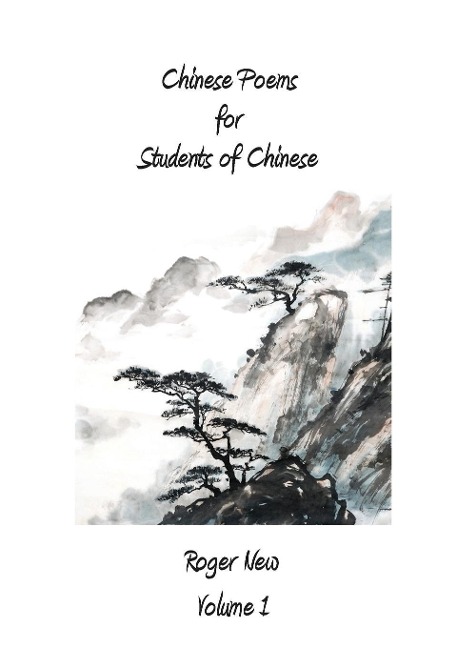
Summary This is a book to help students of Chinese increase their familiarity with Chinese culture and strengthen their command of the language. The book presents, in a unique format, 28 short couplets (5 character or 7 character cut-shorts) comprising Chinese poems all very well known to Chinese nationals. Explanatory notes for each poem are provided in English, and translations are given at the end of the book. This is an ideal textbook for both students and teachers wanting to incorporate Chinese poetry into their study curriculum. Blurb This is a book that every student of Chinese will want to buy. For the first time, Chinese poems are presented in an accessible form, with the characters, their pronunciation, and their English meaning all alongside each other, together with text in English providing insight on the poet, the cultural context and historical background for each one. English versions of all the poems are at the end of the book. Poems are an important part of Chinese culture, and the ones included here are some of the best known, studied by Chinese schoolchildren from an early age. For foreign students of Chinese, these poems present a unique opportunity to get to know the culture and to strengthen their command of the language at the same time. All of the poems here are classics, and their study provides an entry into Chinese literature far more readily than immersion in weighty novels. Each poem is short and easy to assimilate; memorising the poems, both to write and to declaim, helps to embed the characters in the mind, and to build up confidence in reading, writing and speaking the language. The poems are presented in such a way that the tools are available to understand each one, but the reader has the opportunity to come to their own conclusion as to the interpretation of the poem - in exactly the same way as an established scholar of Chinese might do. Reading a Chinese poem is a bit like solving a riddle, and indeed, the information and clues provided here are sufficient to allow even someone with no previous knowledge of Chinese to appreciate the beauty of these poems.
The author has lived and worked in China since the early nineteen eighties, spending extensive periods of time in Guangdong and Xinjiang, as well as Beijing and Shanghai. He is an academic, starting out at Oxford and London, with a PhD in immunology in 1975, pursuing a varied career in science, and setting up a biotechnology company in 2000, where he is currently working. In addition to fluent Mandarin, he speaks Russian and Portuguese, and has lectured in all of these. It is the experience of studying these languages which he considers most qualifies him for the writing of this book.
Preface Acknowledgements Chronology of Poets Featured 1. Searching for a hermit, and not finding him - Jia Dao (Tang); 2. Seven step stanza - Cao Zhi (Wei); 3. Pity the toiler - Li Shen (Tang); 4. Spring dawn - Meng Hao Ran (Tang); 5. Returning home - He Zhi Zhang (Tang); 6. Grass - Bai Ju Yi (Tang); 7. Staying a night on the mountain - Li Bai (Tang); 8. Quiet thoughts - Li Bai (Tang); 9. Sitting alone on Jing Ting mountain - Li Bai (Tang); 10. Deserted southern slope - Su Shi (Song); 11. Producing a grandson - Wang An Shi (Song); 12. Deer enclosure - Wang Wei (Tang); 13. Meng Cheng Pass - Wang Wei (Tang); 14. Ascending Crane Tower - Wang Zhi Huan (Tang); 15. An autumn evening - Du Mu (Tang); 16. Having an appointment - Zhao Shi Xiu (Tang); 17. Poem - Du Fu (Tang); 18. Dusk on the river - Bai Ju Yi (Tang); 19. Autumn Cove - Li Bai (Tang); 20. Bamboo branch verse - Liu Yu Xi (Tang); 21. Parting: number 2 - Du Mu (Tang); 22. Mooring at night by maple bridge - Zhang Ji (Tang); 23. Spring dusk - Cao Bin (Song); 24. Visiting a garden, but not stopping - Ye Shao Weng (Song); 25. Clear Spring - Wang Jia (Tang); 26. On the lake - Xu Yuan Jie (Tang); 27. Le You Grounds - Li Shang Yin (Tang); 28. Leaving early from Bai Di city - Li Bai (Tang); Discussion of the An Lu Shan Rebellion Renditions of Poems in English