
Stöbern
genialokal zum Startbildschirm hinzufügen
Installieren Sie die genialokal App auf Ihrem Startbildschirm für einen schnellen Zugriff und eine komfortable Nutzung.
Installieren Sie die genialokal App auf Ihrem Startbildschirm für einen schnellen Zugriff und eine komfortable Nutzung.
Tippen Sie einfach auf Teilen:
 Und dann auf "Zum Home-Bildschirm [+]".

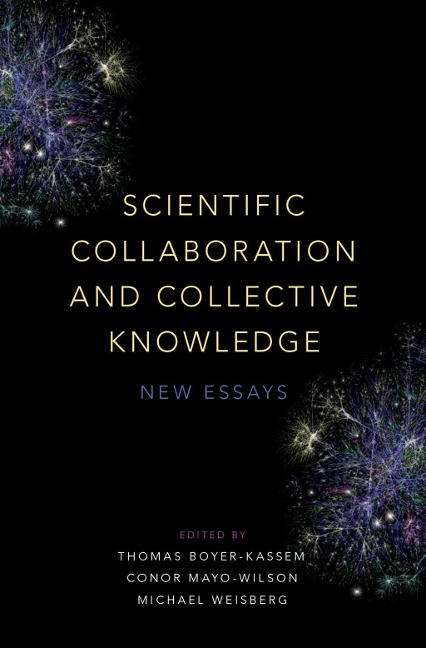
Descartes once argued that, with sufficient effort and skill, a single scientist could uncover fundamental truths about our world. Contemporary science proves the limits of this claim. From synthesizing the human genome to predicting the effects of climate change, some current scientific research requires the collaboration of hundreds (if not thousands) of scientists with various specializations. Additionally, the majority of published scientific research is now co-authored, including more than 80% of articles in the natural sciences, meaning small collaborative teams have become the norm in science. This volume is the first to address critical philosophical questions regarding how collective scientific research could be organized differently and how it should be organized. For example, should scientists be required to share knowledge with competing research teams? How can universities and grant-giving institutions promote successful collaborations? When hundreds of researchers contribute to a discovery, how should credit be assigned - and can minorities expect a fair share? When collaborative work contains significant errors or fraudulent data, who deserves blame? In this collection of essays, leading philosophers of science address these critical questions, among others. Their work extends current philosophical research on the social structure of science and contributes to the growing, interdisciplinary field of social epistemology. The volume's strength lies in the diversity of its authors' methodologies. Employing detailed case studies of scientific practice, mathematical models of scientific communities, and rigorous conceptual analysis, contributors to this volume study scientific groups of all kinds, including small labs, peer-review boards, and large international collaborations like those in climate science and particle physics.
Thomas Boyer-Kassem is an AXA post-doctoral research fellow at TiLPS, Tilburg University, The Netherlands. He holds a PhD in philosophy (Paris 1, 2011) and a Master in physics (ÉNS de Cachan, 2006). He has published articles in philosophy of science, social epistemology, and decision theory, in particular on scientific collaboration and publication strategies. Conor Mayo-Wilson is Assistant Professor of Philosophy at the University of Washington. His primary interests are in epistemology, philosophy of science, philosophy of mathematics, and logic. Michael Weisberg is Professor and Chair of Philosophy at the Univeristy of Pennsylvania, where he co-directs the Penn Laboratory for Understanding Science.
Part I: Sharing knowledge 1. Scientific Sharing: Communism and the Social Contract Michael Strevens 2. Publish Late, Publish Rarely! Network Density and Group Performance in Scientific Communication Staffan Angere and Erik J. Olsson Part II: Forming collaborations 1. Learning to collaborate Kevin Zollman 2. Diversity, Rationality and the Division of Cognitive Labor Ryan Muldoon Part III: Authorship and refereeing in collaborative research 1. Making an Author in Radically Collaborative Research Bryce Huebner, Rebecca Kukla and Eric Winsberg 2. The Impact of Collaboration on the Epistemic Cultures of Science K. Brad Wray 3. Power, Bargaining, and Collaboration Justin Bruner and Cailin O'Connor Part IV: From individual to collection opinion 1. A Clustering-Based Approach to Collective Beliefs Denis Bonnay 2. Opinion Aggregation and Individual Expertise Carlo Martini and Jan Sprenger