Und dann auf "Zum Home-Bildschirm [+]".

Stöbern
genialokal zum Startbildschirm hinzufügen
Installieren Sie die genialokal App auf Ihrem Startbildschirm für einen schnellen Zugriff und eine komfortable Nutzung.
Installieren Sie die genialokal App auf Ihrem Startbildschirm für einen schnellen Zugriff und eine komfortable Nutzung.
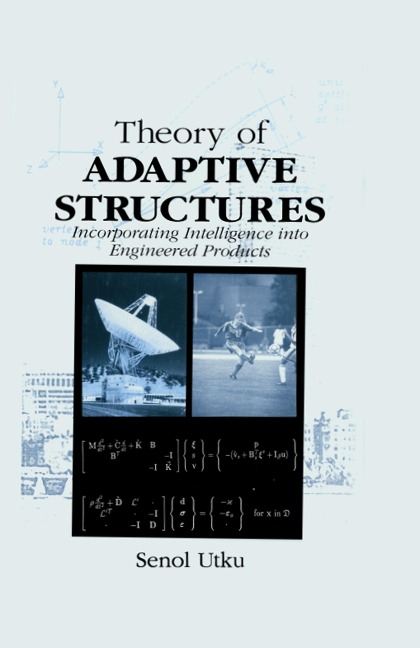
Theory of Adaptive Structures provides the basic theory for controlling adaptive structures in static and dynamic environments. It synthesizes well-established theories on modern control as well as statics and dynamics of deformable bodies. Discussions concentrate on the discrete parameter adaptive structures dealing with actuator placement, actuator selection, and actuation computation problems - keeping these structures at close proximity of any chosen nominal state with the least energy consumption. An introduction to the distributed parameter adaptive structures is also provided. The book follows that modern trend in research and industry striving to incorporate intelligence into engineered products through microprocessors that are becoming smaller, faster, and cheaper at astounding rates. Not using them in engineered products may become an enormous liability. Resulting from the advances in materials technology on sensors and actuator technologies as well as the availability of very powerful and reliable microprocessors, there is an ever-increasing interest in actively controlling the behavior of engineering systems. Engineers and engineering scientists must revive and broaden their activities to maximize applications for predicting and controlling the behavior of deformable bodies. Topics include:- An introduction to adaptive structures - Incremental excitation-response relations in static and dynamic cases - Active control of response in static case - Statically determinate adaptive structures - Statically indeterminate adaptive structures - Active vibration control for autonomous and non-autonomous cases - Active control against wind - Active control against seismic loads - Distributed parameter adaptive structures The technology of adaptive structures has created an environment where the analysis, not the computation, of structural response - du
Senol Utku, W.F. Chen
Preface Introduction History Definitions Types of Structures Types of Problems Qualitative Analysis in State Space Constituents of Adaptive Structures Objectives, Scope, and Outline Incremental Excitation-Response Relations, Static Case Basic Definitions Equilibrium of Forces Geometric Relations Stiffness Relations of Elements Incremental Excitation-Response Relations Active Control of Response, Static Case Inverse Relations Actuators of Adaptive Structures Basic Equations for Adaptive Structures Actuator Locations and Controls Observed Response Components and Output Determination of Controls Fate of Unobserved Response Components Control Energy Compatibility of Controls in Adaptive Structures Recapitulation Statically Determinate Adaptive Structures Excitation-Response Relations Observed Response Components and Disturbances Actuators and Controls Actuator Placement and Control Problems Actuator Placement and Control Computation When q=p
Dieses eBook wird im PDF-Format geliefert und ist mit einem Adobe Kopierschutz (DRM) versehen. Sie können dieses eBook mit allen Geräten lesen, die das PDF-Format und den Adobe Kopierschutz (DRM) unterstützen.
Zum Beispiel mit den folgenden Geräten:
• tolino Reader
Laden Sie das eBook direkt über den Reader-Shop auf dem tolino herunter oder übertragen Sie das eBook auf Ihren tolino mit einer kostenlosen Software wie beispielsweise Adobe Digital Editions.
• Sony Reader & andere eBook Reader
Laden Sie das eBook direkt über den Reader-Shop herunter oder übertragen Sie das eBook mit der kostenlosen Software Sony READER FOR PC/Mac oder Adobe Digital Editions auf ein Standard-Lesegeräte mit epub- und Adobe DRM-Unterstützung.
• Tablets & Smartphones
Möchten Sie dieses eBook auf Ihrem Smartphone oder Tablet lesen, finden Sie hier unsere kostenlose Lese-App für iPhone/iPad und Android Smartphone/Tablets.
• PC & Mac
Lesen Sie das eBook direkt nach dem Herunterladen mit einer kostenlosen Lesesoftware, beispielsweise Adobe Digital Editions, Sony READER FOR PC/Mac oder direkt über Ihre eBook-Bibliothek in Ihrem Konto unter „Meine eBooks“ - „online lesen“.
Schalten Sie das eBook mit Ihrer persönlichen Adobe ID auf bis zu sechs Geräten gleichzeitig frei.
Bitte beachten Sie, dass die Kindle-Geräte das Format nicht unterstützen und dieses eBook somit nicht auf Kindle-Geräten lesbar ist.