
Stöbern
genialokal zum Startbildschirm hinzufügen
Installieren Sie die genialokal App auf Ihrem Startbildschirm für einen schnellen Zugriff und eine komfortable Nutzung.
Installieren Sie die genialokal App auf Ihrem Startbildschirm für einen schnellen Zugriff und eine komfortable Nutzung.
Tippen Sie einfach auf Teilen:
 Und dann auf "Zum Home-Bildschirm [+]".

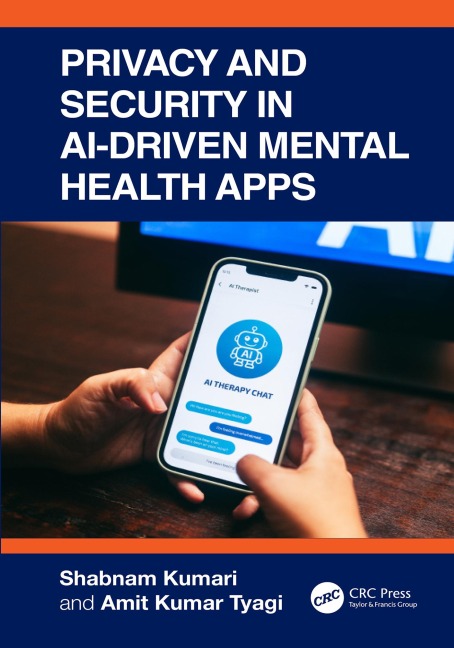
Today, privacy and security are increasingly important in the expanding landscape of AI-driven mental health technology. As the use of AI-driven solutions in mental health treatment advances, questions about the ethical management of sensitive data, user privacy and system vulnerabilities have emerged as serious challenges. This book provides a comprehensive investigation of these issues, addressing how privacy-preserving approaches and secure systems can maintain trust, transparency and ethical integrity in mental health applications. The book covers a broad range of subjects. It begins with an introduction to mental health applications and their integration with AI technology, followed by a detailed discussion of the types of data collected, including sensitive behavioral, physiological and psychological data. It then analyses privacy threats, such as data breaches and misuse of personal information, and security problems, including cyberattacks and vulnerabilities in AI systems. Several chapters cover advanced solutions, including encryption approaches, differential privacy, blockchain integration and federated learning, as well as the importance of regulatory frameworks such as the General Data Protection Regulation (GDPR) and the Health Insurance Portability and Accountability Act (HIPAA). Case studies of real-world applications are also included to illustrate both successes and failures in privacy and security. The final sections cover future directions, ethical issues and recommendations for developers, clinicians and policymakers. With contributions from specialists across disciplines, this book serves as an important resource for understanding the convergence of AI, mental health and data security, seeking to stimulate innovation while respecting user rights.
Shabnam Kumari is working as Ph.D. Research Scholar in Department of Computer Science, SRM Institute of Science and Technology, Chennai, Tamil Nadu, India. She has more than 6 years of experience including teaching, research and other areas. She has completed her MCA from YMCA University of Science and Technology, Faridabad. She has filed more than five national and international patents in the area of IoTs, Machine Learning, Deep Learning and Wireless Network. She has published twenty plus research articles in International Conferences and Journals. Her areas of interest include Machine Learning, Deep Learning, and related fields. She is a lifetime member of ACM-Women and SCRS. Amit Kumar Tyagi is working as an Assistant Professor, at National Forensic Sciences University, Gandhinagar, Gujarat, India. He received his Ph.D. Degree (Full-Time) in 2018 from Pondicherry Central University, 605014, Puducherry, India. About his academic experience, he has worked as an assistant professor at several institutes like Lord Krishna College of Engineering (LKCE), Ghaziabad (for the periods of July 2009- July 2010, and October 2012- October 2013), Lingaya's Vidyapeeth (formerly known as Lingaya's University), Faridabad (September 2018- May 2019), VIT Chennai (June 2019- November 2022) and NIFT New Delhi (November 2022- September 2025). His supervision experience includes more than 10 Masters' dissertations and one PhD thesis. He has contributed to several projects such as "AARIN" and "P3- Block" to address some of the open issues related to the privacy breaches in Vehicular Applications (such as Parking) and Medical Cyber Physical Systems (MCPS). He has done more than 60 Edited and authored books and collaborated with eminent professors across the world from top QS ranked university. Also, He has published over 350 research articles in refereed high impact journals, conferences and books, and some of his articles has been awarded as best paper awards. Also, he has filed more than 15 patents (Nationally and Internationally) in the area of Deep Learning, Internet of Things, Cyber Physical Systems and Computer Vision. He is a Winner of Faculty Research Award for the Year of 2020, 2021 and 2022 (consecutive three years) given by Vellore Institute of Technology, Chennai, Tamilnadu, India. His current research focuses on Next Generation Machine Based Communications, Blockchain Technology, Smart and Secure Computing and Privacy. He is a senior member of IEEE.
Part I. Foundations and Context, 1. The Role of Artificial Intelligence in Modern Mental Healthcare, 2. The Digital Transformation of Mental Health Services, 3. Data Privacy and Security in AI-Driven Mental Health Ecosystems, 4. Ethical, Legal, and Regulatory Frameworks in AI-Driven Mental Health, Part II. Technical Foundations and Data Management, 5. AI Models and Algorithms for Mental Health Applications, 6. Secure Data Infrastructure and System Architecture, 7. Privacy-Preserving Data Processing and Sharing, 8. Federated Learning and Edge Computing for AI-Enabled Mental Health, Part III. Privacy Risks, Ethics, and Trust, 9. Risk Assessment and Threat Modeling in AI-Driven Mental Health, 10. Data Breaches, User Trust, and Psychological Safety, 11. Bias, Fairness, and Cultural Sensitivity in AI Systems, 12. Ethical and Psychological Implications of AI Surveillance, Part IV. Governance, Transparency, and Accountability, 13. Explainable AI and Transparency in Clinical Decision-Making, 14. Digital Consent, Autonomy, and Identity Management, 15. Accountability, Auditing, and Compliance Mechanisms, Part V. Future Directions, 16. Balancing Innovation, Ethics, and Security in the Future of AI-Driven Mental Health, 17. Conclusion