
Stöbern
genialokal zum Startbildschirm hinzufügen
Installieren Sie die genialokal App auf Ihrem Startbildschirm für einen schnellen Zugriff und eine komfortable Nutzung.
Installieren Sie die genialokal App auf Ihrem Startbildschirm für einen schnellen Zugriff und eine komfortable Nutzung.
Tippen Sie einfach auf Teilen:
 Und dann auf "Zum Home-Bildschirm [+]".
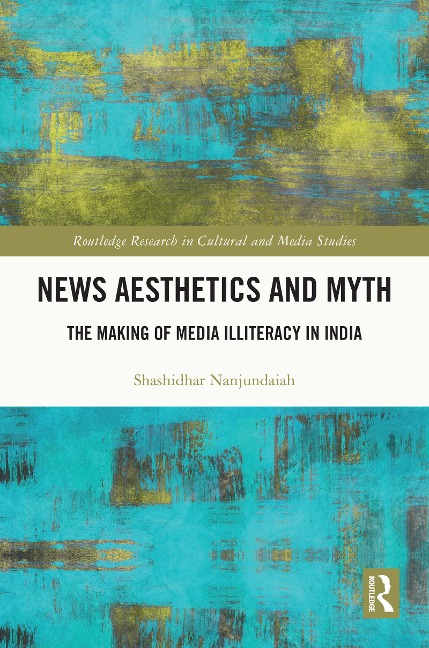
This book considers the presence of media illiteracy in a world in which we are supposedly consumed by media, live a media life, in a media ecosystem, surrounded by mediated communication. Unpacking this paradoxical situation, the author proposes that before venturing into media literacy, we must first understand the workings of how mystification occurs. Departing from the idea that aesthetics work on an agreed set of principles between art and society, the author applies this ideology of aesthetics to news-based narration. Using empirical cases from India, the author proposes demystification as a possible methodology to approach media illiteracy and recommends completely transformed media literacy programs that deliver to communities, drawing from the construct of critical pedagogy. The book offers the possibilities for a collectivistic, non-Western, postcolonialist model of learning by using the very collective and hierarchical identities of societies that must be critiqued. This vital and innovative book will be an important resource for scholars and students in the areas of media literacy and critical media literacy, media education, journalism, mass communication, aesthetics and media technology.
Shashidhar Nanjundaiah holds a PhD in Mass Communication and Media Arts from Southern Illinois University, Carbondale, an MS in Corporate and Professional Communication from Radford University, Virginia, and an MA in English and a BSc in Physics from the University of Mysore, India. His career has straddled the distance from banking to media practice and his current vocation as an academic administrator and teacher.
Introduction: Is there a problem? 1. The discomfort with media literacy 2. Trust, promise, and duty 3. Post-reflexive modernity 4. Continuity in postcolonial narration 5. Aesthetics, presentation, absentation 6. Case study: The spectacle of India's Potemkin village 7. News aesthetics and the narrative structure 8. Case study: Invisibility in Boolgarhi 9. Towards demystification of media illiteracy 10. An evaluative framework Conclusion: Some reflections
Dieses eBook wird im PDF-Format geliefert und ist mit einem Adobe Kopierschutz (DRM) versehen. Sie können dieses eBook mit allen Geräten lesen, die das PDF-Format und den Adobe Kopierschutz (DRM) unterstützen.
Zum Beispiel mit den folgenden Geräten:
• tolino Reader
Laden Sie das eBook direkt über den Reader-Shop auf dem tolino herunter oder übertragen Sie das eBook auf Ihren tolino mit einer kostenlosen Software wie beispielsweise Adobe Digital Editions.
• Sony Reader & andere eBook Reader
Laden Sie das eBook direkt über den Reader-Shop herunter oder übertragen Sie das eBook mit der kostenlosen Software Sony READER FOR PC/Mac oder Adobe Digital Editions auf ein Standard-Lesegeräte mit epub- und Adobe DRM-Unterstützung.
• Tablets & Smartphones
Möchten Sie dieses eBook auf Ihrem Smartphone oder Tablet lesen, finden Sie hier unsere kostenlose Lese-App für iPhone/iPad und Android Smartphone/Tablets.
• PC & Mac
Lesen Sie das eBook direkt nach dem Herunterladen mit einer kostenlosen Lesesoftware, beispielsweise Adobe Digital Editions, Sony READER FOR PC/Mac oder direkt über Ihre eBook-Bibliothek in Ihrem Konto unter „Meine eBooks“ - „online lesen“.
Schalten Sie das eBook mit Ihrer persönlichen Adobe ID auf bis zu sechs Geräten gleichzeitig frei.
Bitte beachten Sie, dass die Kindle-Geräte das Format nicht unterstützen und dieses eBook somit nicht auf Kindle-Geräten lesbar ist.