Und dann auf "Zum Home-Bildschirm [+]".

Stöbern
genialokal zum Startbildschirm hinzufügen
Installieren Sie die genialokal App auf Ihrem Startbildschirm für einen schnellen Zugriff und eine komfortable Nutzung.
Installieren Sie die genialokal App auf Ihrem Startbildschirm für einen schnellen Zugriff und eine komfortable Nutzung.
Ihr gewünschter Artikel ist in 0 Buchhandlungen vorrätig - wählen Sie hier eine Buchhandlung in Ihrer Nähe aus:

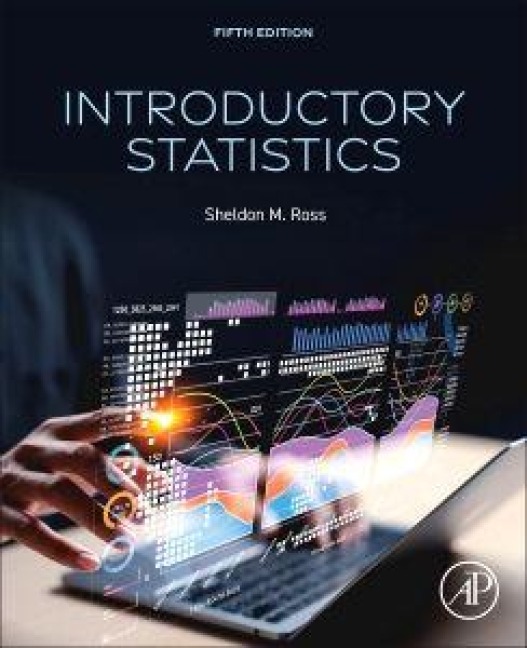
Introductory Statistics, Fifth Edition, reviews statistical concepts and techniques in a way that teaches students not only how and when to utilize the statistical procedures developed, but also how to understand why these procedures should be used. The text's main merits are the clarity of presentation, contemporary examples, applications from diverse areas, an explanation of intuition, and the ideas behind the statistical methods. Concepts are motivated, illustrated, and explained in a way that attempts to increase intuition. Applications and examples refer to real-world issues, such as gun control, stock price models, vaccines and other health issues, driving age limits, and many others. To quote from the preface, it is only when a student develops a feel or intuition for statistics that they are really on the path toward making sense of data. Ross achieves this goal through a coherent mix of mathematical analysis, intuitive discussions, and examples.
Dr. Sheldon M. Ross is a professor in the Department of Industrial and Systems Engineering at the University of Southern California. He received his PhD in statistics at Stanford University in 1968. He has published many technical articles and textbooks in the areas of statistics and applied probability. Among his texts are A First Course in Probability, Introduction to Probability Models, Stochastic Processes, and Introductory Statistics. Professor Ross is the founding and continuing editor of the journal Probability in the Engineering and Informational Sciences. He is a Fellow of the Institute of Mathematical Statistics, a Fellow of INFORMS, and a recipient of the Humboldt US Senior Scientist Award.
1. Introduction to Statistics 2. Describing Data Sets 3. Using Statistics to Summarize Data 4. Probability 5. Discrete Random Variables 6. Normal Random Variables 7. Distribution of sampling Statistics 8. Statistical Estimation 9. Testing Statistical Hypotheses 10. Hypothesis Testing concerning two populations 11. Analysis of Variance 12. Linear Regression 13. Chi-squared goodness of fit tests 14. Nonparametric Hypothesis Tests 15. Quality Control 16. Machine Learning and Big Data APPENDIX A APPENDIX B ANSWERS TO ODD-NUMBERED PROBLEMS Index