Und dann auf "Zum Home-Bildschirm [+]".

Stöbern
genialokal zum Startbildschirm hinzufügen
Installieren Sie die genialokal App auf Ihrem Startbildschirm für einen schnellen Zugriff und eine komfortable Nutzung.
Installieren Sie die genialokal App auf Ihrem Startbildschirm für einen schnellen Zugriff und eine komfortable Nutzung.
Ihr gewünschter Artikel ist in 0 Buchhandlungen vorrätig - wählen Sie hier eine Buchhandlung in Ihrer Nähe aus:

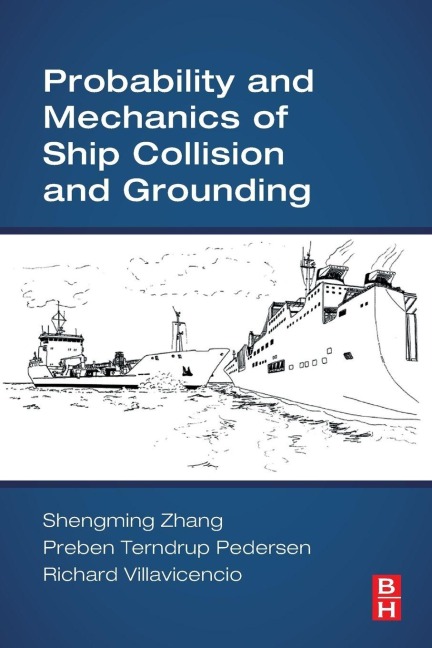
Probability and Mechanics of Ship Collision and Grounding provides simplified analytical procedures for ship collision and grounding assessments, including probabilistic methods, an estimation of the energy released during collisions, and a prediction of the extent of damage on involved structures. An additional chapter is dedicated to current finite element analysis techniques that are used for estimating structural damage during ship collisions. The book encapsulates reliable and fast analysis methods for collision and grounding assessment, presenting tactics that have been extensively validated with experimental and numerical results. In addition, all described analysis methods include realistic calculation examples to provide confidence in their use.
Shengming Zhang is currently a Principal Specialist at Lloyd's Register (UK), Marine Technology Department where he joined in 1999 after obtained a PhD in ship structures on ship collision analysis from Technical University of Denmark. Prior to this, he received a MSc on structural dynamics from China Ship Scientific Research Centre in 1988 and obtained a BSc on solid mechanics and mathematics at Lanzhou University, China in 1985. His primary research fields and interests are on developments of ship rules and design assessment procedures for ship collision and grounding, fatigue design assessment, buckling and ultimate strength assessment. He was a Member of Fatigue & Fracture Committee (2009-2012) and Ultimate Strength Committee (2006-2009 and 2012-2015) of International Ship and Offshore Structure Congress (ISSC).
1. Probability of Ship Collision2. External Dynamics of Ship Collision3. Internal Mechanics of Ship Collision4. Damaged Material Volume Method5. Collision Damage Assessment by Finite Element Method