
Stöbern
genialokal zum Startbildschirm hinzufügen
Installieren Sie die genialokal App auf Ihrem Startbildschirm für einen schnellen Zugriff und eine komfortable Nutzung.
Installieren Sie die genialokal App auf Ihrem Startbildschirm für einen schnellen Zugriff und eine komfortable Nutzung.
Tippen Sie einfach auf Teilen:
 Und dann auf "Zum Home-Bildschirm [+]".
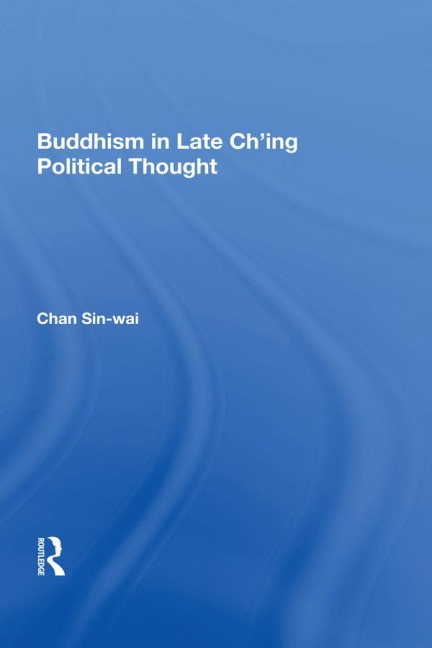
This book is a revised version of the doctoral thesis I presented to the School of Oriental and African Studies, University of London, in 1977. It is basically an attempt to study the religious, cultural and political significance of Buddhism in late Ch'ing intellectual thought through an examination of the writings of a few influential figures like liang Ch'i-ch'ao, K'ang Yu-wei, Chang Ping-lin, and particularly T'an Ssu-t'ung. My findings reveal that Buddhism came to play a part in these reformers' thought as a result of several factors: the rekindled interest in Buddhism brought about through the efforts of laymen such as Yang Wen-hui, the need to find a counter-balance to Christianity, the search for a new unifying ideology for China as Confucianism crumbled before the challenge from the West, and the immense potentiality of Buddhism to cater for the intellectuals' diverse cultural and political purposes. The masterpiece of T'an Ssu-t'ung, entitled An Exposition of Benevolence (Jen-hsiieh), is chosen here to exemplify the use of Buddhism in late Ch'ing political thought. Buddhism not only served as the all-embracing school of his eclectic synthesis, it also formed the foundation of the major concepts in the treatise, and was closely related to his radical thinking.
Chan, Sin-wai
Preface - Introduction -- PART 1: -- BUDDHISM AND THE LATE CH'ING INTELLECTUALS -- Chapter 1. Buddhism in Nineteenth-Century China Chapter 2. Intellectuals and the Study of Buddhism -- PART II: -- THE BUDDHIST THOUGHT OF T'AN SSU-T'UNG -- Chapter 3. T'an Ssu-t'ung's Acceptance of Buddhism Chapter 4. The Buddhist Foundation of the Major Concepts in An Exposition o[Benevolence Chapter 5. Buddhism and the Political Thought ofT'an Ssu-t'ung -- PART III: -- BUDDHISM IN CHINA'S TRANSITIONAL PERIOD -- Chapter 6. Chinese Intellectuals and Buddhism Chapter 7. Conclusion - Bibliography - Index.
Dieses eBook wird im PDF-Format geliefert und ist mit einem Adobe Kopierschutz (DRM) versehen. Sie können dieses eBook mit allen Geräten lesen, die das PDF-Format und den Adobe Kopierschutz (DRM) unterstützen.
Zum Beispiel mit den folgenden Geräten:
• tolino Reader
Laden Sie das eBook direkt über den Reader-Shop auf dem tolino herunter oder übertragen Sie das eBook auf Ihren tolino mit einer kostenlosen Software wie beispielsweise Adobe Digital Editions.
• Sony Reader & andere eBook Reader
Laden Sie das eBook direkt über den Reader-Shop herunter oder übertragen Sie das eBook mit der kostenlosen Software Sony READER FOR PC/Mac oder Adobe Digital Editions auf ein Standard-Lesegeräte mit epub- und Adobe DRM-Unterstützung.
• Tablets & Smartphones
Möchten Sie dieses eBook auf Ihrem Smartphone oder Tablet lesen, finden Sie hier unsere kostenlose Lese-App für iPhone/iPad und Android Smartphone/Tablets.
• PC & Mac
Lesen Sie das eBook direkt nach dem Herunterladen mit einer kostenlosen Lesesoftware, beispielsweise Adobe Digital Editions, Sony READER FOR PC/Mac oder direkt über Ihre eBook-Bibliothek in Ihrem Konto unter „Meine eBooks“ - „online lesen“.
Schalten Sie das eBook mit Ihrer persönlichen Adobe ID auf bis zu sechs Geräten gleichzeitig frei.
Bitte beachten Sie, dass die Kindle-Geräte das Format nicht unterstützen und dieses eBook somit nicht auf Kindle-Geräten lesbar ist.