
Stöbern
genialokal zum Startbildschirm hinzufügen
Installieren Sie die genialokal App auf Ihrem Startbildschirm für einen schnellen Zugriff und eine komfortable Nutzung.
Installieren Sie die genialokal App auf Ihrem Startbildschirm für einen schnellen Zugriff und eine komfortable Nutzung.
Tippen Sie einfach auf Teilen:
 Und dann auf "Zum Home-Bildschirm [+]".
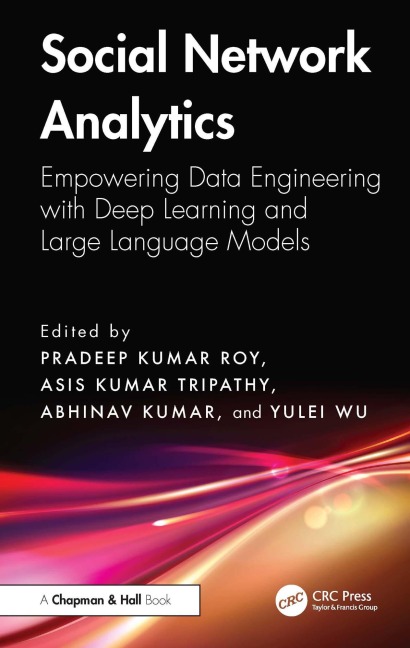
This book presents the cutting-edge techniques of social network analytics, focusing on both the positive and negative aspects of social media. While platforms like X, Facebook, and LinkedIn serve as powerful tools for product promotion and crisis management, they also present challenges such as the spread of misinformation, cyberbullying, and hateful content. This book explores these dimensions while highlighting the advancements in social media analytics, specifically through the lens of emerging technologies like artificial intelligence, machine learning, and deep learning. This book is intended for data engineers, researchers, practitioners, and students in the fields of data science, social computing, and artificial intelligence. This book - Explores state-of-the-art deep learning methodologies tailored for social network analysis, including Convolutional Neural Networks (CNNs), Recurrent Neural Networks (RNNs), and Graph Neural Networks (GNNs) to uncover hidden patterns and trends within social media data. - Examines the application of large language models, such as GPT (Generative Pre-trained Transformer), in analysing and generating text-based content. Readers will gain practical insights into using these models for content generation, summarisation, and classification tasks. - Provides detailed coverage of sentiment analysis techniques, enabling readers to extract valuable insights from user-generated content, helping organisations better understand public opinion. - Explores methodologies for detecting communities within social networks, uncovering hidden structures, relationships, and influential nodes or communities. - Offers insights into predicting user behaviour on social media platforms, including engagement, preferences, and click-through rates, equipping readers with tools to drive informed decision-making.
Pradeep Kumar Roy earned a BTech degree in Computer Science and Engineering from BPUT University Odisha. He earned his MTech and PhD degrees in Computer Science and Engineering from the National Institute of Technology Patna in 2015 and 2018, respectively. He received a Certificate of Excellence for securing a top rank in the MTech course. He is currently an assistant professor in the Decision Science and Information Systems area, IIM Nagpur Maharashtra, India. Asis Kumar Tripathy is a professor at the School of Information Technology and Engineering, Vellore Institute of Technology, Vellore, India. He has more than ten years of teaching experience. He completed his PhD from the National Institute of Technology, Rourkela. His areas of research interest include wireless sensor networks, cloud computing, the Internet of Things, and advanced network technologies. He has several publications in refereed journals, reputed conferences, and book chapters to his credit. Abhinav Kumar is currently an assistant professor in the Department of Computer Science and Engineering, Motilal Nehru National Institute of Technology Allahabad (MNNIT Allahabad), Prayagraj, India. Prior to joining MNNIT Allahabad, he worked as an assistant professor in the Department of CSE at IIIT Surat and Siksha "O" Anusandhan Deemed to be University, Bhubaneswar, Odisha. He earned a PhD in Computer Science & Engineering from the Department of CSE of the National Institute of Technology Patna, India. Dr. Yulei Wu is an associate professor working across the Faculty of Engineering and the Bristol Digital Futures Institute, University of Bristol, UK. He is also affiliated with the Smart Internet Lab and is a member of the High-Performance Networks Research Group. He earned his PhD in Computing and Mathematics and BSc (1st Class Hons.) in Computer Science from the University of Bradford, UK, in 2010 and 2006, respectively. Before joining the University of Bristol, Dr. Wu worked at the University of Exeter and the Chinese Academy of Sciences (CAS).
The Role of Artificial Intelligence in Social Network Analysis. 2. Unraveling the Impact of Social Networks: A Comprehensive Overview. 3. Understanding factors leading to local and global spatial spread in social media. 4. Understanding Deep Learning and LLMs for Detecting Depression in Social Media Posts. 5. Deep Learning and Large Language Models for Detecting Depression in Social Media Posts - An Indian Context. 6. Identifying Hate and Offensive Content using Multimodal Deep Learning. 7. Personalised Advertising, Customer Segmentation through Social Network Analytics. 8. Role of Digital Agriculture in Shaping the Future of Farming: A Social Network Analytics Approach. 9. Explainable Transfer Learning Model for Disaster Damage Assessment from Social Media Images. 10. Understanding and Detecting Online Homophobia and Transphobia in Low-Resource Indian Languages: A Focus on Kannada and Telugu. 11. Sarcasm Detection in Code-Mixed Social Media Posts: A Hybrid Perspective.