Und dann auf "Zum Home-Bildschirm [+]".

Stöbern
genialokal zum Startbildschirm hinzufügen
Installieren Sie die genialokal App auf Ihrem Startbildschirm für einen schnellen Zugriff und eine komfortable Nutzung.
Installieren Sie die genialokal App auf Ihrem Startbildschirm für einen schnellen Zugriff und eine komfortable Nutzung.

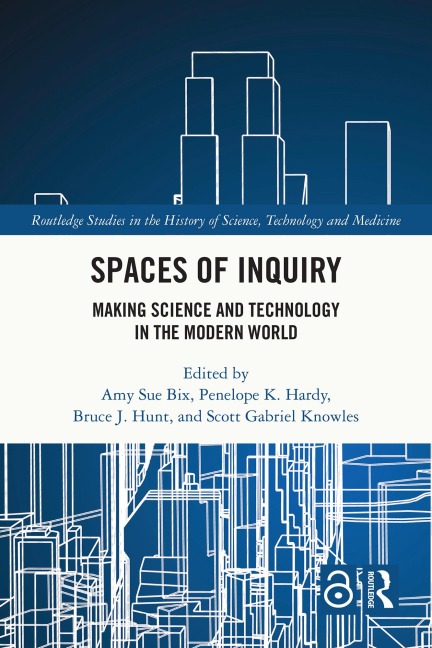
This book traces the historical development of key sites of knowledge creation in science and technology and the robust traditions of scholarship around their origins, exploring commonalities, divergences, and transnational features of knowledge-making cultures from the 18th century to the present. The "space of inquiry" is a meeting of knowledge, labor, and public policy that explodes beyond the confines of lab, campus, and corporation. It is a distinct site connected, formally or informally, to pursuing, teaching, or sharing knowledge - practices that have taken many different shapes across time and around the globe. The space of inquiry ranges from microchips in one scientist's computer to the factory that builds and sells those microchips around the world. In the Internet age, the spatial aspect of inquiry approaches immateriality, yet knowledge is still produced by people, in communities, in specific places. Through vivid case studies of place-making from East Asia to Europe to North America, this volume documents the historical processes of modernization via scientific and technological intensification in new spaces for knowledge production. Scholars of science, technology, and institutional practices will find this book essential, and its open-access chapters are accessible for use in a variety of undergraduate and graduate classrooms.
Amy Sue Bix, Distinguished Professor of History at Iowa State University, won the History of Science Society's Margaret Rossiter Prize for her 2013 book 'Girls Coming to Tech!': A History of American Engineering Education for Women. Her current research examines advocacy for girls in STEM (Science, Technology, Engineering, and Mathematics). Penelope K. Hardy is an historian of ocean science and technology at the University of Wisconsin-La Crosse. Her 2021 article "Finding the History of the World at the Bottom of the Ocean" received the Charles Dana Gibson Award from the North American Society for Oceanic History. Bruce J. Hunt is a historian of science and technology at the University of Texas. His book Imperial Science: Cable Telegraphy and Electrical Physics in the Victorian British Empire appeared in 2021 and he is now at work on a biography of James Clerk Maxwell. Scott Gabriel Knowles is Research Faculty in History and Senior Research Director for the Defense Industrial Base Institute at Northeastern University. His work focuses on the history of disasters worldwide. He published "Slow Disaster in the Anthropocene: A Historian Witnesses Climate Change on the Korean Peninsula" in 2020.
Prologue: Spaces of Inquiry 1. The Laboratory, the Studio, and the Clinic 2. "Hallway Conversations about the Silicon Valley Phenomenon": Bob Kargon and Bill Leslie's Spaces of Inquiry. Bibliography of Works by Robert Kargon and Stuart W. "Bill" Leslie Part 1: Laboratory Spaces Reconsidered 3. Light and Lighting along Cleveland's Euclid Avenue: A Transportation Scape and a Linear "Space of Inquiry" During the Second Industrial Revolution 4. Organism X and the Oyster Commons: The Chesapeake MSX Disease Crisis as a Space of Inquiry for Advancing Laboratory-Based Aquaculture, 1959-69 5. Spatial History of the Kamiokande Observatory: Masatoshi Koshiba, His Cosmic Ray Research, and the Creation of Observational Neutrino Astrophysics 6. Nuclear Gerontology: Maintenance as Expertise 7. Screens, Models, and Offices: The National Weather Center as a Space of Inquiry Part 2: Imperial and Decolonized Spaces 8. Making (and Using) Ohms: Laboratories and Testing Rooms 9. Ships as Spaces of Inquiry in Nineteenth-Century Ocean Science 10. Innovative Spaces in Mussolini's Italy 11. Is There Life Beyond Paradigm?: Max Marwick's Epistemological Journey Part 3: Labs Without Walls 12. "Enquire Within upon Everything": World's Fairs, Museums, and Progressive Development 13. "$50,000 of Free Advertising for MIT": Selling Science, Technology, and Universities at the Century of Progress 14. Garages and Other Domestic Spaces of Inquiry 15. Space for Play: Inspiring the Next Generation of STEM Workers at Space Camp 16. Theater as a Space of Inquiry Part 4: Spaces for Education 17. Improving the Best: The International Education Board in Copenhagen in the 1920s 18. The Charm School: A Summer Research Experience for Undergraduate Women in the 1940s 19. The Temple, the Phoenix and the Heavy-Water Pot: Teaching Reactors as Spaces of Inquiry 20. "The Summer Writing Group: Creating a Fruitful Space for Curriculum Development in the "New Math" Era 21. Campus Career Courses as Spaces of Technological Inquiry