
Stöbern
genialokal zum Startbildschirm hinzufügen
Installieren Sie die genialokal App auf Ihrem Startbildschirm für einen schnellen Zugriff und eine komfortable Nutzung.
Installieren Sie die genialokal App auf Ihrem Startbildschirm für einen schnellen Zugriff und eine komfortable Nutzung.
Tippen Sie einfach auf Teilen:
 Und dann auf "Zum Home-Bildschirm [+]".
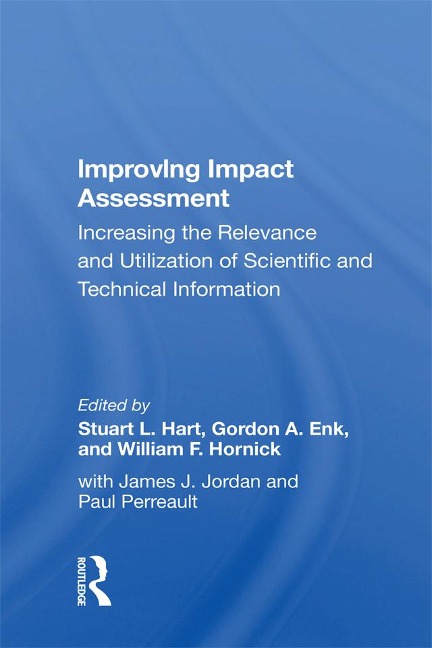
As Environmental Impact Statements (EIS) become increasingly important in the policymaking process, it is vital that they be as complete and accurate as possible. The authors of this volume consider ways in which the development and evaluation of scientific and technical information for EIS can be improved. Addressing key legal, social, political,
Stuart L. Hart is assistant research scientist and project director at the Institute for Social Research at the University of Michigan and consultant to the Research and Decision Center, Medusa, New York.
Gordon A. Enk is president of the Research and Decision Center, where William F. Hornick is an associate.
Introduction: Problem Statement and Project Context -- Redefining the Scope of Environmental Assessment -- A Process-Oriented Approach to Human Concerns in Environmental Decision Making1 -- Assessing Human Concerns for Environmental Decision Making1 -- EIA Scoping for Aesthetics: Hindsight from the Greene County Nuclear Power Plant EIS1 -- Socioeconomic Impact Assessment and Nuclear Power Plant Licensing: Greene County, New York -- The Role of Human Values, Attitudes, and Beliefs in Environmental Assessment -- Applying Assessment Techniques -- Improving Predictive Performance and Usefulness of Biological Environmental Impact Assessment: Experimental Impact Studies and Adaptive Impact Assessment -- Preliminary Environmental Assessment Techniques for Soils1 -- Land-Capability Analysis As a Planning and Regulatory Tool -- The Application of Image-Based Information Systems for Environmental Assessment1 -- Toward a Participant Value Method for the Presentation of Environmental Impact Data1 -- Comparisons of Methods for Evaluating Multiattributed Alternatives in Environmental Assessments: Results of the BNL-NRC Siting Methods Project1 -- The Scoping Concept and Citizen Involvement: An Opportunity for Rejuvenating NEPA -- Keying Analysis to Decision Makers -- How to Write a Socially Useful EIS -- The EIS and the Decision Maker: Closing the Gap -- The Impact Judgment: A Technical Impasse? -- Organizational Environmental Management: The Los Alamos National Laboratory and Tennessee Valley Authority Experience -- Analysis and Case Study -- The Costs of Environmental Review: Assessment Methods and Trends -- The Fate of EIS Projects: A Retrospective Study -- Improving the EIS Process: A Case Study of Spruce Budworm Control -- The Interface Between Federal and State EIS Requirements: An Overview -- The Uses of Scoping: The Massachusetts Experience -- Changing the Environmental Review Procedure in Minnesota1 -- Recent Changes and Conclusions -- The 1979 CEQ NEPA Regulations -- Concluding Observations and Future Directions
Dieses eBook wird im PDF-Format geliefert und ist mit einem Adobe Kopierschutz (DRM) versehen. Sie können dieses eBook mit allen Geräten lesen, die das PDF-Format und den Adobe Kopierschutz (DRM) unterstützen.
Zum Beispiel mit den folgenden Geräten:
• tolino Reader
Laden Sie das eBook direkt über den Reader-Shop auf dem tolino herunter oder übertragen Sie das eBook auf Ihren tolino mit einer kostenlosen Software wie beispielsweise Adobe Digital Editions.
• Sony Reader & andere eBook Reader
Laden Sie das eBook direkt über den Reader-Shop herunter oder übertragen Sie das eBook mit der kostenlosen Software Sony READER FOR PC/Mac oder Adobe Digital Editions auf ein Standard-Lesegeräte mit epub- und Adobe DRM-Unterstützung.
• Tablets & Smartphones
Möchten Sie dieses eBook auf Ihrem Smartphone oder Tablet lesen, finden Sie hier unsere kostenlose Lese-App für iPhone/iPad und Android Smartphone/Tablets.
• PC & Mac
Lesen Sie das eBook direkt nach dem Herunterladen mit einer kostenlosen Lesesoftware, beispielsweise Adobe Digital Editions, Sony READER FOR PC/Mac oder direkt über Ihre eBook-Bibliothek in Ihrem Konto unter „Meine eBooks“ - „online lesen“.
Schalten Sie das eBook mit Ihrer persönlichen Adobe ID auf bis zu sechs Geräten gleichzeitig frei.
Bitte beachten Sie, dass die Kindle-Geräte das Format nicht unterstützen und dieses eBook somit nicht auf Kindle-Geräten lesbar ist.