
Stöbern
genialokal zum Startbildschirm hinzufügen
Installieren Sie die genialokal App auf Ihrem Startbildschirm für einen schnellen Zugriff und eine komfortable Nutzung.
Installieren Sie die genialokal App auf Ihrem Startbildschirm für einen schnellen Zugriff und eine komfortable Nutzung.
Tippen Sie einfach auf Teilen:
 Und dann auf "Zum Home-Bildschirm [+]".

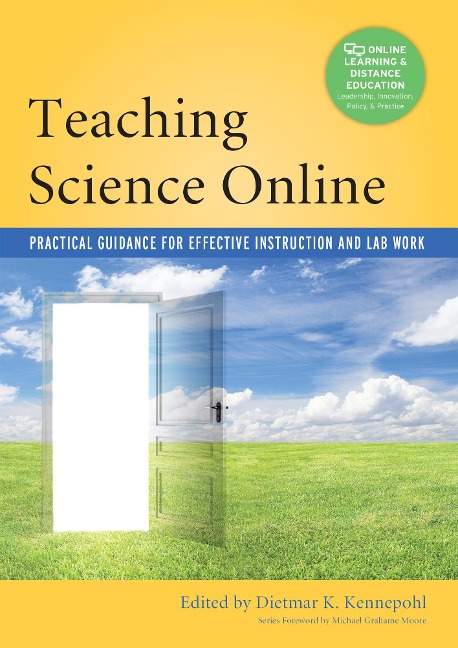
With the increasing focus on science education, growing attention is being paid to how science is taught. Educators in science and science-related disciplines are recognizing that distance delivery opens up new opportunities for delivering information, providing interactivity, collaborative opportunities and feedback, as well as for increasing access for students. This book presents the guidance of expert science educators from the US and from around the globe. They describe key concepts, delivery modes and emerging technologies, and offer models of practice. The book places particular emphasis on experimentation, lab and field work as they are fundamentally part of the education in most scientific disciplines. Chapters include:* Discipline methodology and teaching strategies in the specific areas of physics, biology, chemistry and earth sciences.* An overview of the important and appropriate learning technologies (ICTs) for each major science.* Best practices for establishing and maintaining a successful course online.* Insights and tips for handling practical components like laboratories and field work.* Coverage of breaking topics, including MOOCs, learning analytics, open educational resources and m-learning.* Strategies for engaging your students online.
Dietmar Kennepohl is Professor of Chemistry and Associate Vice President Academic at Athabasca University (AU) Canada's Open University. He graduated Summa Cum Laude from McMaster University with a B.Sc. (Honours) degree in chemistry and continued directly into his doctoral studies at the University of Alberta in main group synthetic chemistry. Before coming to Athabasca University he also did a post-doctoral fellowship at the University of Guelph and was an Alexander von Humboldt Fellow at the Universität Göttingen in Germany. Most of his teaching experience has been in a distributed and online setting. He holds both university and national teaching awards. Over the years, his research interests have included chemical education as well as petroleum, main group and coordination chemistry. His research in chemical education includes online chemistry courses and concentrates on the use of innovative distance delivery methods for undergraduate laboratory work. Michael G. Moore is known in academic circles for his leadership in promoting the scholarship of distance education and online learning. He published his first statement of theory about distance education in 1972, and has achieved a number of firsts in this field.While teaching the first graduate course in this subject at University of Wisconsin in the mid 70's, he was contributory to founding the national annual conference there. Appointed to The Pennsylvania State University in 1986, he founded the first American journal (American Journal of Distance Education) and established the first sequence of taught graduate courses, including the first such courses taught online. Moore has served on the editorial boards of all the main journals of distance education, and about a hundred publications include the books, Contemporary Issues in American Distance Education (Pergamon Press, 1990), Distance Education: a Systems View, co-authored with G. Kearsley (Wadsworth Publishers, Third Edition, 2011 in press), p
Foreword-Michael G. Moore Acknowledgments Introduction. Setting the Stage-Dietmar K. Kennepohl Part One. The Basics of Getting Science Courses Online 1. The Basics of Getting Biology Courses Online-Wendy Wright, Jennifer Mosse, Barbara C. Panther 2. Teaching Undergraduate Chemistry by Distance and Online. Lessons from the Front Line-Peter Lye, Erica Smith 3. Developing Online Earth Science Courses-Kevin F. Downing 4. Physics Teaching in Distance Education-Robert Lambourne and Nicholas Braithwaite Part Two. Applications Case Studies and Special Topics 5. Science Online. Bringing the Laboratory Home-Mary V. Mawn 6. Practical Biology at a Distance. How Far Can We Go With Online Distance Learning?-Mark C. Hirst and Hilary A. MacQueen 7. Assessment in Physics Distance Education. Practical Lessons at Athabasca University-Farook Al-Shamali and Martin Connors 8. Computer-Based Laboratory Simulations for the New Digital Learning Environments-Jessie Webb, Richard Swan, and Brian F. Woodfield 9. Remote Access Laboratory Equipment for Undergraduate Science Education-Daniel M. Branan, Paul Bennett, and Nick Braithwaite 10. Situated Science Learning for Higher Level Learning With Mobile Devices-Brett McCollum 11. Online Delivery of Field- and Laboratory-Based Environmental and Earth Sciences Curriculum-Ron Reuter 12. Enabling Remote Activity. Widening Participation in Field Study Courses-Trevor Collins, Sarah Davies, and Mark Gaved 13. Collaborative e-learning in Pharmacy. Design, Evaluation, and Outcomes of a European Cross-Border Project-Marion Bruhn-Suhr, Dorothee Dartsch, and Jasmin Hamadeh 14. Online Professional Development for Australian Science Teachers. Developing and Deploying a Curriculum Evaluation Model-Karen Spence, Jennifer Donovan, and P. A. Danaher Part Three. Summary and Future Trends The Future Starts Today-Dietmar K. Kennepohl Appendix A. Online Versus Face-to-Face Approaches for Various Learning Activities Appendix B. Selected Online Resources Editor and Contributors Index