
Stöbern
genialokal zum Startbildschirm hinzufügen
Installieren Sie die genialokal App auf Ihrem Startbildschirm für einen schnellen Zugriff und eine komfortable Nutzung.
Installieren Sie die genialokal App auf Ihrem Startbildschirm für einen schnellen Zugriff und eine komfortable Nutzung.
Tippen Sie einfach auf Teilen:
 Und dann auf "Zum Home-Bildschirm [+]".

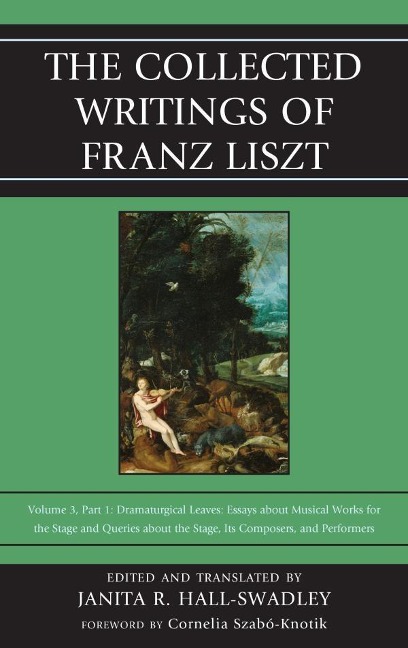
In Dramaturgical Leaves: Essays about Musical Works for the Stage and Queries about the Stage, Its Composers and Performers, the third volume in Janita R. Hall-Swadley's The Collected Writings of Franz Liszt, Liszt heralds his admiration for early nineteenth-century opera and musical stage works. He honors Gluck, the musical prophet, as the cultivator of dramatic truth in the Romantic opera Orpheus, expounds on Beethoven's harmonic inventions and innovative treatment of form in Fidelio, and argues for the latter's incidental music to Goethe's Egmont as the epitome of music organicism, a complete unity of words and tone. He also comments on Weber's Euryanthe as offering the most progressive musical characterizations and declamation-even more so than his popular work Der Freischütz-and on how both works prefigure Wagner's music dramas; awards Mendelssohn, whose genius Liszt ranks only slightly less than Beethoven's, top honors for creating in Midsummer's Night Dream the highest standards of music poetry; suggests how Scribe and Meyerbeer's Robert the Devil paints a mental image of art's eternal flames, where poet and musician share equal space in the development of music tragedy; reveals how the poetic deficiencies in the libretto to Schubert's Alfonso and Estrella are too easily overlooked because of the music's melodic and lyrical supremacy; and offers in contrast Auber's Mute from Portici, a remarkable text by many historically picturesque musical motives that are universal and nationalistic at the same time. Finally Liszt offers an early gender study in music in his essay about Bellini's Montague and Capulet (as well as its impact on nineteenth-century audiences), a look at Boieldieu's White Lady as a sublime depiction of literary music, and Donizetti's Favorite as colored with a special type of imagery, a laterna magica, in Liszt's hand. The beloved soprano Pauline Viardot-Garcia receives special attention in an essay devoted entirely to her, and Liszt proffers a critique of entr'acte music as a pointless tradition that dethrones music and insults the artist and composer by making music a "palate cleanser."
This volume includes a detailed discussion about what it meant to be patronized by Liszt and how his support-financial, literary, and musical-helped shape many a music career. It also offers commentary on how gender in opera was sometimes obscured not only for dramatic interest but also as part of the process of outlining a nation's identity,as well as a thorough study of Liszt's concepts of Gestalt theory, the Archetype, and his musical Weltanschauung (his musical "world view"), all revealing his contribution to 19th-century music philosophy as it relates to opera. Finally, a historical review of entr'acte music is presented-how it began and how it developed-to clarify Liszt's stance against it, making this volume a necessary read for music historians, serious musicians, and music connoisseurs alike.
Janita R. Hall-Swadley is a music researcher and German translator. She received her formal music training in musicology, piano performance, 19th-century philosophy, and German studies at Florida State University, The Boston Conservatory, and the University of North Texas. Her music focus is concentrated in the 19th century, especially in the independent study of the music and ideologies of Franz Liszt and Robert Schumann.