Und dann auf "Zum Home-Bildschirm [+]".

Stöbern
genialokal zum Startbildschirm hinzufügen
Installieren Sie die genialokal App auf Ihrem Startbildschirm für einen schnellen Zugriff und eine komfortable Nutzung.
Installieren Sie die genialokal App auf Ihrem Startbildschirm für einen schnellen Zugriff und eine komfortable Nutzung.
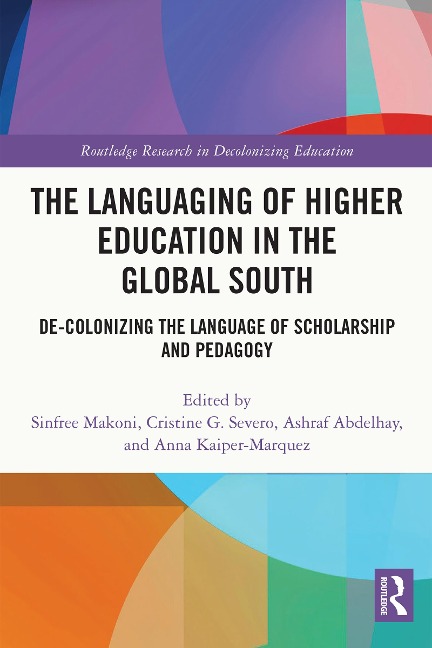
By foregrounding language practices in educational settings, this timely volume offers a postcolonial critique of the languaging of higher education and considers how Southern epistemologies can be used to further the decolonization of post-secondary education in the Global South. Offering a range of contributions from diverse and minoritized scholars based in countries including South Africa, Rwanda, Sudan, Qatar, Turkey, Portugal, Sweden, India, and Brazil, The Languaging of Higher Education in the Global South problematizes the use of language in various areas of higher education. Chapters demonstrate both subtle and explicit ways in which the language of pedagogy, scholarship, policy, and partcipiation endorse and privelege Western constructs and knowledge production, and utilize Southern theories and epistemologies to offer an alternative way forward - practice and research which applies and promotes Southern epistemologies and local knowledges. The volume confronts issues including integrationism, epistemic solidarity, language policy and ideology, multilingualism, and the increasing use of technology in institutions of higher education. This innovative book will be of interest to researchers, scholars, and postgraduate students in the fields of higher education, applied linguistics, and multicultural education. Those with an interest in the decolonization of education and language will find the book of particular use.
Sinfree Makoni is Professor of Applied Linguistics at the Pennsylvania State University, US. Cristine G. Severo is Associate Professor of Language Policy and Linguistics at the Federal University of Santa Catarina, Brazil. Ashraf Abdelhay is Associate Professor of Sociolinguistics at the Doha Institute for Graduate Studies, Qatar. Anna Kaiper-Marquez is Associate Director and Assistant Teaching Professor of the Institute for the Study of Adult Literacy and the Goodling Institute for Research in Family Literacy at Pennsylvania State University, US.
Introduction Part 1: Confronting Epistemological Language Issues 1. Global North Technocratic Discourse in Arab Higher Education: The Case of a North American Technical College in an Arab State 2. Reflections on the Global North and Global South Engagement Initiative in Kinigi, Rwanda 3. Polycentric or Pluricentric? Epistemic Traps in Sociolinguistic Approaches to Multilingual Portuguese 4. RE-. Vocabularies we live by in the Language and Educational Sciences Part 2: Language Policy in Postcolonial Academic Contexts 5. Decolonizing Epistemology in Sudanese Linguistics: Integrationist and Political Perspectives 6. Multilingualism at South African Universities: A Eeflection from an Integrationist Perspective 7. 'Everyone was Happy When Talking': Revisiting the Use of Mother Tongues in Kenyan Universities 8. Existential Sociolinguistics: The Fundamentals of the Political Legitimacy of Linguistic Minority Rights Part 3: Languaging Pedagogy in Post-Secondary Contexts 9. Teaching Gender Awareness in Teacher Education through a Curriculum which De-links from Abyssal Thinking 10. Recontextualization of the Author's and Reader's Positions in Simone De Beauvoir's Le Deuxième Sexe in the Turkish Cultural Environment Through Translation Part 4: Technology and Decolonial Practices 11. Languaging in Computer-Mediated Communication: Heteroglossia and Stylization in Online Education 12. (How) Can Critical Posthumanism Help to Decolonize Tertiary Education in the South in the Age of Cognitive Capitalism? 13. Concluding Commentary
Dieses eBook wird im PDF-Format geliefert und ist mit einem Adobe Kopierschutz (DRM) versehen. Sie können dieses eBook mit allen Geräten lesen, die das PDF-Format und den Adobe Kopierschutz (DRM) unterstützen.
Zum Beispiel mit den folgenden Geräten:
• tolino Reader
Laden Sie das eBook direkt über den Reader-Shop auf dem tolino herunter oder übertragen Sie das eBook auf Ihren tolino mit einer kostenlosen Software wie beispielsweise Adobe Digital Editions.
• Sony Reader & andere eBook Reader
Laden Sie das eBook direkt über den Reader-Shop herunter oder übertragen Sie das eBook mit der kostenlosen Software Sony READER FOR PC/Mac oder Adobe Digital Editions auf ein Standard-Lesegeräte mit epub- und Adobe DRM-Unterstützung.
• Tablets & Smartphones
Möchten Sie dieses eBook auf Ihrem Smartphone oder Tablet lesen, finden Sie hier unsere kostenlose Lese-App für iPhone/iPad und Android Smartphone/Tablets.
• PC & Mac
Lesen Sie das eBook direkt nach dem Herunterladen mit einer kostenlosen Lesesoftware, beispielsweise Adobe Digital Editions, Sony READER FOR PC/Mac oder direkt über Ihre eBook-Bibliothek in Ihrem Konto unter „Meine eBooks“ - „online lesen“.
Schalten Sie das eBook mit Ihrer persönlichen Adobe ID auf bis zu sechs Geräten gleichzeitig frei.
Bitte beachten Sie, dass die Kindle-Geräte das Format nicht unterstützen und dieses eBook somit nicht auf Kindle-Geräten lesbar ist.