Und dann auf "Zum Home-Bildschirm [+]".

Stöbern
genialokal zum Startbildschirm hinzufügen
Installieren Sie die genialokal App auf Ihrem Startbildschirm für einen schnellen Zugriff und eine komfortable Nutzung.
Installieren Sie die genialokal App auf Ihrem Startbildschirm für einen schnellen Zugriff und eine komfortable Nutzung.
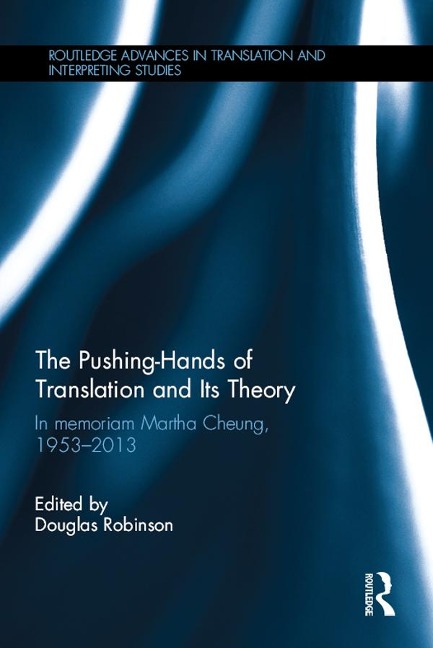
This book presents an East-West dialogue of leading translation scholars responding to and developing Martha Cheung's "pushing-hands" method of translation studies. Pushing-hands was an idea Martha began exploring in the last four years of her life, and only had time to publish at article length in 2012. The concept of pushing-hands suggests a promising line of inquiry into the problem of conflict in translation. Pushing-hands opens a new vista for translation scholars to understand and explain how to develop an awareness of non-confrontational, alternative ways to handle translation problems or problems related to translation activities that are likely to give rise to tension and conflict. The book is a timely contribution to celebrate Martha's work and also to move the conversation forward. Despite being somewhat tentative and experimental, it probes into how to enable and develop dynamic interaction between and reciprocal determinism of different hands involved in the process of translation.
Douglas Robinson is Dean of Arts and Chair Professor of English at Hong Kong Baptist University. A scholar of language, literature, translation, and rhetoric and a translator from Finnish to English since 1975, he is author most recently of Schleiermacher's Icoses (Zeta Books, 2013), The Dao of Translation (Routledge, 2015), The Deep Ecology of Rhetoric in Mencius and Aristotle (SUNY Press, 2015), and Semiotranslating Peirce (Tartu Semiotics Library, 2015). His current project is an English translation of Finland's greatest novel, Aleksis Kivi's Seven Brothers (1870).
Editor's introduction: pushing hands with Martha Cheung Part 1: Backgrounds 1. The medited nature of knowledge and pushing-hands approach to research on translation history" 2. Pushing Hands with Martha Cheung: The Genealogy of a Translation Metaphor"3. Towards a yin-yang poetics of translation: Tai Chi pushing-hands, hao-ran zhi qi, and pure language" Part 2: Practical Applications 4. Tuishou: a theoretical framework for (re)translation history?" 5. Pushing Hands, the invisible hand, and the changing (pre-)faces of the baihua Chinese Translations of The Wealth of Nations"6. Pushing papaer, pushing hands, pushing the envelope: Three Eleanors (Arts as Historiography) as theatrical trasnlation across media" 7. The Pushing-hands Approach to Translation Practice: A Case Study of Team Translation of A Full Load of Moonlight by Mary M.Y. Fung and David Lunde" 8. Translation Paratexts and the Pushing-Hands Approach to Translation History Part 3: Theoretical Applications 9. Applying the 'Pushing-Hands Approach' to a Dialogue among Microhistory, Macrohistory and Histoire Croisée10. Conceptualizing pushing-hands in translation studies: a Heideggerian perspective11. Pushing-Hands and Periperformativity
Dieses eBook wird im PDF-Format geliefert und ist mit einem Adobe Kopierschutz (DRM) versehen. Sie können dieses eBook mit allen Geräten lesen, die das PDF-Format und den Adobe Kopierschutz (DRM) unterstützen.
Zum Beispiel mit den folgenden Geräten:
• tolino Reader
Laden Sie das eBook direkt über den Reader-Shop auf dem tolino herunter oder übertragen Sie das eBook auf Ihren tolino mit einer kostenlosen Software wie beispielsweise Adobe Digital Editions.
• Sony Reader & andere eBook Reader
Laden Sie das eBook direkt über den Reader-Shop herunter oder übertragen Sie das eBook mit der kostenlosen Software Sony READER FOR PC/Mac oder Adobe Digital Editions auf ein Standard-Lesegeräte mit epub- und Adobe DRM-Unterstützung.
• Tablets & Smartphones
Möchten Sie dieses eBook auf Ihrem Smartphone oder Tablet lesen, finden Sie hier unsere kostenlose Lese-App für iPhone/iPad und Android Smartphone/Tablets.
• PC & Mac
Lesen Sie das eBook direkt nach dem Herunterladen mit einer kostenlosen Lesesoftware, beispielsweise Adobe Digital Editions, Sony READER FOR PC/Mac oder direkt über Ihre eBook-Bibliothek in Ihrem Konto unter „Meine eBooks“ - „online lesen“.
Schalten Sie das eBook mit Ihrer persönlichen Adobe ID auf bis zu sechs Geräten gleichzeitig frei.
Bitte beachten Sie, dass die Kindle-Geräte das Format nicht unterstützen und dieses eBook somit nicht auf Kindle-Geräten lesbar ist.