
Stöbern
genialokal zum Startbildschirm hinzufügen
Installieren Sie die genialokal App auf Ihrem Startbildschirm für einen schnellen Zugriff und eine komfortable Nutzung.
Installieren Sie die genialokal App auf Ihrem Startbildschirm für einen schnellen Zugriff und eine komfortable Nutzung.
Tippen Sie einfach auf Teilen:
 Und dann auf "Zum Home-Bildschirm [+]".
Ihr gewünschter Artikel ist in 0 Buchhandlungen vorrätig - wählen Sie hier eine Buchhandlung in Ihrer Nähe aus:

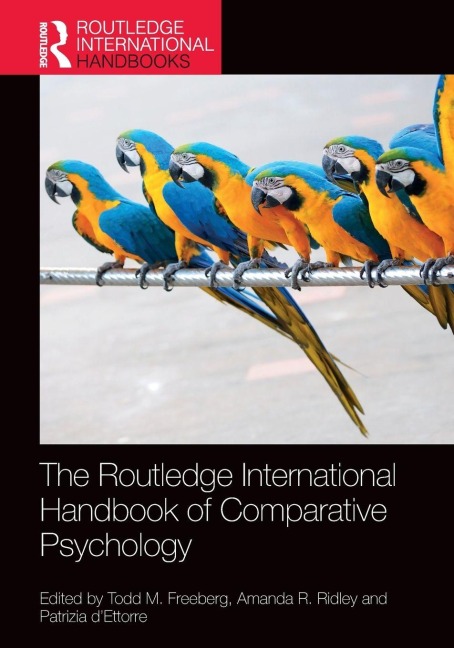
The Routledge International Handbook of Comparative Psychology is an international reference work that offers scientists and students a balanced overview of current research in the field of comparative psychology and animal behavior.
Todd M. Freeberg is a Professor in the Department of Psychology at the University of Tennessee - Knoxville. His research focuses on animal communication: the factors driving signaling complexity and how variation in social groups influences variation in signaling behavior. He is currently the Associate Editor of the Journal of Comparative Psychology. Amanda R. Ridley is an Associate Professor of behavioral ecology whose research has primarily focused on cooperative breeding, cognition, and the relationship between the two. She primarily works with wild animals and has established several long-term study sites on avian species - pied babblers and western Australian magpies. Amanda is currently an Editor for Behavioural Ecology. Patrizia d'Ettorre is Exceptional Class Professor at Sorbonne Paris Nord University, and senior member of Institut Universitaire de France. Using an interdisciplinary approach, incorporating behavioral and evolutionary biology, chemical ecology and neuro-ethology, she has been studying recognition of identity, communication, personality and cognition in social insects. She is Associate Editor of several Frontiers journals.
Part 1. Foundations Introduction to Handbook 1. Historical Perspectives on Comparative Psychology and Related Fields 2. Behaviourism: Past and Present 3. On strengths and limitations of field, semi-natural captive, and laboratory study settings 4. Ontogeny of Behavior 5. Sensation, Perception, and Attention 6. Motivation and Emotion 7. Comparative Cognition 8. Cognitive Ecology Part 2. Behavioral Systems 9. Habitat Selection 10. Where, what and with whom to eat: towards an integrative study of foraging behaviour 11. Causal factors in the study of vigilance 12. Communication 13. Intraspecific Aggression and Social Dominance 14. Mating Behaviour 15. Parental Behaviour 16. Play behavior: a comparative perspective Part 3. Complexities and Interactions 17. Sociality and Cooperation 18. Cultural Behaviour in Cetaceans 19. Tool Use 20. Bridging the gap between human language and animal vocal communication 21. Reasoning 22. Deception in Animal Communication 23. Evolutionary behavioural ecology perspectives on personality in non-human animals 24. Social Contextual Influences on Behaviour 25. Network approaches to understanding social organization and complexity 26. Changing Ideas About Mating Systems 27. Human mate choice 28. Bridging the gap: human-animal comparisons