
Stöbern
genialokal zum Startbildschirm hinzufügen
Installieren Sie die genialokal App auf Ihrem Startbildschirm für einen schnellen Zugriff und eine komfortable Nutzung.
Installieren Sie die genialokal App auf Ihrem Startbildschirm für einen schnellen Zugriff und eine komfortable Nutzung.
Tippen Sie einfach auf Teilen:
 Und dann auf "Zum Home-Bildschirm [+]".
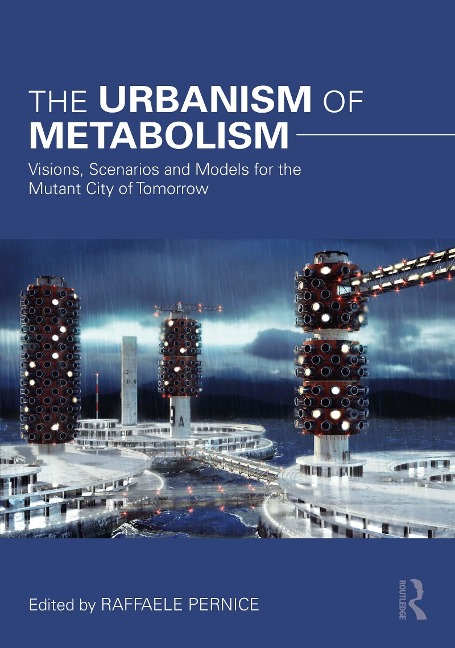
This edited book explores and promotes reflection on how the lessons of Metabolism experience can inform current debate on city making and future practice in architectural design and urban planning. More than sixty years after the Metabolist manifesto was published, the author's original contributions highlight the persistent links between present and past that can help to re-imagine new urban futures as well as the design of innovative intra-urban relationships and spaces. The essays are written by experienced scholars and renowned academics from Japan, Australia, Europe, South Korea and the United States and expose Metabolism's special merits in promoting new urban models and evaluate the current legacy of its architectural projects and urban design lessons. They offer a critical, intellectual, and up-to-date account of the Metabolism projects and ideas with regard to the current evolution of architectural and urbanism discourse in a global context. The collection of cross-disciplinary contributions in this volume will be of great interest to architects, architectural and urban historians, as well as academics, scholars and students in built environment disciplines and Japanese cultural studies.
Raffaele Pernice is an Italian architect and Senior Lecturer in Architecture and Urbanism at the University of New South Wales, Sydney, Australia. He holds a Ph.D. in Architecture from Waseda University in Tokyo and a M.Arch. from the University IUAV of Venice in Italy. He has extensive research and teaching experience in Australia, East Asia, and the Middle East, and his interests and activities lie at the nexus of architecture and urbanism, ranging from design practice through to the theory and history of architecture and city planning, with a focus on the evolution of the cities of Japan and the Asia-Pacific region. He has been the recipient of scholarships and grants from universities and national and international institutions, such as the Japanese Ministry of Education (MEXT), the Italian Ministry of Foreign Affairs, the Japan Foundation, the Australian Department of Foreign Affairs and Trade (DFAT), and the Japan Society for the Promotion of Science (JSPS).
Foreword: The Logic of Metabolism (Toyo Ito); Introduction (Raffaele Pernice); 1. Back from Behind the Curtain of Oblivion: Metabolism and the Postwar Actuality of Japan (Hajime Yatsuka); 2. The Aesthetics and/or Formalism of Change: Paradoxes and Contradictions in the Metabolist Movement (Botond Bognar); 3. Engineering a Poetic Techno-urbanism: The Metabolists' Visionary City in Postwar Japan (Raffaele Pernice); 4. The Metabolists in Context (Jon Lang); 5. The Infrastructure of Care: Metabolist Architecture as a Social Catalyst (Peter senk); 6. "Sunday Carpenter" Metabolism: Artificial-Land Housing and Resident Decision-Making (Casey Mack); 7. Maki and Dutch Team X: Step towards Group Form (Kiwa Matsushita); 8. Kikutake Kiyonori circa 2011: Sustaining Life through Metabolism (Ken Tadashi Oshima); 9. Metabolism as Survival Architecture (Hyunjung Cho); 10. Metabolism Adventure: A Personal View (Philip Drew); 11. This is Your City: The Pop Future Foretold by Metabolism (Yasutaka Tsuji); 12. Spaceship Earth: Metabolist Capsules, the Petro-economy, and Geoengineering (Yuriko Furuhata); 13. An Eternal Return? Considering the Temporality and Historicity of Metabolism (Julian Worrall); Afterword (Gevork Hartoonian)
Dieses eBook wird im PDF-Format geliefert und ist mit einem Adobe Kopierschutz (DRM) versehen. Sie können dieses eBook mit allen Geräten lesen, die das PDF-Format und den Adobe Kopierschutz (DRM) unterstützen.
Zum Beispiel mit den folgenden Geräten:
• tolino Reader
Laden Sie das eBook direkt über den Reader-Shop auf dem tolino herunter oder übertragen Sie das eBook auf Ihren tolino mit einer kostenlosen Software wie beispielsweise Adobe Digital Editions.
• Sony Reader & andere eBook Reader
Laden Sie das eBook direkt über den Reader-Shop herunter oder übertragen Sie das eBook mit der kostenlosen Software Sony READER FOR PC/Mac oder Adobe Digital Editions auf ein Standard-Lesegeräte mit epub- und Adobe DRM-Unterstützung.
• Tablets & Smartphones
Möchten Sie dieses eBook auf Ihrem Smartphone oder Tablet lesen, finden Sie hier unsere kostenlose Lese-App für iPhone/iPad und Android Smartphone/Tablets.
• PC & Mac
Lesen Sie das eBook direkt nach dem Herunterladen mit einer kostenlosen Lesesoftware, beispielsweise Adobe Digital Editions, Sony READER FOR PC/Mac oder direkt über Ihre eBook-Bibliothek in Ihrem Konto unter „Meine eBooks“ - „online lesen“.
Schalten Sie das eBook mit Ihrer persönlichen Adobe ID auf bis zu sechs Geräten gleichzeitig frei.
Bitte beachten Sie, dass die Kindle-Geräte das Format nicht unterstützen und dieses eBook somit nicht auf Kindle-Geräten lesbar ist.