
Stöbern
genialokal zum Startbildschirm hinzufügen
Installieren Sie die genialokal App auf Ihrem Startbildschirm für einen schnellen Zugriff und eine komfortable Nutzung.
Installieren Sie die genialokal App auf Ihrem Startbildschirm für einen schnellen Zugriff und eine komfortable Nutzung.
Tippen Sie einfach auf Teilen:
 Und dann auf "Zum Home-Bildschirm [+]".
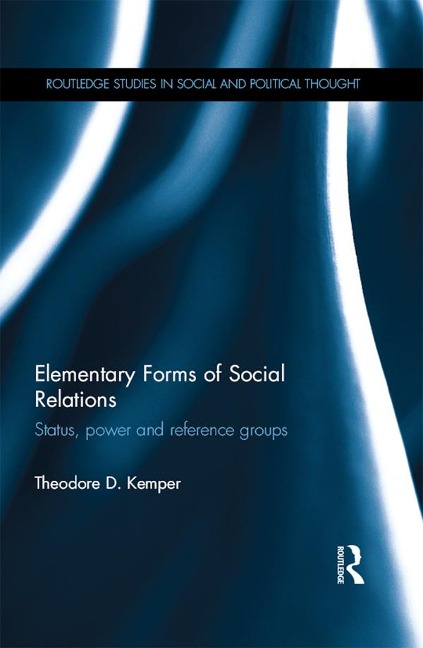
Elementary Forms of Social Relations introduces the reader to social life as a perpetual quest by individuals to gain attention, respect and regard (status) accompanied by an effort to marshal defensive and offensive means (power) to overcome the reluctance of others to grant status. This work is based on empirical evidence from many research settings showing that status and power are the main relational modes and that to understand our own and others' social behaviour, we need to understand how status and power operate in relational conduct. The status-power and reference group approach is applied to enumerate the relatively few ways in which social interaction can occur. Chapters compare the analytic value of the concept of the self with the value of reference groups that create the self. Threads of investigation include: considering the fallacy of abandoning reference groups as sources of cultural information in favour of approaches derived from cognitive neuroscience; examining a multi-person conversation from a status-power-and-reference-group stance as against a view of the same conversation based on principles of Conversation Analysis; and asserting the universality of personal status-power interests even among national leaders to name a few. By applying the author's main theory to a range of specific cases, the author reaffirms the importance of the social to our understanding of a variety of phenomena, including the self, cultural transmission, the conduct of leaders and economic activity. This book provides readers with transparent instances of the theory in action and thus will appeal to scholars across the social sciences with interests in theory and social interaction.
Theodore D. Kemper is Professor of Sociology (Ret.) at St. John's University, NY, USA.
Contents List of Tables Preface Acknowledgments Chapter 1: Elementary Forms: Status, Power and Reference Groups Chapter 2: The Minimum Complexity of Social Relations Chapter 3: G. H. Mead Had Gotten it Half-Right Chapter 4: After the Dialogical Self, What? Chapter 5: The Marriage of Cognitive Neuroscience and Sociology: A Dissenting View Chapter 6: A Nobel? Well, Yes! But Where's the Social? Chapter 7: Status, Power and Conversational Analysis Chapter 8: Leaders and Social Relations Chapter 9: Some Applications of Status-Power and Reference Group Theory Chapter 10: Concluding Theoretical Considerations Appendix: A Status-Power Glossary References Index
Dieses eBook wird im PDF-Format geliefert und ist mit einem Adobe Kopierschutz (DRM) versehen. Sie können dieses eBook mit allen Geräten lesen, die das PDF-Format und den Adobe Kopierschutz (DRM) unterstützen.
Zum Beispiel mit den folgenden Geräten:
• tolino Reader
Laden Sie das eBook direkt über den Reader-Shop auf dem tolino herunter oder übertragen Sie das eBook auf Ihren tolino mit einer kostenlosen Software wie beispielsweise Adobe Digital Editions.
• Sony Reader & andere eBook Reader
Laden Sie das eBook direkt über den Reader-Shop herunter oder übertragen Sie das eBook mit der kostenlosen Software Sony READER FOR PC/Mac oder Adobe Digital Editions auf ein Standard-Lesegeräte mit epub- und Adobe DRM-Unterstützung.
• Tablets & Smartphones
Möchten Sie dieses eBook auf Ihrem Smartphone oder Tablet lesen, finden Sie hier unsere kostenlose Lese-App für iPhone/iPad und Android Smartphone/Tablets.
• PC & Mac
Lesen Sie das eBook direkt nach dem Herunterladen mit einer kostenlosen Lesesoftware, beispielsweise Adobe Digital Editions, Sony READER FOR PC/Mac oder direkt über Ihre eBook-Bibliothek in Ihrem Konto unter „Meine eBooks“ - „online lesen“.
Schalten Sie das eBook mit Ihrer persönlichen Adobe ID auf bis zu sechs Geräten gleichzeitig frei.
Bitte beachten Sie, dass die Kindle-Geräte das Format nicht unterstützen und dieses eBook somit nicht auf Kindle-Geräten lesbar ist.