Und dann auf "Zum Home-Bildschirm [+]".

Stöbern
genialokal zum Startbildschirm hinzufügen
Installieren Sie die genialokal App auf Ihrem Startbildschirm für einen schnellen Zugriff und eine komfortable Nutzung.
Installieren Sie die genialokal App auf Ihrem Startbildschirm für einen schnellen Zugriff und eine komfortable Nutzung.
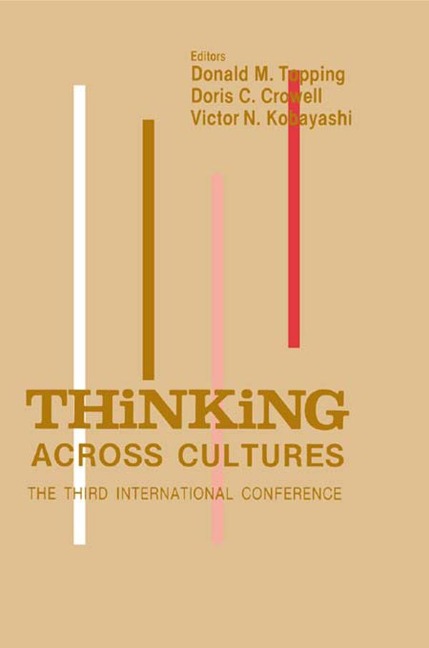
This volume compares and contrasts contemporary theories of cognition, modes of perception, and learning from cross-cultural perspectives. The participants were asked to consider and assess the question of whether people from different cultures think differently. Moreover, they were asked to consider whether the same approaches to teaching and development of thinking will work in all cultures as well as they do in Western, literate societies.
Donald M. Topping, Doris C. Crowell, Victor N. Kobayashi
Contents: S. Ka'ai, An Introduction to Hawaiian Thought. Part I:Thinking Across Cultures.J. Buscaglia, Cultural Psychology: Understanding the Riddle of Unbalanced Development. D.F. Lancy, An Information Processing Framework for the Study of Culture and Thought. M.D. Palmer, Fiction as a Tool for Cross-Cultural Thinking and Teaching. N.H. Watson, L.J. Zimmerman, P.M. Peterson, The Present Past: An Examination of Archaeological and Native American Thinking About Law and Time. C. Muse, A Study of Samoan Children on Eleven Cognitive Tasks. G.E. Speidel, D.C. Farran, C. Jordan, On the Learning and Thinking Styles of Hawaiian Children. S. White, R.G. Tharp, C. Jordan, L. Vogt, Cultural Patterns of Cognition Reflected in the Questioning Styles of Anglo and Navajo Teachers. Part II:Language and Cognition.D.R. Olson, Literate Thought. C.B. Cazden, The Myth of Autonomous Text. M.F. McTear, Semanitc-Pragmatic Disability: A Disorder of Thought. J.F. Kess, The Structuring of Inferential Processes in Oral Documentation. Y. Kuroda, T. Suzuki, Language and Attitude: A Study in Arabic, English, and Japanese on the Role of Language in Cross-Cultural Thinking. L.G. Liu, Reasoning and Representation Across Cultures: A Comparison of Chinese and American Thinking. Part III:Thinking: Philosophical Considerations.D.N. Perkins, Reasoning as It Is and Could Be: An Empirical Perspective. D. Krishna, Thinking Versus Thought: Strategies for Conceptual Creativity. B. Shanon, Structural Relations in Thought Sequences. F.A. Tillman, Photographic/Videographic Images and Conceptual Thought. J.C. Bishop, Cultural Relativism and the Virtue of Tolerance. Part IV:Animal Cognition.R.E. Anderson, Cognitive Ethology and the Study of Human Cognition. D.R. Griffin, Education About Animal Minds. H.L. Roiblat, L.M. Herman, Animal Thinking. P.F. Ginsberg, Thinking Across Cultures: Humans and Bees. Part V:Empirical Studies of Thinking.J.J. Clement, Generation of Spontaneous Analogies by Students Solving Science Problems. D. Horgan, K. Millis, T. Horgan, R.A. Neimeyer, Predecision Processes in Chess: Masters, Experts, and Novices. F.T. Bail, J.A. Abalos, How Different is Problem Solving in the Social Domain? S. Mukhopadhyay, The Influence of Occupational Experience in the Spatial Development of Children in a Rural Indian Setting. Part VI:Infant Cognition.W.E. Jeffrey, Thoughts on Thinking in the Thoughtless Infant. D.S. Palermo, The Transfer Dilemma: From Cross-Modal Perception to Metaphor. L.B. Cohen, What Develops in Infant Cognition Development. A.B. Tokioka, D.H. Crowell, J.W. Pearce, Electrophysiological Investigation of Cognition in Infants. Part VII:The Teaching of Thinking.D.N. Perkins, Making the Horse Drink: An "Engineering" Ideology Underlying U.S. Education. R.S. Brandt, A. Costa, B. Presseisen, R. Feuerstein, E. deBono, An Assessment of the Thinking Skills Movement: Miles to Go Before We Sleep. D.C. Crowell, K.Y. Aka, K. Blake, K. Choi, G. Mar-Chun, Teaching Thinking Strategies: An Attempt to Promote Generalization. R.J. Swartz, Making Good Thinking Stick: The Role of Metacognition, Extended Practice, and Teacher Modelling in Teaching Thinking. C.J. Slattery, J.J. Slattery, Thinking About Time: Helping Children Gain a Sense of History. C.M. Campbell, The Guided Design Model and Methodology: Emphasizing Critical Thinking and Proficiency in the University. J.P. Mestre, W.J. Gerace, P.T. Hardiman, J. Lochhead, Computer-Based Methods for Promoting Thinking in Physics and Algebra: Incorporating Cognitive Research Findings into Software Design. M.C. Mehl, J. Lochhead, Teaching Thinking in Subject-Specific Contexts to Disadvantaged South African Communities. A.J.L. Sinclair, J.H.C. Oliver, Computers, Cognition, and Language: A Cross-Cultural Liaison.
Dieses eBook wird im PDF-Format geliefert und ist mit einem Adobe Kopierschutz (DRM) versehen. Sie können dieses eBook mit allen Geräten lesen, die das PDF-Format und den Adobe Kopierschutz (DRM) unterstützen.
Zum Beispiel mit den folgenden Geräten:
• tolino Reader
Laden Sie das eBook direkt über den Reader-Shop auf dem tolino herunter oder übertragen Sie das eBook auf Ihren tolino mit einer kostenlosen Software wie beispielsweise Adobe Digital Editions.
• Sony Reader & andere eBook Reader
Laden Sie das eBook direkt über den Reader-Shop herunter oder übertragen Sie das eBook mit der kostenlosen Software Sony READER FOR PC/Mac oder Adobe Digital Editions auf ein Standard-Lesegeräte mit epub- und Adobe DRM-Unterstützung.
• Tablets & Smartphones
Möchten Sie dieses eBook auf Ihrem Smartphone oder Tablet lesen, finden Sie hier unsere kostenlose Lese-App für iPhone/iPad und Android Smartphone/Tablets.
• PC & Mac
Lesen Sie das eBook direkt nach dem Herunterladen mit einer kostenlosen Lesesoftware, beispielsweise Adobe Digital Editions, Sony READER FOR PC/Mac oder direkt über Ihre eBook-Bibliothek in Ihrem Konto unter „Meine eBooks“ - „online lesen“.
Schalten Sie das eBook mit Ihrer persönlichen Adobe ID auf bis zu sechs Geräten gleichzeitig frei.
Bitte beachten Sie, dass die Kindle-Geräte das Format nicht unterstützen und dieses eBook somit nicht auf Kindle-Geräten lesbar ist.