
Stöbern
genialokal zum Startbildschirm hinzufügen
Installieren Sie die genialokal App auf Ihrem Startbildschirm für einen schnellen Zugriff und eine komfortable Nutzung.
Installieren Sie die genialokal App auf Ihrem Startbildschirm für einen schnellen Zugriff und eine komfortable Nutzung.
Tippen Sie einfach auf Teilen:
 Und dann auf "Zum Home-Bildschirm [+]".
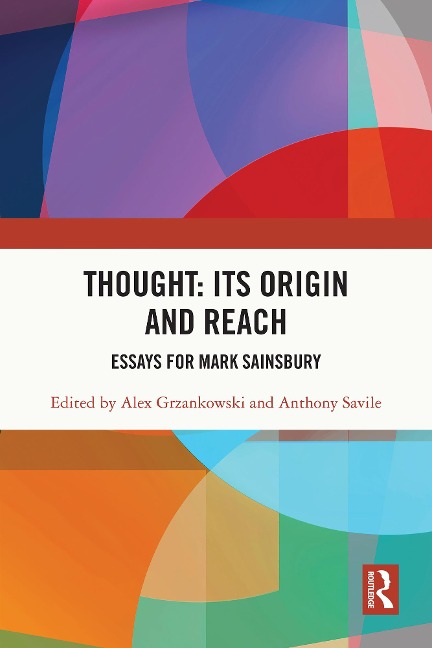
The work of Mark Sainsbury has made a significant and challenging contribution to several central areas of philosophy, especially philosophy of language and logic. He has made significant contributions to puzzles concerning the nature of thought and language and pioneered research in the philosophical theory known as fictionalism. In this outstanding volume, 20 contributors engage with Sainsbury's work but also go beyond it, exploring fundamental problems in the philosophy of language, mind, and logic. Topics covered include propositional thought, intentionality, the mind-body problem, singular thoughts, the individuation of concepts, nominalisation, logical form, non-existent objects, and vagueness. Thought: Its Origin and Reach will be of interest to professional philosophers and students working in philosophy of mind, language, epistemology, and metaphysics.
Alex Grzankowski is Reader in Philosophy at Birkbeck College and the Associate Director of the Institute of Philosophy at the School of Advanced Studies, University of London. His research is in the Philosophy of Mind and Language with a focus on intentionality and representation. He is an editor of Nonpropositional Intentionality (2018). Anthony Savile is Emeritus Professor of Philosophy at King's College London and Honorary Research Fellow at Birkbeck College, University of London.
Introduction Alex Grzankowski and Anthony Savile Part 1: Thought and Consciousness 1. Awareness of Universals Alex Grzankowski 2. More Vorblick than Flashback Anthony Savile 3. On Being Open Minded about Objectual Attitudes Mark Textor 4. A New Solution to the Hard Problem of Consciousness Michael Tye Part 2: Singular Thoughts and Displayed Thoughts 5. Reference and Form Rachel Goodman 6. Brentano's Legacy, Display Theory and Non-Existence Max Koelbel 7. The Gallows Graham Priest 8. Individuating (and typing) Mental Files François Recanati Part 3: Logic and Quantification 9. Definite Descriptions Graeme Forbes 10. Thoughts about Thinking about Things Hans Kamp 11. Special Quantification: Substitutional, Higher-Order and Nominalization Approaches Fredrike Moltmann 12. Two Notions of Rigidity Ian Rumfitt 13. Fast-Fish and Loose-Fish David Sosa Part 4: The Non-Existent, the Fictional, and the Exotic 14. Exotica Tim Crane 15. Judgements of Co-Identification Stacie Friend 16. Something and the Things that do not Exist Dolf Rami 17. Can We Dispense with Non-Existent Intentionalia? Alberto Voltolini Part 5: Vagueness 18. Two Kinds of Indeterminacy Dorothy Edgington 19. Sainsbury's Scrambled Sorites Dianna Raffman 20. Vagueness Redux: Boundaryless Concepts, the Transition Problem and Luminosity Crispin Wright. Index
Dieses eBook wird im PDF-Format geliefert und ist mit einem Adobe Kopierschutz (DRM) versehen. Sie können dieses eBook mit allen Geräten lesen, die das PDF-Format und den Adobe Kopierschutz (DRM) unterstützen.
Zum Beispiel mit den folgenden Geräten:
• tolino Reader
Laden Sie das eBook direkt über den Reader-Shop auf dem tolino herunter oder übertragen Sie das eBook auf Ihren tolino mit einer kostenlosen Software wie beispielsweise Adobe Digital Editions.
• Sony Reader & andere eBook Reader
Laden Sie das eBook direkt über den Reader-Shop herunter oder übertragen Sie das eBook mit der kostenlosen Software Sony READER FOR PC/Mac oder Adobe Digital Editions auf ein Standard-Lesegeräte mit epub- und Adobe DRM-Unterstützung.
• Tablets & Smartphones
Möchten Sie dieses eBook auf Ihrem Smartphone oder Tablet lesen, finden Sie hier unsere kostenlose Lese-App für iPhone/iPad und Android Smartphone/Tablets.
• PC & Mac
Lesen Sie das eBook direkt nach dem Herunterladen mit einer kostenlosen Lesesoftware, beispielsweise Adobe Digital Editions, Sony READER FOR PC/Mac oder direkt über Ihre eBook-Bibliothek in Ihrem Konto unter „Meine eBooks“ - „online lesen“.
Schalten Sie das eBook mit Ihrer persönlichen Adobe ID auf bis zu sechs Geräten gleichzeitig frei.
Bitte beachten Sie, dass die Kindle-Geräte das Format nicht unterstützen und dieses eBook somit nicht auf Kindle-Geräten lesbar ist.