
Stöbern
genialokal zum Startbildschirm hinzufügen
Installieren Sie die genialokal App auf Ihrem Startbildschirm für einen schnellen Zugriff und eine komfortable Nutzung.
Installieren Sie die genialokal App auf Ihrem Startbildschirm für einen schnellen Zugriff und eine komfortable Nutzung.
Tippen Sie einfach auf Teilen:
 Und dann auf "Zum Home-Bildschirm [+]".
Ihr gewünschter Artikel ist in 0 Buchhandlungen vorrätig - wählen Sie hier eine Buchhandlung in Ihrer Nähe aus:

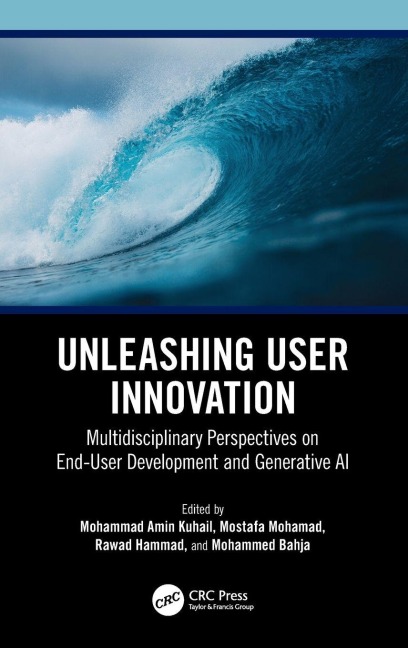
End-user development (EUD) is creating or modifying software by end users, typically non-programmers. EUD has become popular in recent years due to the rise of user-friendly low-code software development tools and the growing demand for custom software solutions by nonprogrammers. This book provides an overview of the latest trends in EUD.
Dr. Mohammad Amin Kuhail is a researcher in human-computer interaction, end-user development, and IT education. He has authored more than 30 publications. Dr. Mostafa Mohamad is an associate professor of Digital Innovation and Analytics at Zayed University, UAE, and at Newcastle Business School. Dr. Rawad Hammad is a co-director for Smart Health Centre, Programme Leader for MSc Computing Course, and MSc Digital Education Course, Technology Enhanced Learning Research Group Leader, and a senior lecturer in Computer Science and Digital Technologies at the University of East London. Dr. Mohammed Bahja is a lecturer in computer science at the University of Birmingham. His research interest is in data science for healthcare applications, including natural language processing for capturing patients' experience of the NHS, crime detection, and other horizon scanning applications.
I. The Rise of EUD and GenAI: Setting the Stage. 1. End-User Development: History, Classification, and Applications. 2. An Overview of End-User Development Tools for Building Chatbots. II. Empowering Educators with Prompt Engineering and GenAI 3. Employing Generative AI in Education: A Prompt Engineering Approach to Develop AI Literacy for Educators and Students. 4. AI-Enhanced Professional Development: Transforming Teaching Practices and Methodologies. 5. From Theory to Practice: Enhancing GenAI Fluency with Insights from Instructors' Reflections. III. Transforming Learning with GenAI 6. Enhancing Academic Feedback Through GenAI Prompt Engineering. 7. Optimizing Educational Resource Creation: A Comparative Study of ChatGPT and Google Gemini for Text Adaptation. 8. Text to Mind Map: Automated AI-based Conception for Effective Learning and Comprehension. 9. Enhancing Personalized Learning with Integrated Question Answering and Question Generation. 10. Revolutionizing Tutoring with Retrieval-Augmented Generation (RAG). 11. The Potential of Generative AI in Special Education: A Review of Applications and Impact. IV. Expanding Horizons: Applications of GenAI Across Industries 12. How Personalized Learning Can Bring Equity and Digital Inclusion in Education. 13. Exploring the Role of Generative AI for Immersive Experiences. 14. Generative AI Applications in the Tourism Industry: Opportunities and Challenges. 15. NLP and Prompt Engineering for AI Chatbots. 16. Predicting Adult Obesity Prevalence in Missouri Using Satellite Imagery and Deep Learning: A Multidisciplinary Approach to End-User Development and Prompt-Driven Innovation. 17. User Innovation and Generative AI in Public Health: Analyzing COVID- V. Ethics, Policy, and Global Perspectives of EUD and GenAI. 19 Data in Boone County, Missouri, with AI-Driven Prompts for Enhanced Community Safety. 18. End User Development for Mobile Money System: A Socio-Technical Perspective. 19. Punctuated Equilibrium: Exploring Public Attitudes Towards Artificial Intelligence Across 35 Countries. 20. GenAI and Ethics: A proposed approach for ethical development and Utilization of ChatGPT in Education. 21. Ethical Considerations in the Deployment of Generative AI Technologies.