
Stöbern
genialokal zum Startbildschirm hinzufügen
Installieren Sie die genialokal App auf Ihrem Startbildschirm für einen schnellen Zugriff und eine komfortable Nutzung.
Installieren Sie die genialokal App auf Ihrem Startbildschirm für einen schnellen Zugriff und eine komfortable Nutzung.
Tippen Sie einfach auf Teilen:
 Und dann auf "Zum Home-Bildschirm [+]".
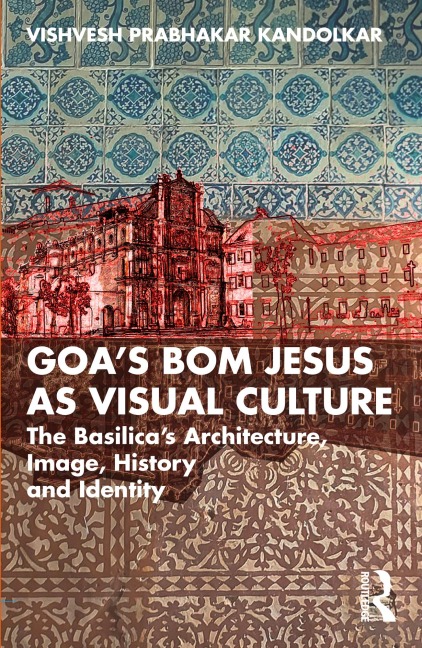
This book chronicles the visual history of the Basilica of Bom Jesus, one of the longest-surviving churches from Goa's Portuguese colonial era. In the sixteenth century, this baroque church in Old Goa was constructed to house the sacred relics of St. Francis Xavier and is emblematic of Goa Dourada or Golden Goa. Despite their early modern origins, monuments like the Basilica continue to influence visual culture that pertains to Goa. Accordingly, this book uncovers the traces of architectural images of Goa's sixteenth- and seventeenth-century monuments and conducts a genealogical study of how uses of religious architecture shift over time. Thus, even as the Basilica originally functioned to portray or recall a grand empire by evoking the notion of Goa Dourada, its iconicity has been employed in marking Goa's difference from the rest of India thereafter. By employing an analysis of historical texts, illustrations, photography, film, and pageantry, this volume demonstrates how the image of the Basilica has been employed to create a discourse on Goan identity. In fact, right from the colonial period, when Goa was heralded as the Rome of the East, to the post-Portuguese period, when Goa became an idyllic destination for leisure tourism, architectural images of Bom Jesus have been central in shaping Goa's identity. Goa's Bom Jesus as Visual Culture will be useful to students and educators in the fields of architecture, history, anthropology, sociology, history of architecture, and colonial/postcolonial studies. Finally, the long history of a single monument that the book documents highlights how Goans have been shaping their unique culture. At the same time as Goans imbibed Portuguese and other European influences, they also domesticated and remade such colonial heritage in South Asian fashion and, in turn, contributed to global aesthetics.
Vishvesh Prabhakar Kandolkar is Associate Professor at the Goa College of Architecture, India. His research on Goa's architectural history focuses on early modern church design as well as the evolution of Indo-Portuguese aesthetics from the colonial to the postcolonial period. His writing has appeared in peer-reviewed journals, including the Journal of the Society of Architectural Historians, Verge: Studies in Global Asias, the Oxford Journal of Hindu Studies, eTropic, the Journal of Human Values, and Economic and Political Weekly.
List of Figures. Acknowledgements. 1. Bom Jesus's Golden (After)Life 2. 3. Resurrection: Bom Jesus and the Print Publications of the Nineteenth Century 4. Negative Space and Bom Jesus: Photography as Strategy in Late-Colonial Old Goa 5. Itinerant Saint: The Architecture of Golden Goa and the 1952 Exposition of St. Francis Xavier's Relics 6. Rain in the Basilica. Index.
Dieses eBook wird im PDF-Format geliefert und ist mit einem Adobe Kopierschutz (DRM) versehen. Sie können dieses eBook mit allen Geräten lesen, die das PDF-Format und den Adobe Kopierschutz (DRM) unterstützen.
Zum Beispiel mit den folgenden Geräten:
• tolino Reader
Laden Sie das eBook direkt über den Reader-Shop auf dem tolino herunter oder übertragen Sie das eBook auf Ihren tolino mit einer kostenlosen Software wie beispielsweise Adobe Digital Editions.
• Sony Reader & andere eBook Reader
Laden Sie das eBook direkt über den Reader-Shop herunter oder übertragen Sie das eBook mit der kostenlosen Software Sony READER FOR PC/Mac oder Adobe Digital Editions auf ein Standard-Lesegeräte mit epub- und Adobe DRM-Unterstützung.
• Tablets & Smartphones
Möchten Sie dieses eBook auf Ihrem Smartphone oder Tablet lesen, finden Sie hier unsere kostenlose Lese-App für iPhone/iPad und Android Smartphone/Tablets.
• PC & Mac
Lesen Sie das eBook direkt nach dem Herunterladen mit einer kostenlosen Lesesoftware, beispielsweise Adobe Digital Editions, Sony READER FOR PC/Mac oder direkt über Ihre eBook-Bibliothek in Ihrem Konto unter „Meine eBooks“ - „online lesen“.
Schalten Sie das eBook mit Ihrer persönlichen Adobe ID auf bis zu sechs Geräten gleichzeitig frei.
Bitte beachten Sie, dass die Kindle-Geräte das Format nicht unterstützen und dieses eBook somit nicht auf Kindle-Geräten lesbar ist.