
Stöbern
genialokal zum Startbildschirm hinzufügen
Installieren Sie die genialokal App auf Ihrem Startbildschirm für einen schnellen Zugriff und eine komfortable Nutzung.
Installieren Sie die genialokal App auf Ihrem Startbildschirm für einen schnellen Zugriff und eine komfortable Nutzung.
Tippen Sie einfach auf Teilen:
 Und dann auf "Zum Home-Bildschirm [+]".

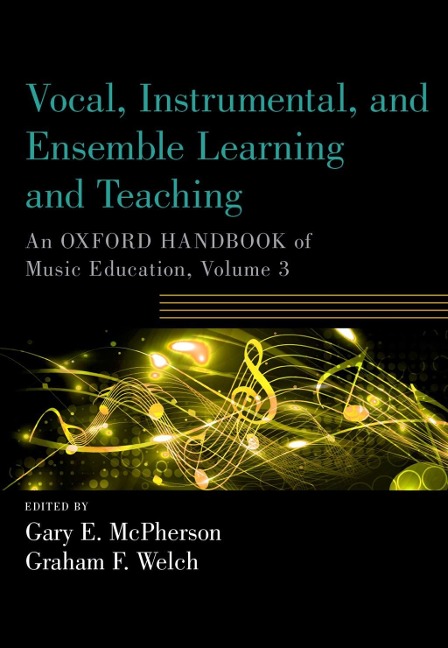
Vocal, Instrumental, and Ensemble Learning and Teaching is one of five paperback books derived from the foundational two-volume Oxford Handbook of Music Education. Designed for music teachers, students, and scholars of music education, as well as educational administrators and policy makers, this third volume in the set emphasizes the types of active musical attributes that are acquired when learning an instrument or to sing, together with how these skills can be used when engaging musically with others. These chapters shed light on how the field of voice instruction has changed dramatically in recent decades and how physiological, acoustical, biomechanical, neuromuscular, and psychological evidence is helping musicians and educators question traditional practices. The authors discuss research on instrumental learning, demonstrating that there is no 'ideal' way to learn, but rather that a chosen learning approach must be appropriate for the context and desired aims. This volume rounds out with a focus on a wide range of perspectives dealing with group performance of instrumental music, an area that is organized and taught in many varied ways internationally. Contributors Alfredo Bautista, Robert Burke, James L. Byo, Jean Callaghan, Don D. Coffman, Andrea Creech, Jane W. Davidson, Steven M. Demorest, Robert A. Duke, Robert Edwin, Shirlee Emmons, Sam Evans, Helena Gaunt, Susan Hallam, Lee Higgins, Jere T. Humphreys, Harald Jers, Harald Jørgensen, Margaret Kartomi, Reinhard Kopiez , William R. Lee, Andreas C. Lehmann, Gary E. McPherson, Steven J. Morrison, John Nix, Ioulia Papageorgi, Kenneth H. Phillips, Lisa Popeil, John W. Richmond, Carlos Xavier Rodriguez, Nelson Roy, Robert T. Sataloff, Frederick A. Seddon, Sten Ternström, Michael Webb, Graham F. Welch, Jenevora Williams, Michael D. Worthy
Gary E. McPherson studied music education at the Sydney Conservatorium of Music, before completing a master of music education at Indiana University, a doctorate of philosophy at the University of Sydney, and a Licentiate and Fellowship in trumpet performance through Trinity College, London. He is the Ormond Professor and Director of the Melbourne Conservatorium of Music at the University of Melbourne, and has served as National President of the Australian Society for Music Education and President of the International Society for Music Education. His research interests are broad and his approach interdisciplinary. His most important research examines the acquisition and development of musical competence, and motivation to engage and participate in music from novice to expert levels. With a particular interest in the acquisition of visual, aural and creative performance skills he has attempted to understand more precisely how music students become sufficiently motivated and self-regulated to achieve at the highest level. Graham F. Welch holds the University College London (UCL) Institute of Education Established Chair of Music Education. He is elected Chair of the internationally based Society for Education, Music and Psychology Research (SEMPRE), a former President of the International Society for Music Education (ISME), and past co-chair of the Research Commission of ISME. Current Visiting Professorships include the Universities of Queensland (Australia), Guildhall School of Music and Drama, and Liverpool (UK). He is an ex-member of the UK Arts and Humanities Research Council's (AHRC) Review College for music and has been a specialist consultant for Government departments and agencies in the UK, Italy, Sweden, USA, Ukraine, UAE, South Africa and Argentina. Publications number over three hundred and fifty and embrace musical development and music education, teacher education, the psychology of music, singing and voice science, and music in special education and disability. Publications are in English, Spanish, Portuguese, Italian, Swedish, Greek, Japanese and Chinese.
Part 1 Vocal and Choral Music Part Editor: John Nix Chapter 1. Commentary: Vocal and choral music? John Nix Chapter 2. Solo voice pedagogy? Jean Callaghan, Shirlee Emmons, and Lisa Popeil Chapter 3. Group and ensemble vocal music? Sten Ternström, Harald Jers, and John Nix Chapter 4. The young singer? Ken Phillips, Jenevora Williams, and Robert Edwin Chapter 5. The older singer? Robert T. Sataloff and Jane Davidson Chapter 6. Voice health and vocal education? John Nix and Nelson Roy
Part 2 Instrumental Music Part Editor: Susan Hallam Chapter 7. Commentary: Instrumental music? Susan Hallam Chapter 8. Processes of instrumental learning: The development of musical expertise? Susan Hallam and Alfredo Bautista Chapter 9. Practice? Andreas C. Lehmann and Harald Jørgensen Chapter 10. The changing face of individual instrumental tuition: Value, purpose and potential? Andrea Creech and Helena Gaunt Chapter 11. Building musicianship in the instrumental classroom? Robert A. Duke and James L. Byo Chapter 12. Psychological and physiological aspects of learning to perform? Ioulia Papageorgi and Reinhard Kopiez Chapter 13. Musical instrument learning, music ensembles, and musicianship in a global and digital age? Michael Webb and Frederick A. Seddon Chapter 14. The role of bodily movement in learning and performing music: Applications for education? Jane Davidson Part 3 Ensembles Part Editor: Jere T. Humphreys Chapter 15. Commentary: Ensembles? Jere T. Humphreys Chapter 16. The sociology and policy of ensembles? John W. Richmond Chapter 17. North American school ensembles? William R. Lee with Michael D. Worthy Chapter 18. Once from the top: Reframing the role of the conductor in ensemble teaching? Steven J. Morrison and Steven M. Demorest Chapter 19. Community music ensembles Don D. Coffman and Lee Higgins Chapter 20. Youth orchestras? Margaret Kartomi Chapter 21. Popular music ensembles? Carlos Xavier Rodriguez Chapter 22. Pathways to learning and teaching indigenous and world music ensembles? Robert Burke and Sam Evans