
Stöbern
genialokal zum Startbildschirm hinzufügen
Installieren Sie die genialokal App auf Ihrem Startbildschirm für einen schnellen Zugriff und eine komfortable Nutzung.
Installieren Sie die genialokal App auf Ihrem Startbildschirm für einen schnellen Zugriff und eine komfortable Nutzung.
Tippen Sie einfach auf Teilen:
 Und dann auf "Zum Home-Bildschirm [+]".
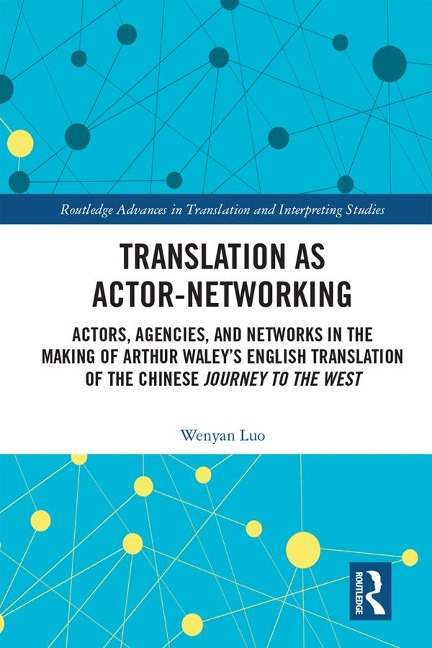
This book employs actor-network theory (ANT) to explore the making of the English translation of a work of Chinese canonical fiction, Journey to the West, demonstrating how ANT, as applied to Translation Studies, can contribute to a richer understanding of the translation process. The volume builds on previous research to apply ANT theory to translation studies by looking in-depth at a single work, highlighting the unique factors underpinning the making of Monkey, Arthur Waley's English translation of the Chinese classic Journey to the West, which make the work an ideal candidate for showing ANT theory in practice in translation. Luo uses an in-depth exploration of the work to examine the ways in which both human and nonhuman translation actors and agents interact in different ways in the publication of this translation, showcasing them as dynamic, changing, and active participants whose roles shifted over the course of the translation process, rather than as fixed entities as traditionally categorized in existing research. The book moves beyond a descriptive account of an ANT-based case study toward offering a systematic theoretical and methodological framework of ANT-based translation studies, using the conclusions drawn from its application to a single work to suggest a way forward for applying ANT in translation production on a wider scale. This book will be of interest to scholars in translation studies, sociology, and comparative literature, particularly those interested in actor-network theory or network studies and their application to related disciplinary fields.
Wenyan Luo received her PhD in 2019 from Durham University, UK. Her research interests lie in text analysis in translation, history of translation between English and Chinese, translation ethics, translator studies, and sociology of translation, in particular Actor-network Theory-approached translation studies.
Introduction Chapter 1 Actor-Network Theory 1.1 Basic clarifications of the name and nature of actor-network theory 1.2 Nonhuman actor 1.3 Long distance control 1.4 The black box 1.5 TranslationANT 1.6 Obligatory passage point 1.7 Immutable mobiles, inscriptions and centres of calculation Chapter 2 Research Context 2.1 Journey to the West: the novel 2.2 The many English translations of Journey to the West 2.3 Monkey translated by Waley: focus of the present study 2.4 Monkey: a unique translation of popularity and fame 2.5 Positioning the research: from literature to the present study 2.6 Approaches to data selection and analysis Chapter 3 The Monkey Project: A Translation in Production 3.1 The Monkey project: a translation under production (1941-1942) 3.2 The Monkey project: from slow to accelerated expansion Chapter 4 All about People: Multiple Human Actors, Multiplied Roles 4.0 Prelude: more actors, but not overwhelmingly more 4.1 Arthur Waley: more than the translator of Monkey 4.2 Duncan Grant: the designer being controlled and resisted
Dieses eBook wird im PDF-Format geliefert und ist mit einem Adobe Kopierschutz (DRM) versehen. Sie können dieses eBook mit allen Geräten lesen, die das PDF-Format und den Adobe Kopierschutz (DRM) unterstützen.
Zum Beispiel mit den folgenden Geräten:
• tolino Reader
Laden Sie das eBook direkt über den Reader-Shop auf dem tolino herunter oder übertragen Sie das eBook auf Ihren tolino mit einer kostenlosen Software wie beispielsweise Adobe Digital Editions.
• Sony Reader & andere eBook Reader
Laden Sie das eBook direkt über den Reader-Shop herunter oder übertragen Sie das eBook mit der kostenlosen Software Sony READER FOR PC/Mac oder Adobe Digital Editions auf ein Standard-Lesegeräte mit epub- und Adobe DRM-Unterstützung.
• Tablets & Smartphones
Möchten Sie dieses eBook auf Ihrem Smartphone oder Tablet lesen, finden Sie hier unsere kostenlose Lese-App für iPhone/iPad und Android Smartphone/Tablets.
• PC & Mac
Lesen Sie das eBook direkt nach dem Herunterladen mit einer kostenlosen Lesesoftware, beispielsweise Adobe Digital Editions, Sony READER FOR PC/Mac oder direkt über Ihre eBook-Bibliothek in Ihrem Konto unter „Meine eBooks“ - „online lesen“.
Schalten Sie das eBook mit Ihrer persönlichen Adobe ID auf bis zu sechs Geräten gleichzeitig frei.
Bitte beachten Sie, dass die Kindle-Geräte das Format nicht unterstützen und dieses eBook somit nicht auf Kindle-Geräten lesbar ist.