
Stöbern
genialokal zum Startbildschirm hinzufügen
Installieren Sie die genialokal App auf Ihrem Startbildschirm für einen schnellen Zugriff und eine komfortable Nutzung.
Installieren Sie die genialokal App auf Ihrem Startbildschirm für einen schnellen Zugriff und eine komfortable Nutzung.
Tippen Sie einfach auf Teilen:
 Und dann auf "Zum Home-Bildschirm [+]".
Ihr gewünschter Artikel ist in 0 Buchhandlungen vorrätig - wählen Sie hier eine Buchhandlung in Ihrer Nähe aus:

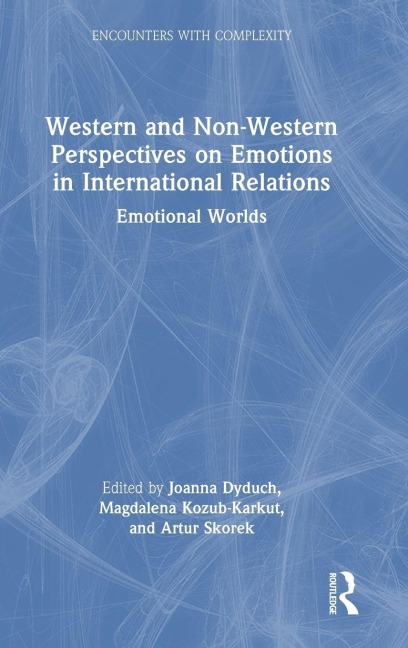
This book investigates emotions within International Relations (IR), focusing on their role in shaping political actions and global interactions. For decades, IR theorists and politicians emphasized rational decision-making. However, recent scholarship has sparked a wave of interest in emotions, uncovering their significant influence. Collecting cutting-edge research that situates the emotional turn within the broader idea of Global IR, international contributors consider Western and non-Western emotional norms to reveal how cultural diversity permeates emotional expression and its role in politics. With case studies exploring emotions in contexts such as the China-Taiwan conflict, Western states' policy toward Israel, Polish foreign policy, the Korean War, the African Union responses, role of pain in the Middle Eastern context, and anti-liberal contestations in Latin America, this book is primarily aimed at scholars and advanced students in International Relations, Political Science, and Global and Area Studies.
Joanna Dyduch is Professor at Jagiellonian University in Kraków, Poland, Political Scientist, and an International Relations Scholar. She heads the Department of Israel at the Institute of the Middle and Far East and is Director of the Centre for International Studies and Development at the Faculty of International and Political Studies. Her research focuses on foreign policy analysis, particularly in contemporary Israel, the European Union, and EU member states. Magdalena Kozub-Karkut is Assistant Professor at the Faculty of International and Political Studies of the Jagiellonian University in Kraków, Poland. In research work, she deals with the Theory of Politics, International Relations Theory, Foreign Policy Analysis, Research Methodology in the Social Sciences and Theoretical Pluralism. She took part in many international workshops and conferences and is a member of the Polish International Studies Association (PTSM), Polish Political Science Association (PTNP), International Studies Association (ISA), and European International Studies Association (EISA). Since 2023, she has also been a member of the EISA Governing Board. Artur Skorek is Adjunct Professor at the Institute of the Middle and Far East, Jagiellonian University in Kraków (UJ), Poland. He is a political scientist specializing in Israel and International Relations. He holds a PhD in International Relations and an MA in International Relations and Religion Studies from UJ. His research spans the areas of the political system in Israel, religion in international relations and foreign policies, and security in the Middle East. He served as a Chair of the European Association of Israel Studies.
Section I: Theoretical Framework Chapter 1: Setting the Stage: Toward Greater Pluralism in Studies on Emotions in International Relations by Joanna Dyduch, Magdalena Kozub-Karkut and Artur Skorek. Chapter 2: Emotions around the world: Examining emotions as a representation of the Global IR turn by Magdalena Kozub-Karkut. Section II: Local Emotions and Global Liberal World Order Chapter 3: Emotional responses to the liberal world order and democratic values in Pakistan's domestic and international political discourses by Agnieszka Kuszewska-Bohnert Chapter 4: Foreign Policy Historicism: A hawkish ideology and pragmatic operational strategy - a case study of Poland's emotional foreign policy (2015-2023) by Joanna Dyduch Chapter 5: Weaponizing Emotion: Post-Shame Populism, Transnational Affects, and the Making of Electoral Capital in Latin America by Agustín Tomás Alcalde Chapter 6: Navigating contemporary poly/permacrisis: denialism and conspiracism in Brazil's far-right populist logic by Camilla Monteiro Freire and Paula Orrico Sandrin. Section III: West Facing "The Other": How Emotions Shape Western States' Foreign Policies Toward Non-Western Actors? Chapter 7: A Caring Moment: Emotion Norms in European Union - African Union Security Cooperation by John J. Hogan, Özlem Terzi. Chapter 8: "The feminist, the egoist and the altruist"? Morality and emotions in debates on how to "save strangers" in the Polish Sejm, UK House of Commons and the European Parliament by Marcin Zubek. Chapter 9: Solidarity and Shaming: An Emotional Dimension of Israel-Western States Relations after 7 October 2023 by Artur Skorek. Section IV: Political Instrumentalization of Emotions Chapter 10: China's Anger and the Taiwan Question: Is It an Authentic Impulse or a Rational Strategy in Xi Jinping's New Era? by Antonina -uszczykiewicz-Mendis and Patrick Mendis. Chapter 11: Polish-Ukrainian Conflict Over Agricultural Trade: Game of Interests or Result of Emotions? by Mägorzata Michalewska-Pawlak. Chapter 12: Is Pain Middle Eastern? Towards accounting for the variable of pain in the social grammar of the Middle East by Noor Suwwan. Conclusions