
Stöbern
genialokal zum Startbildschirm hinzufügen
Installieren Sie die genialokal App auf Ihrem Startbildschirm für einen schnellen Zugriff und eine komfortable Nutzung.
Installieren Sie die genialokal App auf Ihrem Startbildschirm für einen schnellen Zugriff und eine komfortable Nutzung.
Tippen Sie einfach auf Teilen:
 Und dann auf "Zum Home-Bildschirm [+]".

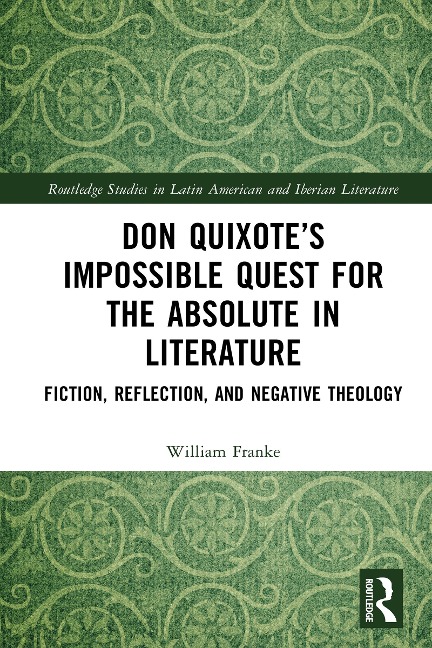
This book offers a reading particularly of Part II of Don Quixote, a reading that is embedded in a philosophical reflection on the revelation of religious truth in and through literature. Part II of Don Quixote is the far richer part for its meta-literary reflection on the novel itself as a genre and on life as such seen through the lens of self-reflection. The author has treated the phenomenon of modern self-reflexivity as originally theological in nature in previous publications (notably Dante's Paradiso and the Theological Origins of Modern Thought: Toward a Speculative Philosophy of Self-Reflection, Routledge, 2021). The present endeavor expands this overall intellectual project, extending it into detailed consideration of what is recognizably another nodal great work inaugurating unprecedented forms of self-reflection in the early modern period. Reading the founding texts of literary and cultural tradition in this negative-theological key proves crucial to allowing them to release the full force of their religious vision in the present age, despite its sometimes obstinate secularity. This reading absorbs and reconciles the religious and secular readings of Miguel de Unamuno and José Ortega y Gasset, two of Spain's outstanding philosophical luminaries. Both thinkers based their entire philosophies and their analyses of the Spanish national character and destiny on their interpretations of the Quixote. Negative theology deploys critical reason that critiques the limits of reason itself and opens toward an unfathomable (un)ground of All. Such speculative interpretation performs a synthesis of the secularizing and sacralizing tendencies that are both sublimely operative in the text of the Quixote. It thereby enables the work to emerge in the fully parodic and paradoxical vitality that other interpretations, governed by one paradigm or the other, access only partially. Rather than falling into one camp or the other, the proposed approach combines and resources both heritages, sacred and secular, in their deepest synergisms. Spanish baroque mysticism and contemporary post-secular thought are made to converge in highlighting the blessed, even sacred, donation that literature like Don Quixote preserves and transmits as our most precious and saving cultural heritage.
William Franke is Professor of Comparative Literature at Vanderbilt University. He is currently Francesco de Dombrowski Professor in Residence at the Harvard University Center for Renaissance Studies in Florence (Villa I Tatti) and Senior Fellow of the International Institute for Hermeneutics. He has been Research Fellow of the Alexander von Humboldt-Stiftung, Professor of Philosophy at the University of Macao, Visiting Professor of Philosophy at the University of Navarra, and Fulbright Distinguished Chair in Intercultural Theology and the Study of Religions at the University of Salzburg. His books include On What Cannot Be Said (2007); Poetry and Apocalypse (2009); Dante and the Sense of Transgression (2013); A Philosophy of the Unsayable (2014); The Revelation of Imagination (2015); Secular Scriptures (2016); A Theology of Literature (2018); The Universality of What is Not (2020); The Divine Vision of Dante's Paradiso (2021); The Vita Nuova and the New Testament (2021); Dantologies (2024); and numerous others.
List of Figures Acknowledgments Prologue Concerning Apophatic Theology in Literary Representation and Reflection Chapter 1 The Revelation of Laughter: Cervantes's Comic Christian Muse The Power of Laughter-The Wisdom of Folly A Negative Theological Reading of Don Quixote Fool for Christ as Universal Sage Don Quixote's Contemporaneity and Universality The Holy Fool as Christian Saint and Crusader Unamuno and Ortega: Dialectic of the Religious and the Secular Chapter 2 Self-reflective Dynamics of Revelation in Literature A. Self-subversive Mirroring Between and Among the Protagonists The Knight of Mirrors and of the White Moon as Self-reflection of Don Quixote Don Quixote's Ideal Reflected in Sancho-and Inversely Self-reflexivity as Self-fulfilling Ideal Becoming a Book and Reading One's Life B. Self-reflection and Undermining the Authority of the Author Self-reflective Questioning of Authorship Cervantes's Self-representations in the Prologues Authorship and Originality Self-reflexivity in the Narrative Structure of Fiction Fictionalization of Author by Self-reflection-Kafka and Borges The Dialectic of Self-reflection and Negative Theology Chapter 3 Negative Theology of the Novel The Novel as Breaking Down the Separation of Styles-Auerbach Recognition Scenes: Epiphanies and Theophanies The Novel as Subjective Reflective Medium and Genre Reflecting Concrete Reality The Novel as Subjectively Lived Experience The Novel as a New and Comprehensive Genre Dialectics of Wholeness The In-breaking of External Reality Into Fiction Mutual Contamination of History and Fiction and Their Exposure to Externality Maese Pedro's Puppet Show and Unamuno's Move Through Fiction to Reality Ortega on Literary Genre: From Epic Myth to Novelistic Formal Reality Novelistic Creation of Formal Reality-Ortega and Maese Pedro's Puppet Theatre Fiction and Realization of the Ideal Chapter 4 Visionary Experience in the Cave of Montesinos as Revelation via Parody The Vision of Montesinos, or the Part of Fiction in the Construction of Prophetic Revelation The Question of Truth Raised by the Vision in the Cave Artifice and the Limits of the Control of the Author The Reality that Our Fictions Become The Ontological Argument for Dulcinea's Existence Real Costs of One's Fictive Inventions Repetitions of Visionary Revelation following Montesinos Sancho's Perversion of Visionary Experience-Clavileño Visionary Revelation After the Cave of Montesinos-Its Translation Into the Everyday Chapter 5 Dialectic of Religious Truth and Its Secular Simulation Religious and Anti-religious Interpretations of the Quixote: Religion Versus Secularity Velázquez's Las Meninas: Self-reflexivity and the Other Camacho's Wedding as Theatrical Artifice and Its Sacramental Transfiguration Baroque Aesthetics of Contrast, the Grotesque, and Theatricalization of the World Feminine Beauty as Ideal and as Simulation Transvestism, Love of Artifice, and the Transhuman Formal Dimension of Reality-Names as Revelation-Antonomasia Archetypal Image and Primal Naming-Spitzer's Linguistic Perspectivism The Epistolary Novel and the Scriptural Ideal Dialectic of Self-reflective Desengaño and Disinterested Dedication Chapter 6 A Political Novel: Representation of an Idealized World Versus Contemporary Reality The Baroque Age: Aesthetics of the Ideal, Realism, and the Unrepresentable Barataria as Anti-utopia of a Perfectly Artificial State Knowing One's Limits and Becoming Oneself: Sancho in "Hell" The Contemporary Expulsion Drama and the Apotheosis of Fiction The Realistic Political Novel as an Overture to Modernity Barcelona and the New Materialism Chapter 7 The Passion of Sancho Panza and the Death of Don Quixote The Wise Fool-Like Master Like Servant: Sancho's Governance Sancho's Assuming the Lead Position in the Duo Visionary Revisitations-Sancho in the Role of the Christ Figure Altisidora's Invention of a Visionary Revelation Don Quixote's Death and Bequest-The Heroism of the Common Person? The Christian Death of Alonso Quijano-and Sancho's Passion to Live Chapter 8 The Metaphysics of Fiction The Force of Fiction Real Tragedy in Fiction-Carl Schmitt Ambiguity of Fictive Truth in Epic Tradition and Its Modern Parody What Makes a Book of Poetic Literature Great-or Revelatory? The Integration of Fiction into Reality and Vice Versa-Vargas Llosa Self-reflection at the Juncture of Fiction and Ultimate Reality The Apophatic in Literature-An Aesthetic Dimension of the Real Chapter 9 Philosophies of Quixotism Unamuno's Quixotesque Turning of Philosophy into Religion Ortega's Cervantesque Philosophy of Desengaño as a Theory of Genres Unamuno on Quixotism as the True Philosophy and Religion of the Spanish People Unamuno's Staging of the Battle Between Reason and Faith-Reason's Self-undermining The Novel as Philosophy, Don Quixote as Tragicomedy Towards Ortega's Philosophy of Relations as a Type of Secular Revelation Maria Zambrano's Mediation of Two Philosophical Masters A Parting Reflection Index