Und dann auf "Zum Home-Bildschirm [+]".

Stöbern
genialokal zum Startbildschirm hinzufügen
Installieren Sie die genialokal App auf Ihrem Startbildschirm für einen schnellen Zugriff und eine komfortable Nutzung.
Installieren Sie die genialokal App auf Ihrem Startbildschirm für einen schnellen Zugriff und eine komfortable Nutzung.
Ihr gewünschter Artikel ist in 0 Buchhandlungen vorrätig - wählen Sie hier eine Buchhandlung in Ihrer Nähe aus:

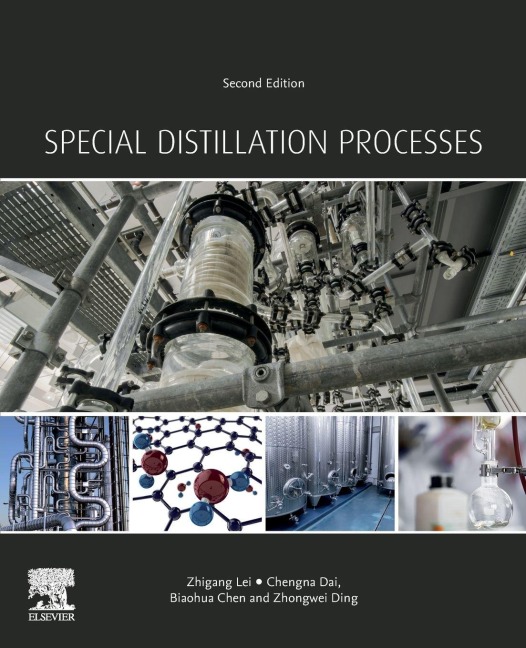
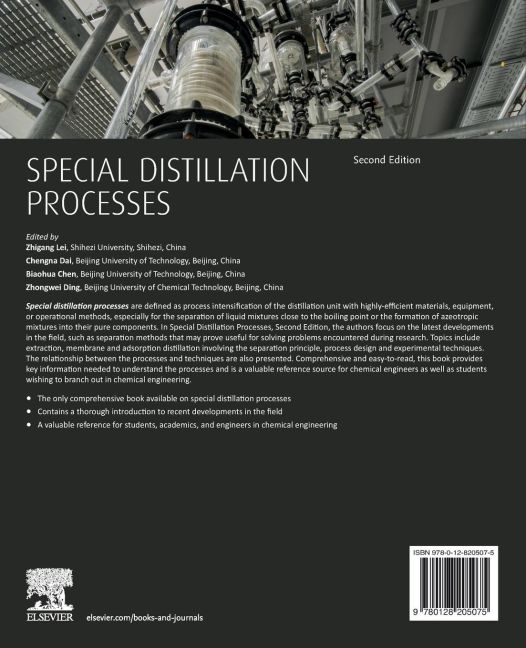
Special Distillation Processes, Second Edition focuses on the latest developments in the field, such as separation methods that may prove useful for solving problems encountered during research. Topics include extraction, membrane and adsorption distillation involving the separation principle, process design and experimental techniques. The relationship between processes and techniques are also presented. Comprehensive and easy-to-read, this book provides key information needed to understand processes. It will be a valuable reference source for chemical engineers and students wishing to branch out in chemical engineering.
Zhigang Lei was born in Hubei province (China) in 1973. He received his B.S. degree in 1995 from Wuhan Institute of Technology, and Ph.D. degree in 2000 from Tsinghua University. Then, he became a postdoctoral researcher in Beijing University of Chemical Technology working with Professor Chengyue Li. In 2003 - 2005, he worked as a researcher in Research Center of Supercritical Fluid Technology (Tohoku University, Sendai, Japan). In 2005 - 2006, he got the world-famous Humboldt Fellowship and carried out his research in Chair of Separation Science and Technology (Universität Erlange-Nürnberg, Erlangen, Germany). In 2006, he came back to China. He is now a Professor in State Key Laboratory of Chemical Resource Engineering (BUCT, China). His current research interests include chemical process intensification and predictive molecular thermodynamics. He has contributed to about 140 papers in international journals and one book entitled "Special Distillation Processes published by Elsevier B.V. (2005).
1. Thermodynamic fundamentals 2. Extractive distillation 3. Azeotropic distillation 4. Catalytic distillation 5. Adsorption distillation 6. Membrane distillation 7. Pressure-swing distillation 8. Pressure-swing distillation