
Stöbern
genialokal zum Startbildschirm hinzufügen
Installieren Sie die genialokal App auf Ihrem Startbildschirm für einen schnellen Zugriff und eine komfortable Nutzung.
Installieren Sie die genialokal App auf Ihrem Startbildschirm für einen schnellen Zugriff und eine komfortable Nutzung.
Tippen Sie einfach auf Teilen:
 Und dann auf "Zum Home-Bildschirm [+]".
Ihr gewünschter Artikel ist in 0 Buchhandlungen vorrätig - wählen Sie hier eine Buchhandlung in Ihrer Nähe aus:

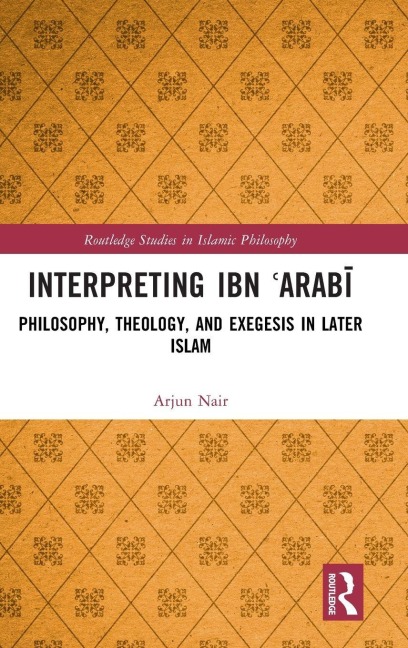
Interpreting Ibn -Arab-: Philosophy, Theology and Exegesis in Later Islam offers a comprehensive and critical examination of one of Islam's most enigmatic and influential thinkers.
Arjun Nair is an Assistant Professor of Religion at the University of Southern California. He holds a PhD in the History and Cultures of the Muslim World from the Department of Near Eastern Languages & Civilizations at Harvard University. He specializes in the study of religion, Islamic philosophy, and Sufi literature. He has also published in numerous peer- reviewed venues, including the Journal of Islamic Studies, the Journal of Qur-anic Studies, the Journal of Sufi Studies, Religions, and the Journal of the Muhyiddin Ibn -Arabi Society.
Acknowledgments Note on Transliteration and Translation Introduction The Problems (mushkil-t) of the Fu---: Interpretive Divergences From the Lack of Understanding (-adam al-fahm): Solving the Problems of the Fu--- The Present Study: Interpreting Ibn -Arab- 1 "All is He, All is Not He": The Vision of Huwa-l- Huwa The Entities (äy-n) are Not Made (ghayr maj--l) and Non-Existent (mäd-m) The Mirror-Entities and the Color-Entities The Pre-Existent Forms (-uwar) of the Entities: The Cloud, the Barzakh, the Creator-Real 2 Divine Power and Human Freedom The Essence (Dh-t) and the Divinity (Il-h), Determination (taqd-r) and Creation (khalq) Freedom and Compulsion, Responsibility (takl-f) and Predestination (qadar) 3 Incomparability and Similarity To Affirm Incomparability is to Affirm Limitation (täd-d) and Restriction (taqy-d) Transcending the God of Beliefs (al-il-h al-mu-taqad-t) The Divinity Clothed in Forms of Belief: Worshiping the Idols of Belief 4 "Created in his/His Form": The All-Comprehensive Form of Man Originated and Beginningless (--dith azal-), Perpetual and Endless (d--im abad-) The Problem of Man's Firstness (awwaliyya) Creation (khalaqa) in Two Senses: Determination (taqd-r) and Existentiation (-j-d) 5 Becoming a Form of God (--rat al--aqq) The False Form (--ra b--ila) of the Pharaoh of Moses (Fir-awn M-s-) The Form of al-Kharr-z, One of the Tongues of God (lis-n min alsinat al--aqq) 6 The Messenger takes his Knowledge from the Seal of the Saints The Prophets (anbiy--) in the Fu--- al--ikam The Seal of the Saints: "the space for two bricks" (maw-i- labinatayn) 7 Interpreting the Qur--n Between täw-l, ish-ra, and -ub-r: Ibn -Arab-'s Qur--nic Hermeneutics Abraham's Sacrifice (dhab-), God's Deception (makr), Drowning in Knowledge 8 The Hermeneutics of Mercy The Faith of Pharaoh (-m-n Fir-awn) in Q. 10:90-92 From Torments (-adh-b) to the Sweetness of Torments (-udh-ba) Conclusion: Interpreting the Shaykh al-Akbar "He/not He" Revisited: Ambiguity and Knowledge as Perplexity (-ayra) "He who does not know the status of imagination has no knowledge" Bibliography Index