
Stöbern
genialokal zum Startbildschirm hinzufügen
Installieren Sie die genialokal App auf Ihrem Startbildschirm für einen schnellen Zugriff und eine komfortable Nutzung.
Installieren Sie die genialokal App auf Ihrem Startbildschirm für einen schnellen Zugriff und eine komfortable Nutzung.
Tippen Sie einfach auf Teilen:
 Und dann auf "Zum Home-Bildschirm [+]".

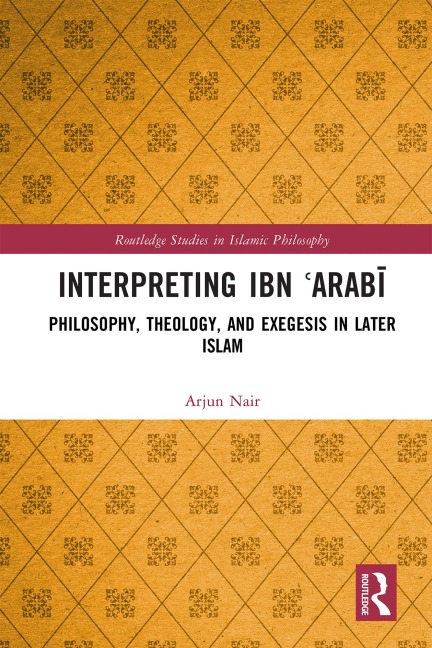
Interpreting Ibn -Arabi: Philosophy, Theology, and Exegesis in Later Islam offers a comprehensive and critical examination of one of Islam's most enigmatic and influential thinkers. Through close engagement with major controversies surrounding Ibn -Arabi's ideas- from the doctrine of the Oneness of Being to his vision of sainthood and Qur-anic interpretation- this volume traces the rich and contested legacy of his thought across the Islamic intellectual tradition. Addressing the most debated aspects of Ibn -Arabi's teachings, this book surveys the major contests around the fixed entities, Divine Power, human freedom, and the nature of the Perfect Man. It delves into accusations of pantheism and theological transgression, and explores the strategies employed by the Shaykh al-Akbar's followers to clarify, defend, or reinterpret his views. It also explores Ibn -Arabi's provocative Qur-anic hermeneutics, which includes perspectives on mercy, the problem of idolatry, and the fate of unbelievers, situating the Shaykh's teachings within broader Sufi, philosophical, and theological currents. Finally, it reveals how Ibn -Arabi challenged dominant rationalist frameworks and expanded the boundaries of Islamic knowledge by restoring to imagination a central epistemological role. This book is an essential resource for scholars of Islamic philosophy, theology, Sufism, Qur-anic studies, and the intellectual history of the Muslim world, shedding new light on the interpretive debates that have shaped Ibn -Arabi's enduring legacy.
Arjun Nair is an Assistant Professor of Religion at the University of Southern California. He holds a PhD in the History and Cultures of the Muslim World from the Department of Near Eastern Languages & Civilizations at Harvard University. He specializes in the study of religion, Islamic philosophy, and Sufi literature. He has also published in numerous peer- reviewed venues, including the Journal of Islamic Studies, the Journal of Qur-anic Studies, the Journal of Sufi Studies, Religions, and the Journal of the Muhyiddin Ibn -Arabi Society.
Acknowledgments Note on Transliteration and Translation Introduction The Problems (mushkilat) of the Fu-u-: Interpretive Divergences From the Lack of Understanding (-adam al-fahm): Solving the Problems of the Fu-u- The Present Study: Interpreting Ibn -Arabi 1 "All is He, All is Not He": The Vision of Huwa-la Huwa The Entities (äyan) are Not Made (ghayr maj-ul) and Non-Existent (mädum) The Mirror-Entities and the Color-Entities The Pre-Existent Forms (-uwar) of the Entities: The Cloud, the Barzakh, the Creator-Real 2 Divine Power and Human Freedom The Essence (Dhat) and the Divinity (Ilah), Determination (taqdir) and Creation (khalq) Freedom and Compulsion, Responsibility (taklif) and Predestination (qadar) 3 Incomparability and Similarity To Affirm Incomparability is to Affirm Limitation (tädid) and Restriction (taqyid) Transcending the God of Beliefs (al-ilah al-mu-taqadat) The Divinity Clothed in Forms of Belief: Worshiping the Idols of Belief 4 "Created in his/His Form": The All-Comprehensive Form of Man Originated and Beginningless (-adith azali), Perpetual and Endless (däim abadi) The Problem of Man's Firstness (awwaliyya) Creation (khalaqa) in Two Senses: Determination (taqdir) and Existentiation (ijad) 5 Becoming a Form of God (-urat al--aqq) The False Form (-ura bäila) of the Pharaoh of Moses (Fir-awn Musa) The Form of al-Kharraz, One of the Tongues of God (lisan min alsinat al--aqq) 6 The Messenger takes his Knowledge from the Seal of the Saints The Prophets (anbiyä) in the Fu-u- al--ikam The Seal of the Saints: "the space for two bricks" (maw-i- labinatayn) 7 Interpreting the Qur-an Between täwil, ishara, and -ubur: Ibn -Arabi's Qur-anic Hermeneutics Abraham's Sacrifice (dhab-), God's Deception (makr), Drowning in Knowledge 8 The Hermeneutics of Mercy The Faith of Pharaoh (iman Fir-awn) in Q. 10:90-92 From Torments (-adhab) to the Sweetness of Torments (-udhuba) Conclusion: Interpreting the Shaykh al-Akbar "He/not He" Revisited: Ambiguity and Knowledge as Perplexity (-ayra) "He who does not know the status of imagination has no knowledge" Bibliography Index